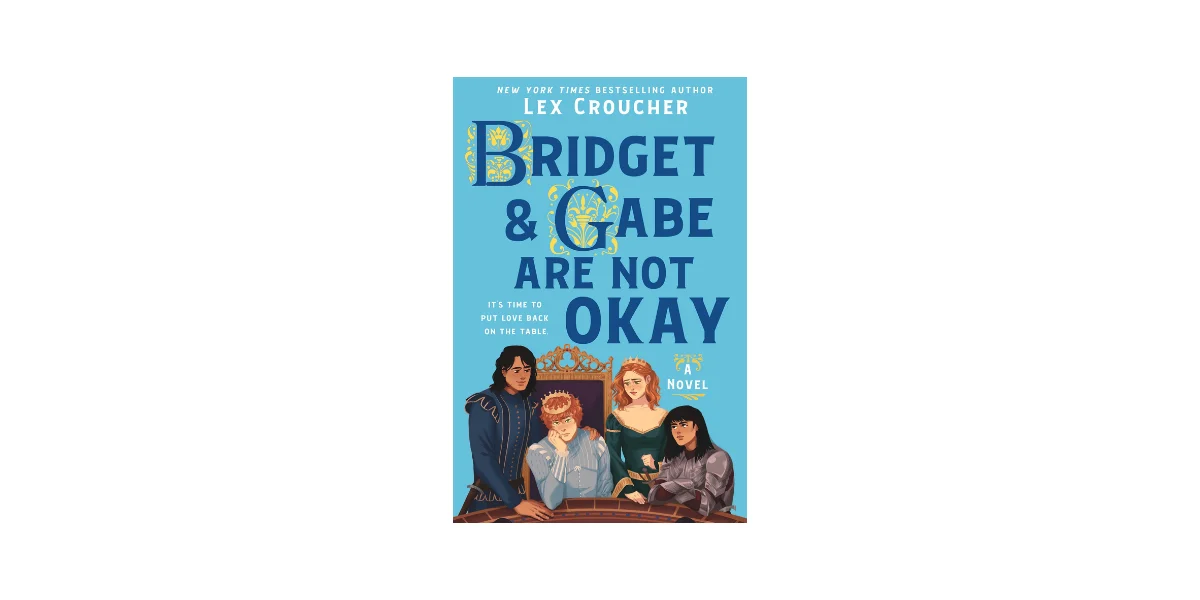
The release of these titles highlights a broader trend in contemporary publishing: the increasing demand for genre-bending narratives that utilize historical settings to explore modern themes of identity, political anxiety, and social progressivism. By anchoring their work in a pseudo-Arthurian version of medieval England, Croucher has crafted a narrative space that appeals to both young adult readers and the growing demographic of adult consumers seeking character-driven, queer-normative fiction.
Chronology and Narrative Context
The publication history of this specific series began with the release of Gwen and Art are Not in Love, a title that established the foundational mechanics of Croucher’s alternate-history England. In this world, the legends of King Arthur and his knights are not merely myths, but a rigid, institutionalized cultural framework that governs the lives of the populace. The narrative established that Gwendoline, a princess, and Arthur Delacey, a young lord, are initially betrothed—a political arrangement that they subvert by agreeing to act as "beards" for one another. This allows Gwen to pursue a relationship with the knight Bridget Leclair, while Arthur pursues a romance with Prince Gabriel, the kingdom’s heir.
The trajectory of the duology is defined by a significant, violent political conflict that concludes the first book. This event altered the power dynamics of the kingdom, leading directly into the events of the sequel. As the narrative of Bridget & Gabe Are Not Okay begins, several months have passed since the upheaval. The characters are depicted in a state of post-traumatic transition, dealing with the fallout of a kingdom in flux and the personal psychological consequences of their previous trials.
The Dynamics of Power and Public Perception
A central pillar of the sequel is the exploration of political legitimacy. Prince Gabriel, now the crowned King, faces the immediate challenge of governing a nation that remains deeply divided by his progressive policies. Most notably, Gabriel has moved to legalize same-sex relationships, a decision supported by historical evidence—specifically, rediscovered letters between King Arthur and Lancelot—that challenges the traditionalist status quo.
The political tension in the narrative mirrors modern concerns regarding populist movements and the struggle to maintain liberal reforms against traditionalist backlash. Analysts in the field of literary studies often point to this as a hallmark of "revisionist fantasy," where the author uses the tropes of the past to hold a mirror to present-day societal friction. In this context, Gabriel’s struggle to maintain public support is not merely a plot device; it is a commentary on the fragility of social progress when it lacks a charismatic or unifying political vanguard.
Character Development and Psychological Realism
While the series is marketed as a romantic comedy with fantasy elements, the structural depth of the characters—particularly in the sequel—diverges from the typical pacing of the genre. Where traditional fantasy might prioritize external conflict and military success, Croucher’s narrative focuses on the internal recovery of its protagonists.
Bridget Leclair, the kingdom’s premier female knight, experiences a professional decline that serves as a proxy for her internal emotional instability. Her inability to succeed in the jousting arena—an environment that previously defined her status and identity—is presented as a direct result of her unaddressed trauma. Simultaneously, Gabriel’s avoidant behavior, characterized by withdrawal and a refusal to engage with his political inner circle, provides a realistic depiction of the psychological toll of leadership under extreme pressure.
The Role of the "PR Tour" in Narrative Progression
To address the growing civil unrest and the perceived failure of his administration, the characters initiate a state-sponsored tour. This serves a dual purpose: first, it functions as a public relations campaign to stabilize the monarchy; second, it serves as a narrative mechanism to move the characters out of their static, isolated environments.
The tour facilitates encounters with both the commoners and the aristocratic factions of the country, providing the author with a canvas to depict a spectrum of public opinion. These interactions range from tentative acceptance of the crown’s progressive decrees to violent rejection of the new status quo. The inclusion of mythical beasts—a nod to the "Arthurian lunatic fringe"—further complicates the journey, forcing the characters to navigate both the tangible realities of governance and the irrational expectations of a society obsessed with an idealized, largely fictionalized version of its own history.
Comparative Analysis of Croucher’s Bibliography
Lex Croucher’s career has been marked by a versatile approach to genre, moving between romcom, fantasy, and young adult literature. A brief review of the author’s seven novels reveals a consistent thematic commitment: the prioritization of complex queer relationships and the subversion of traditional archetypes.
In Not for the Faint of Heart, for example, the author deconstructs the morality of the Robin Hood myth, suggesting that the "heroic" figures of legend were far from altruistic. Similarly, in The Unmagical Life of Briar Jones, the narrative utilizes a magical school setting to critique the influence of insular institutions on the broader public sphere. This consistent thematic thread suggests that the duology is part of a larger, cohesive project: the reimagining of the British literary canon through a queer, critical lens.
Broader Implications and Market Impact
The commercial success of the Gwen and Art duology suggests that there is a robust market for historical fantasy that does not rely on the standard "hero’s journey" structure. By focusing on the administrative and emotional consequences of a revolution rather than the revolution itself, Croucher provides a more nuanced look at the aftermath of political change.
The implications for the publishing industry are significant. As readers increasingly seek "comfort" literature that remains intellectually engaging, authors who successfully balance sharp, witty dialogue with serious explorations of PTSD, anxiety, and the misuse of power are finding sustained success. The reception of Bridget & Gabe Are Not Okay is likely to further cement Croucher’s reputation as an author capable of navigating the intersection of commercial genre fiction and social commentary.
Conclusion: The Future of the Genre
As the literary landscape continues to evolve, the focus on "bookish queers" and the reclamation of historical narratives remains a vibrant area of growth. For readers, the appeal of this duology lies in its ability to validate the experience of living in a world that often feels hostile to one’s existence, while simultaneously offering a narrative of resilience and community.
With the conclusion of this series, the focus now shifts to how Croucher will apply these narrative techniques in future works. The success of the current trajectory—defined by high-stakes emotional arcs and the dismantling of historical myths—provides a strong indication that the author will continue to influence the direction of contemporary fantasy. For those following the evolution of queer literature, the release of Bridget & Gabe Are Not Okay is a definitive milestone in a career that shows no signs of slowing down.