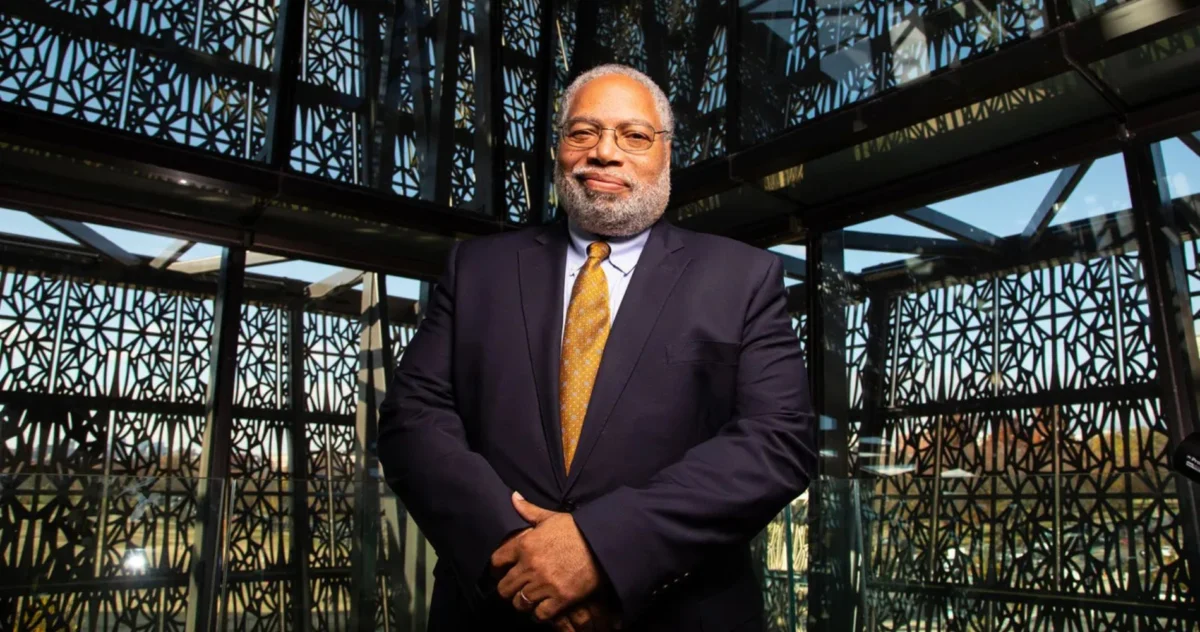
Lonnie G. Bunch III, the 14th Secretary of the Smithsonian Institution, announced this week his intention to retire at the end of the year, concluding a transformative seven-year tenure atop the world’s largest museum, education, and research complex. His departure marks the end of an era defined by both historic expansion and a period of intense ideological friction with the executive branch. Mr. Bunch, 73, leaves behind a legacy of scholarship and accessibility, though his exit occurs under the shadow of a sustained campaign by the Trump administration to reshape how the federal government presents American history to the public.
The Smithsonian’s chancellor, Chief Justice John G. Roberts Jr., issued a formal statement following the announcement, praising Mr. Bunch for his stewardship. “Lonnie Bunch has pursued excellence in the telling of our nation’s story,” Roberts noted, adding that the institution has “benefited greatly from his wisdom, vision and leadership.” While the retirement is described by the Smithsonian as a personal decision, observers note that it follows nearly two years of aggressive oversight, administrative pressure, and public criticism from the White House regarding the ideological direction of the institution’s programming.
A Career Built on Institutional Integrity
Mr. Bunch’s departure marks the close of a career that has spanned nearly four decades within the Smithsonian. His journey began in the late 1970s at the National Air and Space Museum, shortly after he earned a Ph.D. in American and African American history. Over the subsequent decades, he navigated various roles that established his reputation as a bridge-builder between academic rigor and public engagement.
His early career included a six-year stint as the founding curator of the California African American Museum in Los Angeles, followed by a return to the Smithsonian as the associate director for curatorial affairs at the National Museum of American History. During this period, he oversaw significant exhibitions, including “The American Presidency: A Glorious Burden,” and orchestrated the acquisition of the historic Greensboro Lunch Counter, an artifact that became a centerpiece of the civil rights narrative in the American collection.
In 2005, Mr. Bunch achieved a landmark professional milestone when he was appointed the founding director of the National Museum of African American History and Culture. His efforts to secure bipartisan congressional support and private funding culminated in the museum’s 2016 opening on the National Mall. The museum quickly became a cultural touchstone, recording 1.6 million visitors last year, making it the fourth-most-popular destination within the Smithsonian network.
In 2019, he ascended to the role of Secretary, becoming the first African American and the first professional historian to lead the institution. Throughout his tenure, he remained focused on a singular objective: ensuring that the Smithsonian remained a repository for the entirety of the American experience, including its darker chapters.
Chronology of Conflict: The Administration’s Pressure Campaign
The relationship between the Smithsonian and the Trump administration soured significantly following a series of executive directives and public statements from the White House.
- March 2025: The administration issued an executive order titled “Restoring Truth and Sanity to American History,” which explicitly criticized the Smithsonian for allegedly promoting narratives that framed Western values as inherently oppressive. The order mandated a review of all exhibits to ensure they aligned with “shared American values.”
- August 2025: President Trump took to social media to declare the Smithsonian “OUT OF CONTROL,” specifically targeting exhibitions that highlighted the realities of slavery. He demanded a “comprehensive internal review” of all museum content.
- July 2026: On Independence Day, the White House released a report accusing the National Museum of American History of engaging in “extreme political activism.”
- July 2026: The Organization of American Historians issued a formal condemnation of the White House report, labeling it a regressive attempt to sanitize historical education. Mr. Bunch countered in an internal staff memo, asserting that the institution’s work would continue to be “driven by scholarship, accuracy and an uncompromising commitment to tell the fullness of America’s story.”
Supporting Data: Public Trust and Institutional Independence
Data suggests a significant disconnect between the administration’s characterization of the Smithsonian and the public’s perception of the institution. Recent polling conducted by YouGov and other independent entities indicates that 37% of Americans have visited a Smithsonian museum, and those who have continue to view them as highly reliable sources of information.
On a trust index where 10 represents the highest level of confidence, American museums currently rank at 7.3, trailing only public libraries and family/friends (7.4). By comparison, the federal government consistently ranks significantly lower, at 4.5. Furthermore, 84% of Americans express a belief that it is vital for museums to represent history accurately, including the inclusion of challenging topics like slavery, systemic racism, and inequality. The same polling data indicates that a majority of the public opposes government interference in the editorial content of federally funded museums.
The Broader Landscape of Institutional Shifts
The pressure on Mr. Bunch and the Smithsonian is not an isolated event but part of a broader administrative strategy impacting multiple federal cultural and educational entities. The administration’s focus has extended to the National Park Service, which was directed to remove educational signage related to slavery at historic sites. The State Department recently removed a contemporary painting by Kehinde Wiley, citing aesthetic objections. Additionally, the Department of Defense has moved to restore Confederate names to military installations and has scrubbed contextual language regarding a controversial Confederate memorial at Arlington National Cemetery.
Critics of these shifts argue that they represent a deliberate effort to alter the national narrative. Filmmaker Ava DuVernay characterized the loss of Mr. Bunch’s leadership as a “profound loss for those who care about America’s history, not its fantasy,” adding that the secretary had been subjected to treatment that prioritized political control over historical understanding.
Implications and Future Outlook
As Mr. Bunch prepares to vacate his office, the Smithsonian faces a period of uncertainty. The institution is currently in the midst of fundraising and development for two high-profile projects: the Smithsonian American Women’s History Museum and the National Museum of the American Latino. His departure raises questions about whether these projects will proceed with the same level of support and thematic scope envisioned during his tenure.
The professional community has reacted with widespread concern. Sarah Weicksel, executive director of the American Historical Association, noted that the “worry about what the future holds for the Smithsonian” is a direct testament to the importance of the standards Mr. Bunch upheld.
Despite the mounting pressure, Mr. Bunch has remained steadfast in his public messaging. In a final reflection on his departure, he underscored the necessity of historical courage. “Americans are an amazingly brave people, who have accomplished so much,” he stated. “They’ve got to be brave enough to face their own history.”
His commitment to protecting the institution from what he termed the “erasure and softening” of history served as a final directive to his staff and successors. As the institution transitions, the debate over the role of government in defining national identity remains unresolved, with the Smithsonian standing at the center of a fundamental tension between historical accuracy and the political desire to craft a more idealized, and perhaps more palatable, version of the American past. Mr. Bunch leaves with his reputation as an institutional guardian intact, yet the administrative environment he leaves behind ensures that the struggle for the control of historical narrative will likely continue well beyond his retirement.