A recent Pew Research Center survey reveals a significant minority of U.S. adults believe religion is gaining influence in public life, coinciding with a large-scale revival meeting planned on the National Mall. The survey, conducted from April 6-12, 2026, with 3,592 U.S. adults, indicates a growing perception of religion’s expanding role, with over half of Americans still viewing its presence in society as positive. This research delves into the nuances of these perceptions, exploring attitudes toward Christian nationalism, the separation of church and state, and the evolving relationship between faith and governance in the United States.
Key Findings from the Pew Research Center Survey
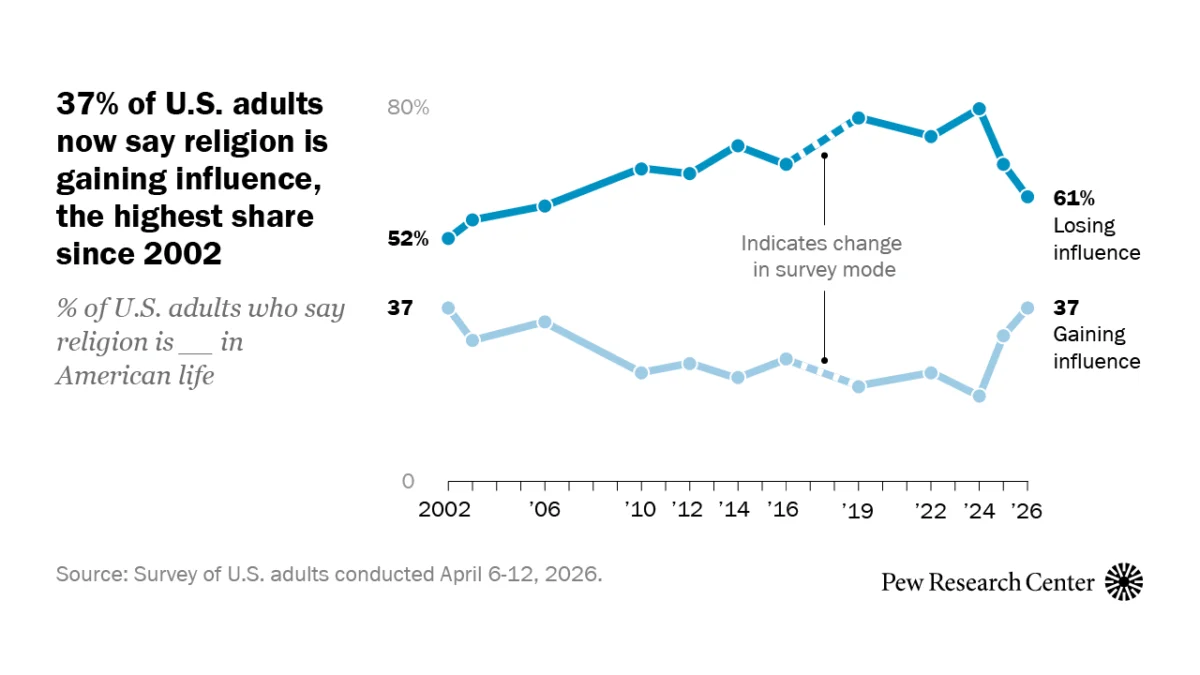
The survey’s findings paint a complex picture of American attitudes toward religion’s place in the public square. A notable 37% of U.S. adults now report that religion is gaining influence in American life, the highest share recorded by the Pew Research Center since 2002. This marks a substantial increase from previous years, with a 19 percentage point jump in just two years. Conversely, 61% believe religion is losing influence, a sentiment that has declined as more Americans perceive its growth.
Despite this perceived increase in religious influence, a majority of Americans (55%) hold a positive overall view of religion’s role in society. This positive sentiment is derived from those who believe religion’s influence is growing and see this as a good thing (21%), and those who believe its influence is declining but view this negatively (34%).
However, the survey also highlights a significant public desire for religious institutions to remain distinct from partisan politics. A substantial 79% of Americans believe that churches and other houses of worship should not endorse political candidates, and two-thirds (66%) think these institutions should steer clear of day-to-day political matters, opting instead to remain apart from political discourse. These sentiments have remained largely consistent over recent years.
Furthermore, the term "Christian nationalism" is becoming more familiar to the American public. Nearly six-in-ten adults (59%) now report having heard or read at least something about Christian nationalism, a 14 percentage point increase since 2024. While familiarity has grown, sentiment toward Christian nationalism remains divided, with 31% viewing it unfavorably and 10% viewing it favorably. A significant portion, 59%, remain unfamiliar with the term or hold no strong opinion.
Shifting Perceptions and the Rise of Christian Nationalism

The survey’s findings on Christian nationalism come at a time when its tenets and influence are increasingly debated in public discourse. While support for core ideas associated with Christian nationalism, such as the belief that God favors the U.S. or that the government should cease enforcing the separation of church and state, has remained relatively stable, there’s been a slight uptick in those who believe Christianity should be the nation’s official religion. Seventeen percent of U.S. adults now express this view, up from 13% in 2024. This suggests a growing, albeit still minority, segment of the population is open to a more explicit intertwining of Christianity and government.
The research also underscores the deep partisan divides that characterize these discussions. Republicans are significantly more likely than Democrats to perceive religion’s influence as positive and to advocate for its prominent role in governance and lawmaking. This ideological chasm shapes how Americans interpret religious influence and its implications for the nation’s future.
Views on Religion’s Influence in Society
The trend of religion gaining influence is not uniform across all demographics. While 37% of all U.S. adults perceive this growth, the numbers are higher among specific religious and political groups. For instance, among Republicans, 43% now believe religion is gaining influence, a significant 28 percentage point increase since 2024. Similarly, 34% of Democrats share this view, marking a 14 percentage point rise. This suggests a broader societal awareness of religion’s presence, even if interpretations of its impact vary widely.
The perception of religion’s influence is closely tied to whether individuals view this trend positively or negatively. A striking 75% of Republicans and Republican-leaning independents express a positive view of religion’s influence, compared to only 38% of Democrats and Democratic-leaning individuals. Conversely, Democrats are nearly as likely to express a negative view (37%) as a positive one (38%), indicating a more divided sentiment within the Democratic party regarding religion’s societal role.
The Role of Churches in Politics
Despite differing views on religion’s overall influence, a strong consensus exists regarding the boundaries between religious institutions and partisan politics. A vast majority of Americans, across the political spectrum, believe that churches and other houses of worship should remain neutral during elections and avoid endorsing specific candidates. This sentiment is reflected in the 79% who stated churches should not favor one candidate over another. Similarly, a significant two-thirds (66%) believe these institutions should refrain from engaging in day-to-day political matters, preferring them to remain apart from political discourse. These figures have shown remarkable stability, suggesting a deeply ingrained expectation of religious neutrality in electoral processes.
Growing Familiarity with Christian Nationalism
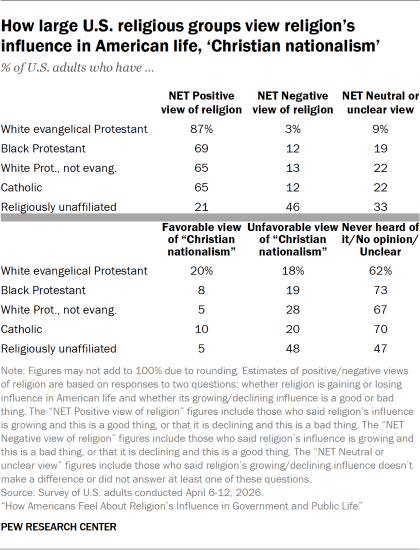
The increasing awareness of "Christian nationalism" is a notable development. With 59% of U.S. adults now familiar with the term, up from 45% two years prior, the concept is no longer confined to niche academic or activist circles. This rise in awareness is accompanied by a shift in public opinion. While unfavorable views of Christian nationalism have increased to 31% (up 6 percentage points), favorable views have also seen a modest rise to 10% (up 5 points). This indicates that as more Americans learn about Christian nationalism, their opinions are becoming more polarized, with a larger segment now holding distinct positive or negative views.
Perspectives on Church-State Relations
The survey also probes attitudes toward the separation of church and state. While the percentage of Americans who believe the government should stop enforcing this separation has declined slightly to 13%, the majority (54%) still favor its enforcement. However, a significant portion of the population remains neutral or undecided on this issue, with 32% expressing such views. This suggests an ongoing public debate about the precise balance between religious freedom and the secular nature of government.
A significant finding is the perception that certain groups have gone too far in their advocacy regarding religion’s role in public life. Fifty-two percent of U.S. adults believe conservative Christians have overstepped in pushing their values, while 48% believe secular liberals have gone too far in attempting to exclude religious values. Notably, 18% of Americans agree with both assertions, suggesting a perception of imbalance or overreach from both religious and secular advocates.
Partisan Divides on Religion’s Influence
The survey highlights stark partisan differences in how Republicans and Democrats perceive religion’s influence and its desired role in government. Republicans are far more likely to view religion’s growing influence positively, with 75% expressing a positive outlook compared to 38% of Democrats. Democrats are nearly equally divided between positive and negative views, indicating a more nuanced and potentially conflicted perspective within the party.
These divergences extend to specific policy preferences. Republicans are more inclined to favor the Bible’s influence on U.S. laws and to support the idea of Christianity as the official religion, or at least the promotion of Christian moral values by the government. Conversely, most Democrats advocate for a stricter separation of church and state and oppose the government establishing or promoting any specific religion.
Religious Group Differences
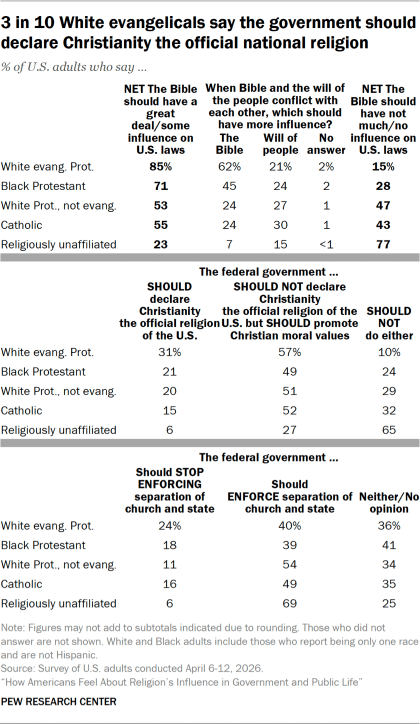
Within the broader population, specific religious groups exhibit distinct patterns of belief and opinion. White evangelical Protestants stand out as particularly strong proponents of religion’s positive role in society, advocating for the Bible’s influence on laws, supporting Christianity as the official religion, and expressing favorable views of Christian nationalism. However, they are not alone in their positive assessments; a majority of Catholics, White nonevangelical Protestants, and Black Protestants also believe religion plays a beneficial role.
The survey also reveals that Black Protestants and Catholics are more likely than other Christian groups to believe the Bible should take precedence over the will of the people when conflicts arise. This suggests a deep-seated conviction among these groups about the ultimate authority of religious texts in shaping societal norms and laws.
A significant portion of individuals across various Christian denominations, including roughly half or more of Catholics, White nonevangelical Protestants, and White evangelicals, believe the government should at least promote Christian moral values, even if it doesn’t officially declare the U.S. a Christian nation. This indicates a nuanced view where an explicit establishment of Christianity is less favored than the broader influence of Christian ethics in public life.
Conclusion: A Nation at a Crossroads
The Pew Research Center’s latest findings underscore a nation grappling with the evolving role of religion in public life. While a growing minority perceives religion’s influence as increasing, the majority still views its societal impact positively. However, concerns about the entanglement of religious institutions with partisan politics persist, with a strong consensus on maintaining a degree of separation. The rise in familiarity with Christian nationalism, coupled with growing partisan polarization, suggests that the debate over religion’s place in American governance and society is likely to intensify in the years to come. The data provides a critical snapshot of these complex attitudes, offering valuable insights for policymakers, religious leaders, and the public alike as the nation navigates these significant cultural and political currents.