
Prosecutors in New York have officially reopened an investigation into a 2024 sexual assault claim involving a former Cornell University student, marking a significant development in a case that has sparked intense debate regarding campus safety, institutional accountability, and the ethical boundaries of student journalism. The victim, who alleges she was raped by multiple men at a fraternity house, has also filed a civil lawsuit naming Cornell University, the fraternity involved, and several individuals as defendants. The case has gained national prominence not only for the severity of the allegations but for the aggressive investigative posture adopted by the Cornell Daily Sun, the university’s independent student newspaper.
A Chronology of the Cornell Case
The origins of the current legal firestorm date back to early 2024, when the student first reported the alleged assault to university authorities. According to court filings, the internal university process that followed failed to result in significant disciplinary action, a common point of contention in modern Title IX litigation. For months, the case remained largely out of the public eye until the Cornell Daily Sun published an extensive investigative report.
The newspaper’s decision to name the accused individuals represented a departure from standard journalistic practices regarding sensitive sexual assault cases, where anonymity is often preserved until formal charges are filed. The editorial board justified this move by citing a lack of institutional transparency and a pattern of systemic failures by the university administration to protect its student body. Following the report, the university faced mounting pressure from alumni, faculty, and student advocacy groups. By September 2026, the editorial board of the Daily Sun issued a bold manifesto titled "Cornell Won’t, We Will," signaling their intent to pursue accountability where they believed the institution had failed. The reopening of the criminal investigation this week is widely seen as a direct consequence of the public pressure generated by this reporting.
The Evolving Role of Journalistic Advocacy
The Cornell situation serves as a primary case study for a fundamental shift in the relationship between the press and the institutions they cover. Historically, the "watchdog" function of journalism emphasized detachment and neutrality. However, recent data suggests that the American public’s expectations for the media are undergoing a paradigm shift.
A 2025 Pew Research Center survey regarding the role of journalists found that a significant majority of U.S. adults believe that news providers should actively engage in advocacy for the communities they represent. Specifically, 32% of respondents stated that journalists should "definitely" advocate for their communities, while 31% suggested it was "probably" the correct approach. Furthermore, 41% of respondents believe that keeping an eye on powerful people is a primary duty that should be pursued with vigor, even if that pursuit involves challenging institutional norms.
This data highlights a tension between traditional journalistic objectivity and a growing demand for accountability-driven reporting. When student journalists at Cornell stepped into an advocacy role, they were arguably fulfilling a public expectation that the press should serve as an agent of change rather than a passive observer. However, this shift also invites scrutiny regarding the potential for bias and the ethical hazards of "trial by press."
Broader Civic Engagement and Social Trends
The Cornell investigation exists within a broader landscape of shifting civic participation. Recent findings from the Pew-Knight Initiative indicate that while Americans in urban, suburban, and rural areas participate in civic life at relatively similar rates, the methods they employ vary significantly. Urban residents are more likely to participate in political movements through organized advocacy, whereas suburban and rural residents often prioritize community-based organizations and localized social groups.
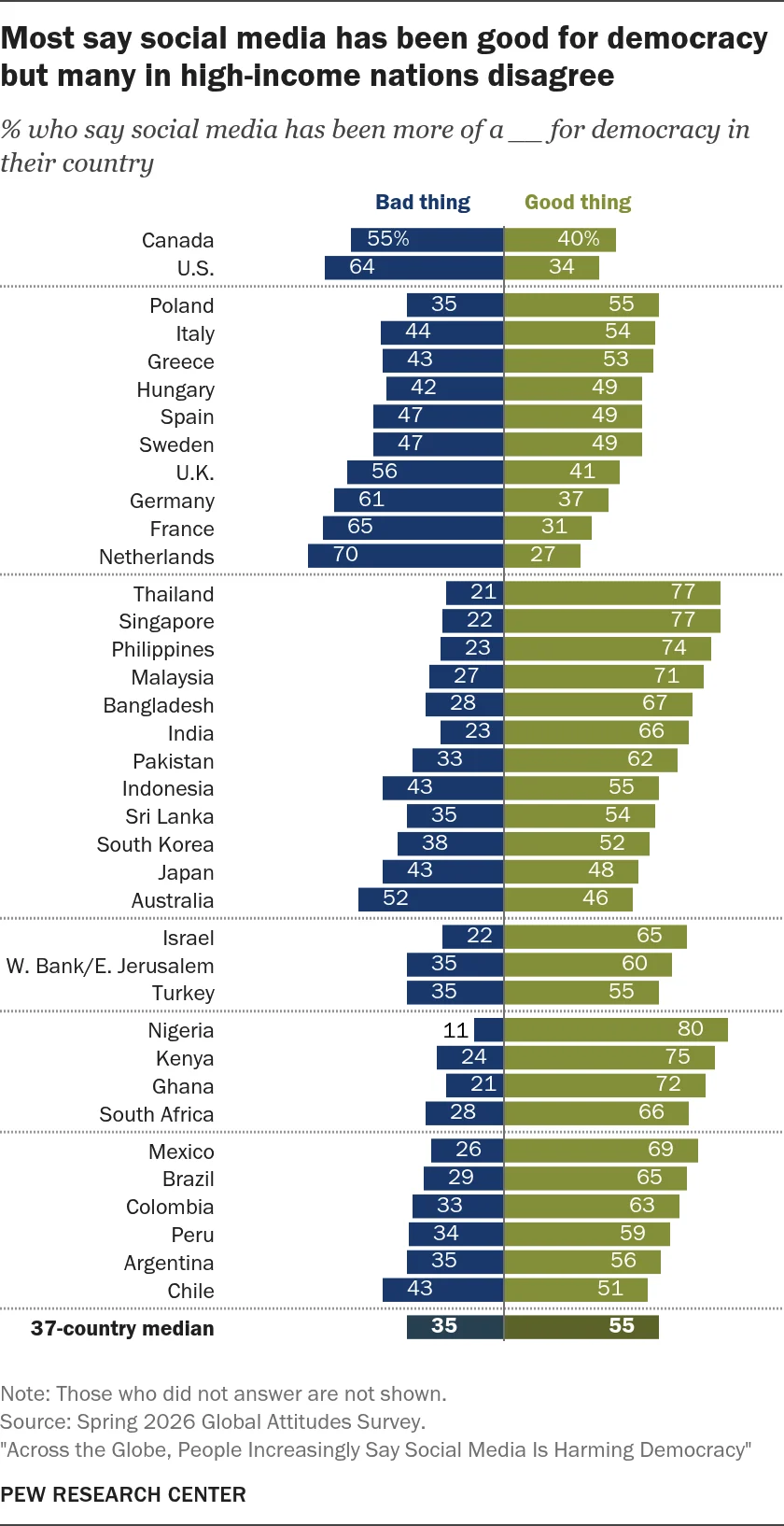
This fragmentation of engagement is occurring against the backdrop of a declining trust in the digital town square. As highlighted by the Spring 2026 Global Attitudes Survey, there is a deep-seated international skepticism regarding the impact of social media on democratic health. While many developing nations report positive views on social media—viewing it as a tool for political mobilization—high-income nations are increasingly wary.

In the United States, 64% of respondents believe social media has been a "bad thing" for democracy. This sentiment is echoed across much of Western Europe, with the Netherlands (70%), France (65%), and Germany (61%) reporting similarly high levels of disillusionment. These figures suggest that the digital environment, which once promised to democratize information, is now perceived as a corrosive element that exacerbates political polarization and complicates the search for objective truth.
Industry Adaptation: The NPR Case Study
The shifting media landscape is not merely affecting editorial content; it is fundamentally altering the business models of legacy media organizations. NPR’s recent acquisition of the AI and technology podcast Machine Gods illustrates a strategic pivot toward "watchable" news.
This move is backed by empirical research. A 2025 survey revealed that 44% of U.S. adults now prefer to consume news through visual formats, such as video or television, compared to only 19% who prefer audio formats. By integrating video-first content into its radio-dominated ecosystem, NPR is attempting to capture a younger, more visually-oriented demographic. This transition mirrors the broader media industry’s struggle to remain relevant in a world where the speed and format of information delivery are as important as the substance of the news itself.
Implications for Institutional Governance
The reopening of the Cornell investigation and the subsequent legal maneuvers by the plaintiff reflect a wider trend of "institutional litigation." Victims of alleged misconduct are increasingly bypassing internal bureaucratic processes, which are often criticized for being opaque and self-serving, in favor of external legal and media-driven campaigns.
From an administrative standpoint, universities and large institutions are finding that the traditional "no comment" approach is no longer effective in an era of digital transparency. The Cornell Daily Sun’s reporting demonstrates that student-led outlets possess the capability to hold massive institutions accountable, effectively utilizing social media and digital publishing to bypass traditional barriers.
However, this newfound power comes with significant responsibility. Legal experts warn that the erosion of the distinction between journalism and activism can create complex legal liabilities for media outlets. If advocacy leads to defamation or the violation of due process, the very institutions that seek to hold power to account may find themselves facing the same scrutiny they once leveled at others.
Conclusion: The Path Forward
As the investigation into the 2024 incident continues, the case will undoubtedly serve as a touchstone for discussions on university conduct policies and the ethical responsibilities of the press. Simultaneously, the global decline in confidence regarding social media’s impact on democracy suggests that society is in the early stages of a reckoning with the digital tools that define our era.
For the public, the challenge remains to reconcile the need for aggressive, advocacy-oriented journalism with the necessity of maintaining rigorous standards of evidence and fairness. The Cornell Daily Sun’s actions represent a high-stakes experiment in this reconciliation. Whether this approach leads to a more just resolution for the survivors of assault or establishes a precarious precedent for campus reporting remains to be seen. What is clear is that the old models of institutional governance and media neutrality are being challenged, replaced by a more volatile, engaged, and skeptical public discourse.
The developments in Ithaca are not an isolated incident but a reflection of a broader global movement toward questioning authority, utilizing digital platforms for accountability, and demanding that institutions—be they universities, corporations, or governments—align their internal practices with the public’s evolving standards of justice and transparency. As the legal proceedings unfold, the academic and media communities will be watching closely, mindful that the outcome of this case could set the tone for institutional accountability in the years to come.




