
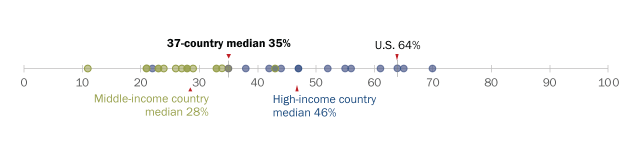
The global consensus on the role of social media in modern governance is undergoing a profound and troubling shift. A comprehensive new report from the Pew Research Center, drawing on data from 42,151 respondents across 37 countries, reveals that public sentiment regarding social media’s impact on democracy has grown increasingly pessimistic. While the United States has long held a uniquely skeptical view of these platforms, the rest of the world is rapidly aligning with the American perspective, viewing digital connectivity as a primary driver of political polarization and a catalyst for the erosion of democratic discourse.
The research, conducted between February and May 2026, highlights a stark divide between high-income and middle-income nations, yet confirms that the perception of social media as a "bad thing" for democracy is gaining traction globally. In 16 of the 26 countries where trend data is available from 2022 or 2023, the share of the public viewing social media as a detrimental force has significantly increased.
A Shifting Global Narrative: From Optimism to Concern
The trajectory of this sentiment marks a departure from the early 21st-century optimism that once characterized the digital age. Years ago, social media was frequently heralded as a democratizing force—a tool that would dismantle information monopolies, empower marginalized voices, and hold power to account. Today, the reality, as perceived by global citizens, is starkly different.
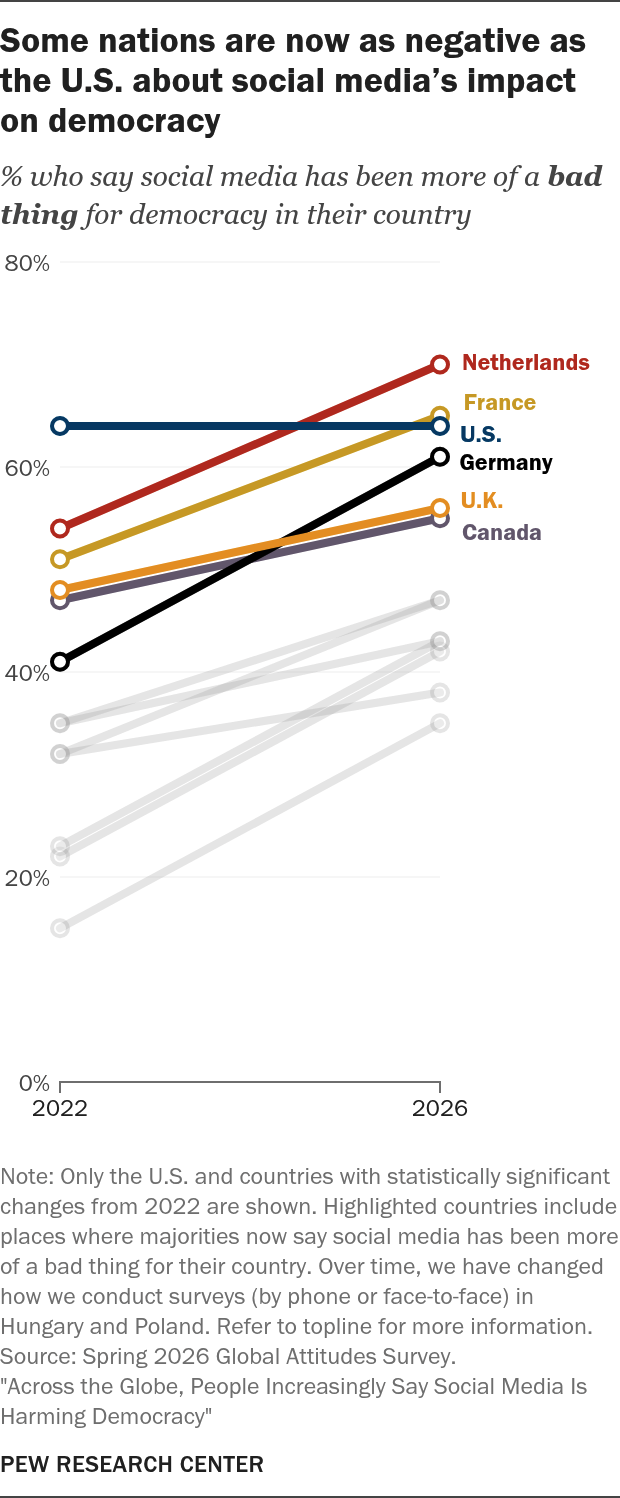
In 2022, Pew Research Center surveyed 19 mostly high-income nations on this exact topic. At the time, the United States stood as a clear outlier in its negativity, with 64% of Americans characterizing social media as a negative influence on democracy. The next closest nation was the Netherlands, at 54%. By 2026, however, that gap has vanished. The Dutch public has become significantly more critical, with 70% now viewing social media as a net negative for their democratic systems. Similarly, France has seen its negative sentiment climb to 65%, while Germany has surged to 61%.
This convergence suggests that the issues plaguing the American information environment—such as the rapid spread of misinformation, the algorithmic amplification of extreme content, and the erosion of a shared objective reality—are no longer contained within the borders of the U.S. They have become systemic features of the global digital landscape.
The Anatomy of Political Polarization
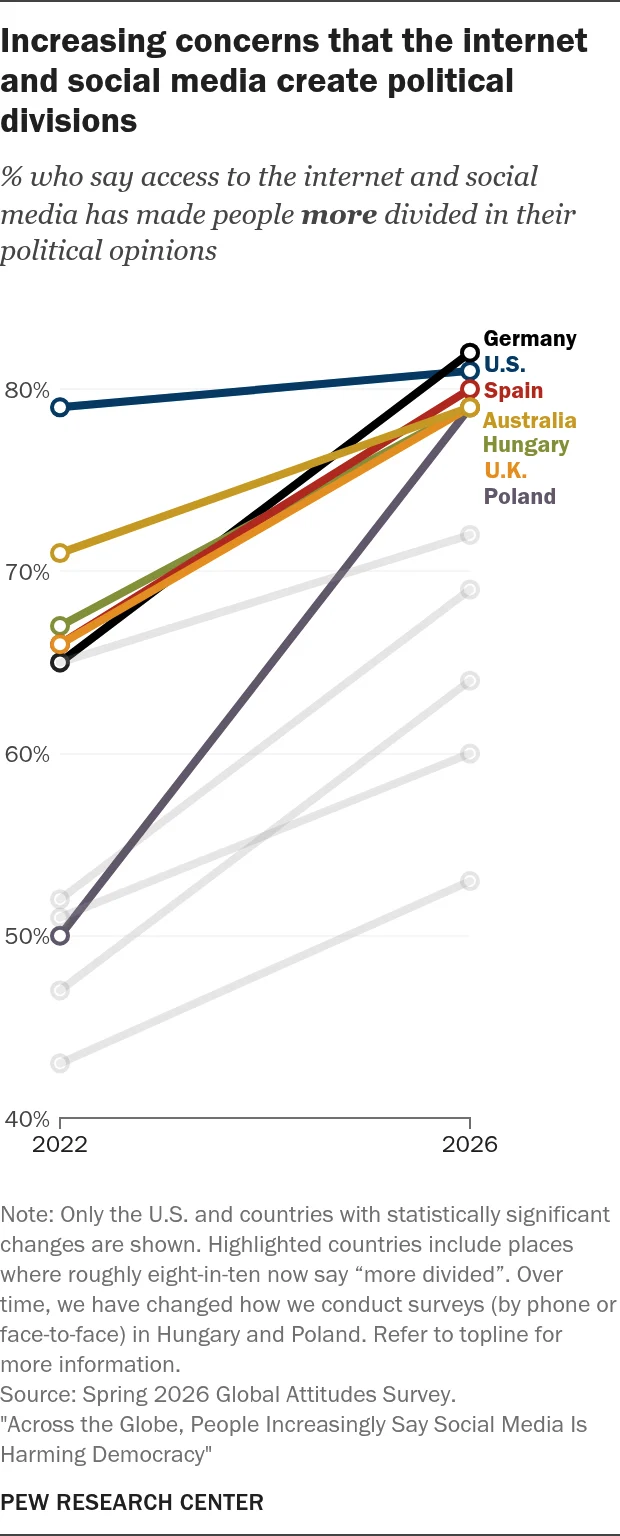
One of the most concerning findings of the 2026 survey is the perceived impact of the internet on political cohesion. Across the 37 countries surveyed, there is a widespread belief that digital platforms have exacerbated societal divisions rather than fostering constructive debate.
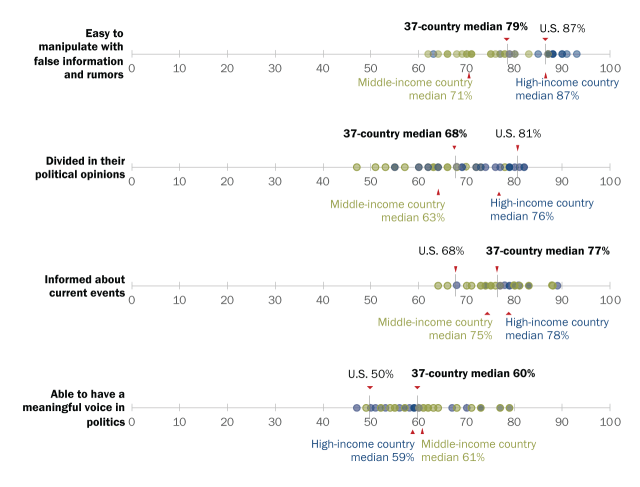
In the United States, 81% of respondents report that access to the internet and social media has made people more divided in their political opinions. While this represents a stable figure compared to 2022, the rest of the world has caught up. In Australia, Germany, Hungary, Poland, Spain, and the United Kingdom, approximately eight-in-ten citizens now report that social media has deepened political schisms.
The mechanism behind this, according to political scientists and digital researchers, lies in the algorithmic structure of major platforms. By prioritizing engagement-based metrics, platforms often amplify inflammatory content that triggers high emotional responses. This "outrage economy" naturally segments populations into echo chambers, making compromise increasingly difficult and creating a climate where political opponents are viewed not just as rivals, but as existential threats.
The Vulnerability of the Information Ecosystem
Beyond polarization, the survey highlights a profound lack of trust in the integrity of the information environment. A staggering 87% of Americans believe that the internet and social media have made it easier to manipulate the public with false information and rumors. This sentiment is echoed across high-income nations, which report a median of 87% agreement on this vulnerability.
Even in middle-income countries, where the initial promise of digital access remains more intact, the concern is rising. The ability for state and non-state actors to deploy misinformation campaigns has transformed digital platforms into a new frontier for geopolitical influence operations. The speed at which misinformation travels—often outpacing fact-checking efforts—has left democratic institutions struggling to maintain a coherent public narrative.
Comparative Usage Patterns and Demographic Nuances
While concerns about democracy are pervasive, the platforms themselves remain deeply integrated into the daily lives of global citizens. The 2026 data shows that Facebook remains the most popular platform globally, followed by Instagram and TikTok.
The survey reveals that while usage patterns in the U.S. generally mirror the 37-country median, there are notable demographic variances. Age remains the primary predictor of usage: across nearly every country, individuals aged 18 to 34 are the most active users of visual-centric platforms like Instagram, Snapchat, and TikTok.
However, the "Facebook generation" appears to be shifting. In the United States and other high-income nations, those aged 35 to 49 represent the most frequent Facebook users, suggesting a demographic entrenchment. Conversely, in many middle-income countries, the youth continue to dominate Facebook usage, which may point to different historical adoption curves and cultural integrations of the platform in those regions.
Implications for Democratic Stability
The implications of these findings for the future of democracy are significant. If a majority of citizens in the world’s most stable democracies view the primary tools of modern communication as a threat to their political system, the resulting loss of faith in public discourse can lead to widespread institutional cynicism.
When people believe that the "digital town square" is compromised, they may withdraw from civic engagement altogether or, conversely, become more radicalized by alternative, less-regulated information sources. This "democratic malaise" is a critical challenge for policymakers, regulators, and technology executives alike.
The research points toward a growing demand for platform accountability. While the survey does not explicitly ask for policy solutions, the data implies that current self-regulatory models are failing to assuage public anxiety. Governments in the European Union, under the Digital Services Act (DSA), and other regions are already moving toward stricter oversight, requiring platforms to be more transparent about their algorithms and more aggressive in addressing systemic risks to the information environment.
A Call for Global Reflection
The Pew Research Center’s 2026 data serves as a sobering mirror for a global society that has spent the last two decades blindly embracing the digital revolution. The "catching up" of other nations to the American level of pessimism indicates that the problems are not localized cultural issues, but rather inherent risks in the architecture of the current digital media ecosystem.
The findings also underscore a fundamental tension: the world is more connected than ever, yet citizens feel more divided. As we look toward the remainder of the decade, the challenge will be whether these platforms can pivot toward models that prioritize public health and democratic stability over pure engagement. If they fail to do so, the global consensus that "social media is a bad thing for democracy" may move from a majority opinion to an overwhelming, and potentially irreversible, reality.
Methodological Context and Future Research
This report was conducted with the objective of providing data-driven insights to policymakers, media, and the public. By surveying 42,151 adults across 36 countries—plus the United States, which utilized two separate, robust methodologies (the American Trends Panel and the National Public Opinion Reference Survey)—Pew has created the most comprehensive snapshot of global sentiment to date.
The inclusion of diverse regions—from Bangladesh and Nigeria to Canada and Japan—allows for a nuanced understanding of how digital technology is viewed through different socio-economic lenses. As the world continues to grapple with the rise of artificial intelligence and further automation, this survey provides a vital baseline for understanding how the public perceives the impact of technology on their most fundamental institutions.
The data is clear: the global public is no longer content to view social media as a neutral platform for expression. It is increasingly viewed as a high-stakes arena where the future of democracy is being contested. Whether this realization leads to technological reform, stricter regulation, or a fundamental change in how citizens consume information remains the central question of our time.




