Virtual reality headsets, once primarily associated with immersive gaming experiences, are now emerging as a transformative tool for life skills development, particularly for young adults with Down syndrome and autism. A groundbreaking study by the Kennedy Krieger Institute in Silver Spring, Maryland, is leveraging this cutting-edge technology to equip individuals with crucial everyday skills in a controlled, low-risk environment, fostering greater independence and confidence. This innovative approach, utilizing platforms like the Meta Quest 3, PlayStation VR 2, and HTC Vive, promises to redefine how individuals with disabilities learn and navigate their communities, pursue employment, and build fulfilling lives.
Pioneering Study at Kennedy Krieger Institute
The Kennedy Krieger Institute, a renowned leader in research and treatment for children and young adults with developmental disabilities, has launched a pilot program as part of its CORE Foundations initiative. This program, under the umbrella of Kennedy Krieger’s Neurodiversity at Work team, is specifically designed to address the challenges faced by older individuals transitioning into adulthood. The acronym CORE—Community, Opportunity, Respect, and Employment—encapsulates the program’s holistic mission.
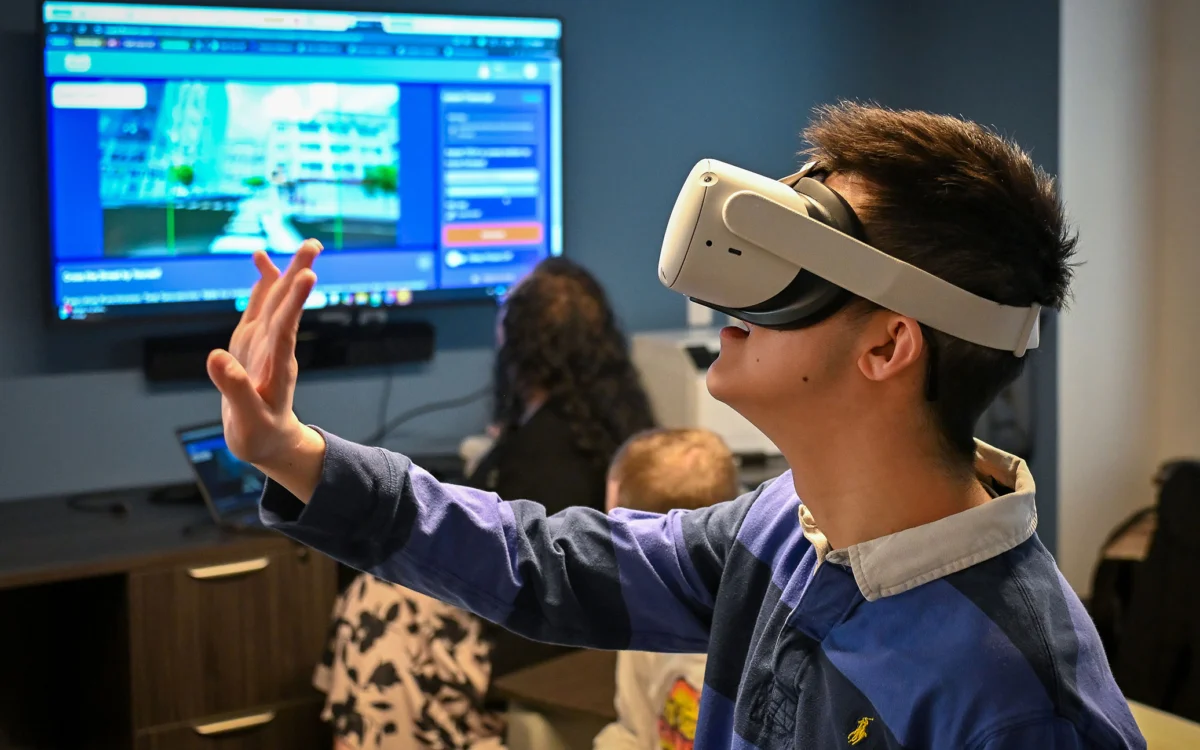
This pioneering study employs virtual reality to simulate a wide range of real-world scenarios, allowing participants to practice and master essential life skills at their own pace. The technology enables users to build confidence and proficiency in everyday tasks, from the fundamental act of crossing a street safely to more complex interactions like making purchases in a store or navigating public transportation. For many, it also offers a safe space to practice vital employment skills, such as participating in mock job interviews.
The Technology and Its Application
The study primarily utilizes Meta Quest 2 headsets in conjunction with Floreo, a specialized virtual reality training program developed for children with learning disabilities. Floreo’s adaptive software is designed to be highly personalized, delivering training modules that are tailored to each individual’s unique needs, interests, and specific learning goals. This person-centered approach is a cornerstone of the program, ensuring that the VR experiences are not only effective but also engaging and relevant to each participant.
Stacey Beichler, Assistant Vice President of Kennedy Krieger’s Neurodiversity at Work team, highlighted the innovative nature of this intervention. "This technology represents an innovative approach to supporting individuals with disabilities as they build functional life skills and employment skills," Beichler stated in an interview with The Baltimore Sun. She further emphasized the nascent stage of research in this field, noting, "Because the field is still emerging, there is limited research available. However, our program is designed to be fully person-centered, focusing on each individual’s unique needs, interests, and goals."
The virtual reality sessions are meticulously crafted to mirror everyday challenges. Participants can practice safely crossing busy streets, learn the intricacies of riding a bus, or engage in simulated transactions at a retail establishment. For those seeking employment, the program extends to practicing job interviews, honing communication skills, and understanding workplace etiquette.
Participant Experiences and Early Successes
The impact of this innovative training is already being felt by participants. Timaron Chang, a member of the CORE Foundations program, shared his enthusiasm: "Of course, it’s awesome. It helps me learn things like how to cross the street safely and have conversations with people. This was the first time for me using virtual reality. I was a little nervous, but I still love it." His sentiment underscores the initial apprehension often associated with new technology, quickly giving way to appreciation for its practical benefits.
The program’s effectiveness is further validated by observable behavioral changes. During a recent observation by The Baltimore Sun, participants were seen demonstrating learned behaviors, such as looking both ways before crossing virtual streets, maintaining appropriate personal space with virtual characters, and confidently negotiating bus fares. One participant, William "Billy" Riggs, expressed his growing confidence, exclaiming, "I’m the confident one! This is easy for me," as he prepared to don the headset.
The VR sessions are designed to be highly interactive. Participants navigate simulated environments, encountering various social cues and scenarios. For instance, when waiting for a bus, they learn to identify the correct bus number by focusing on visual cues, manage interactions with virtual passengers, and understand the social norms of public transportation. If a virtual bus is missed, participants are guided through the process of contacting a parent or program staff, replicating a crucial real-world problem-solving skill.
The Science Behind the Simulation
Beyond the engaging user experience, robust scientific principles are at play. Beichler explained that the Floreo software meticulously tracks users’ timing and responses, providing valuable data to assess their progress and evolving confidence levels. This data, combined with observations of how individuals adapt to the technology, will inform future expansions of the program. The institute plans to offer this VR training to its broader cohort of 60 CORE Foundations members across Baltimore, Howard, and Montgomery counties.
"Our long-term goal is to use this information to support a comprehensive research study and contribute meaningful findings to the field," Beichler stated. The initial pilot program in Rockville, Maryland, involving four young adults, has highlighted a significant need for improved navigation of public spaces and transportation among its participants.
"Travel training is huge for people with a disability, in terms of their independence," Beichler emphasized. "It’s not just practicing riding the bus; it’s an immersive way to train in a fun environment. And it sticks more when it’s fun." This highlights a key advantage of VR: its ability to make learning enjoyable, thereby enhancing retention and application of learned skills.
Reinforcing Real-World Skills
A critical component of the Kennedy Krieger program is the immediate reinforcement of virtual learning in real-world settings. Following their VR sessions, participants often engage in similar activities in their actual community, such as crossing a street for lunch. This direct application of learned skills provides invaluable practice and solidifies their mastery. The team has already witnessed tangible results. Beichler recounted a powerful moment when a participant texted the group chat, sharing, "I practiced what we practiced in VR. I looked both ways before crossing the street." This anecdotal evidence underscores the profound impact of the program on promoting safer behaviors and fostering independence.
Toni Massimo, an instructor guiding participants through the lessons, utilizes the Floreo software’s prompts to provide real-time support and feedback. She observes participants as they navigate complex social interactions, such as offering seats to virtual passengers or managing personal space on a bus. The software’s ability to adapt to individual comfort levels is crucial; for those who may be overwhelmed by crowds or background noise, the virtual environment can be simplified, presenting fewer avatars and less ambient sound.
Sensory Rooms and Socialization
Beyond skill-specific training, the program also incorporates "sensory rooms" within the VR environment. These spaces allow participants to immerse themselves in different virtual settings, offering a calming and de-stressing experience. Jason Milobsky, for example, chose to explore a virtual aquarium, complete with a bubbling treasure chest. Massimo guided him to observe a fish swimming towards him, prompting him to turn his head. "I see a fish," Jason exclaimed, his voice filled with delight. "Whee!"
These sensory rooms serve a dual purpose: providing a tranquil escape and offering simplified versions of real-life activities. This allows individuals to practice engagement in a controlled manner, gradually increasing complexity as their comfort level grows.
"It goes back to learning in a fun way," Beichler reiterated. "It also removes a lot of outside stimuli, so no one gets distracted by what’s going on in the room." This controlled environment is crucial for individuals who may be easily overwhelmed by sensory input in their daily lives.
However, the program doesn’t solely focus on individual skill development. Beichler also stressed the inherent social benefits: "On the other hand, these sessions also provide natural socialization, and that’s what we really want. Our goal is to build community. While they’re waiting their turns, they’re making friends and being part of a community." This highlights the program’s commitment to fostering social connections and a sense of belonging among participants, recognizing that social integration is as vital as practical skill acquisition for overall well-being and independence.
Broader Implications and Future Directions
The success of this VR-based life skills training at the Kennedy Krieger Institute has significant implications for the broader field of disability support. As virtual reality technology becomes more accessible and sophisticated, its potential to revolutionize educational and therapeutic interventions is immense. For individuals with Down syndrome and autism, who may face unique challenges in acquiring and generalizing life skills through traditional methods, VR offers a safe, engaging, and highly effective alternative.
The data collected from this study will be instrumental in advocating for the wider adoption of VR technology in educational institutions, rehabilitation centers, and community support programs. By demonstrating quantifiable improvements in participants’ confidence, independence, and real-world skills, Kennedy Krieger aims to pave the way for future research and development in this rapidly evolving area.
The long-term vision extends beyond individual skill development to fostering greater societal inclusion and employment opportunities for individuals with disabilities. By equipping them with the tools and confidence to navigate the world independently, VR training can unlock new avenues for personal growth, economic participation, and active engagement in community life. The initiative at Kennedy Krieger Institute represents a powerful testament to the transformative potential of technology when thoughtfully applied to meet critical human needs.