Organisations, communities, and societies globally are grappling with the persistent challenge of fostering genuine inclusion, equity, and diversity. Despite significant investment in traditional awareness campaigns and training programs, many change agents report a frustrating cycle of progress followed by regression, with default behaviors often reasserting themselves. This phenomenon underscores a critical disconnect between individuals’ stated intentions and their actual actions, highlighting the limitations of approaches that primarily target conscious understanding. A new paradigm, known as Inclusion Nudges, is emerging as a powerful, scientifically-backed methodology to bridge this gap by redesigning environments and processes to make inclusive behavior the default, rather than an effortful choice.
The Genesis of a Behavioral Revolution in D&I
The concept of Inclusion Nudges was born from the direct experiences of internal change makers within multinational corporations who observed that conventional diversity, equality, gender parity, human rights, and anti-discrimination initiatives frequently failed to deliver anticipated rapid or substantial results. This frustration was echoed across wide global networks, indicating a systemic problem rather than isolated incidents. Recognizing the need for a more impactful solution, the founders embarked on an experimental journey, applying insights from a diverse array of scientific disciplines. This interdisciplinary approach drew heavily from behavioral economics, nudging theory (popularized by Nobel laureate Richard Thaler and Cass Sunstein), psychology, anthropology, linguistics, neuroscience, and complex system and microeconomic theory. The integration of these fields proved transformative, demonstrating a crucial difference in achieving measurable impact on inclusion efforts.
Unmasking the Unconscious: The Root of Exclusion
At the core of the challenge lies a fundamental misunderstanding of human decision-making. Consider a hypothetical scenario: a group of leaders evaluating candidates for a senior management role, with one leader unequivocally stating, "The best qualified candidate is definitely the tallest of them. Tall leaders are the best at executing strategy… They have the most presence and are most resilient in tough times." While such a statement would be deemed absurd and irrational by any conscious, rational mind aiming to hire based on merit, it mirrors a pervasive, albeit unconscious, reality.
Extensive global research consistently demonstrates that height disproportionately influences leadership selection more than actual merit. Studies have revealed that approximately 60% of top leaders are 185 cm (6 ft 1 in) or taller, despite this demographic representing only 14% of the general population. This "height-leadership effect" extends to greater high-status opportunities, more promotions, and higher incomes for taller individuals. This pattern is not mitigated by local cultures, suggesting a universal cognitive bias.
The explanation lies in the unconscious mind’s instinctive and intuitive reactions. It forms associations between physical traits, such as ‘tall,’ and perceived leadership qualities like ‘strong,’ ‘presence,’ ‘powerful,’ and ‘capable.’ Once these unconscious beliefs are activated, the rational mind often seeks evidence to confirm them, becoming blind to contradictory facts or the merits of other candidates. This cognitive blind spot leads to flawed judgments and exclusionary decisions, often without conscious awareness.
The Dual Systems of Thought: Bridging the Intention-Action Gap
A cornerstone of behavioral science is the understanding that human cognition operates through two interdependent modes of thinking, as articulated by Daniel Kahneman in "Thinking, Fast and Slow":
- The Automatic System (System 1): Characterized as unconscious, fast, instinctive, effortless, associative, and uncontrolled, this system operates like an autopilot, dominating 90-99% of our daily behaviors and choices. It relies on mental shortcuts, such as associations and biases, to process information, make judgments, and act swiftly.
- The Reflective System (System 2): Defined as conscious, slow, effortful, rational, logical, self-aware, rule-following, and controlled, this system is engaged for complex problem-solving and deliberate decision-making.
The gap between these two systems is a primary driver for the perpetuation of "absurd realities" in our lives and work. Even when individuals rationally know that height does not equate to leadership ability, their unconscious mind may still make judgments as if it does. This intention-action gap means that despite conscious intentions to be fair and inclusive, and despite knowing the documented benefits of diversity (e.g., increased innovation, better decision-making, higher financial returns as consistently reported by firms like McKinsey and Deloitte), individuals often act in contradictory ways without realizing it. Knowledge and willpower alone are frequently insufficient to close this gap.
The Escalating Power of the Unconscious
Paradoxically, in our increasingly complex and digitally saturated world, the influence of the unconscious mind appears to be growing rather than diminishing. Factors such as cognitive overload, the reinforcing echo chambers of social media, and increasingly busy and stressed lifestyles intensify the reliance on mental shortcuts and effortless judgment. This often leads to greater homogeneity and exclusion, undermining the collective need for diverse perspectives. Therefore, targeting the unconscious mind through inclusive behavioral design is not merely beneficial but a growing necessity.
Inclusion Nudges: A Definition and Approach
An Inclusion Nudge is formally defined as a design based on insights from behavioral and social sciences, specifically crafted to steer the unconscious mind towards inclusive behavior. It achieves this by targeting behavioral drivers, judgment and choice processes, and perceptions. Inclusion Nudges facilitate behavioral change by addressing implicit norms embedded within cultures and systems, making inclusive actions easy and automatic, without requiring rational arguments, threats, punishments, or strenuous conscious thought. It’s about making inclusion the default, the path of least resistance.

It is crucial to define key terms for effective discourse. The initiative emphasizes clear understandings of diversity, equity, inclusion, and belonging, advocating for precise definitions to guide practical application rather than mere rhetorical discussion.
The Mechanics of Change: Three Types of Inclusion Nudges
The Inclusion Nudges change approach is characterized by three distinct types of interventions, each serving a specific purpose in fostering inclusivity:
1. Feel the Need Inclusion Nudges: Making the Invisible Visible
Human behavior is more profoundly influenced by what we see and feel than by what we are told. Simply informing individuals about their biases is rarely effective; however, showing them the tangible implications of bias, without explicitly labeling it, can trigger a powerful need for change. Feel the Need Nudges are designed to expose hidden issues and patterns, thereby motivating the unconscious mind to engage with the change process.
Example: Visualizing Network Imbalances for Sponsorship Buy-in
One compelling application involves making invisible network disparities visible. For instance, in a corporate setting, leaders might be presented with visuals of formal and informal networks within senior executive ranks. A visual depicting numerous male names but only a handful of female names in prominent positions can make the lack of gender equality starkly apparent. This concrete, visual representation can bypass intellectual resistance and create a visceral "feel the need" for interventions like sponsorship programs, by highlighting that many talented individuals are not being seen or sponsored. By confronting leaders with the reality of their own limited, often homogeneous networks, this nudge fosters buy-in for initiatives aimed at greater visibility and advancement for underrepresented groups. The power lies in showing, not just telling, the discrepancy, making the unconscious feel the urgency for action.
2. Process Design Inclusion Nudges: Engineering Inclusion by Default
Motivating people to acknowledge an issue is often insufficient; true change requires enabling inclusive behavior automatically. Process Design Nudges embed inclusivity directly into collaboration methods, idea generation techniques, decision-making processes, IT systems, or physical environments. These designs ensure that individuals default to inclusive actions without conscious effort, mitigating bias and integrating diverse perspectives naturally. This approach is highly effective in cultivating inclusive cultures within teams, communities, and organizations.
Example: Peer Sharing to Access Diverse Perspectives in Groups
A common challenge in group dynamics is the suppression of diverse voices due to conformity pressures, self-silencing, or power imbalances. To counteract this, a Process Design Nudge like "Share with a peer" can be implemented. Before a group discussion, individuals are asked to first share their thoughts or ideas with one peer. This simple intervention, requiring a baseline level of trust within the group, serves multiple purposes:
- Psychological Safety: It provides a safer, lower-stakes environment for individuals to articulate their ideas before presenting them to the larger group, reducing the fear of judgment or rejection.
- Reduced Conformity: By forming an initial opinion and discussing it, individuals are less likely to conform to the majority view once the larger group discussion begins.
- Accessing Hidden Diversity: It ensures that all perspectives, including those of quieter members, are voiced and heard, enriching the collective understanding and decision-making process.
- Clarification: Peer discussions can also help clarify misunderstandings before they escalate in a larger forum.
This nudge empowers individuals to be inclusive by design, making the act of valuing and integrating diverse input a standard operating procedure.
3. Frame Perceptions Inclusion Nudges: Reshaping Understanding and Action
The way information is presented or "framed" profoundly impacts perception, judgment, and subsequent behavior. Frame Perceptions Nudges leverage linguistics, communication strategies, and environmental cues to alter how individuals understand issues, situations, other people, and data. By flipping numbers, priming specific associations, appealing to identity, or changing the anchor of thought processes, these nudges can shift narratives, dismantle stereotypes, and move perceptions of diversity and inclusion from a perceived burden to a recognized value.
Example: Reversing Numbers to Reveal Hidden People
A powerful Framing Nudge involves "reversing the numbers" to highlight hidden populations and their implications. For instance, instead of focusing on the percentage of women in leadership (e.g., "only 20% of leaders are women"), the frame can be reversed to emphasize the percentage of men (e.g., "80% of leaders are men"). This shift in framing can draw attention to the overwhelming dominance of one group, prompting questions about why the other group is underrepresented, and making the ‘hidden’ people (women, in this case) more salient.
Similarly, presenting data on attrition rates for certain demographics by focusing on the number of people leaving rather than a percentage can evoke a stronger emotional response and a clearer understanding of the human cost. This technique alters the unconscious mind’s perception of issues related to inclusion, diversity, gender parity, and human rights, transforming them from abstract statistics into tangible human realities, thereby fostering a greater sense of urgency and support for action.
The Broader Impact: A Global Movement for Systemic Change
The efficacy of Inclusion Nudges has been demonstrated across diverse contexts, from global corporations to local communities. This behavioral approach simplifies the role of change agents, making D&I efforts more impactful and sustainable. By involving "the people it’s about" in co-creating these designs, the changes are more likely to stick and resonate. This methodology offers a roadmap for designing inclusive systems, processes, cultures, technologies, policies, and environments.
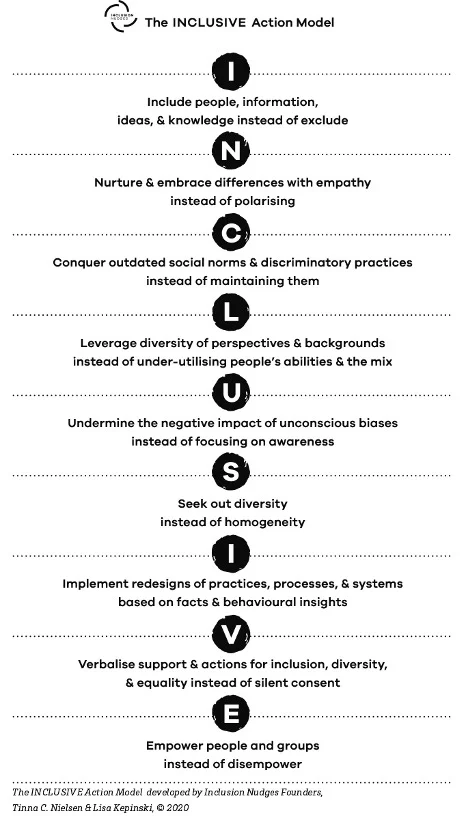
The imperative for fundamentally transforming how inclusion is achieved has never been greater. While being inclusive is often easier said than done, Inclusion Nudges empower individuals to embed inclusive behaviors into their daily actions without perceiving it as an additional burden. Instead, it becomes a natural, integrated part of work, interactions, and decisions. Resources such as "The Inclusion Nudges Guidebook" and "Action Guides" offer detailed, practical guidance, including the INCLUSIVE Action Model, derived from decades of real-world experience.
Beyond Methodology: A Collaborative, Open-Source Initiative
Inclusion Nudges transcends a mere change approach; it embodies a global movement founded on principles of sharing, reciprocity, and open-source collaboration. The initiative addresses a common frustration in social change circles: the reluctance to share "how-to" methodologies that genuinely work. Recognizing that empowerment stems from practical knowledge, the founders, Lisa and Tinna, committed to openly sharing detailed, step-by-step descriptions of effective change designs, complete with underlying behavioral insights.
- Sharing: The initiative thrives on collaboration. Change makers are encouraged to share their experiences and designs based on Inclusion Nudges. These contributions are then documented, analyzed for behavioral insights, and disseminated through guidebooks, action guides, and other publications, fostering a collective knowledge base crucial for accelerating progress.
- Reciprocity: The movement emphasizes mutual exchange. Receiving and contributing examples, offering peer support, and spreading awareness of these resources are all vital acts of reciprocity that sustain the momentum of change.
- Open Source: Operating under a Creative Commons License, the Inclusion Nudges initiative ensures that knowledge and practical designs are freely accessible to all. This commitment reflects a belief that hoarding intellectual property hinders social progress; instead, open access fosters widespread adoption and innovation, essential for creating a more inclusive world.
The Inclusion Nudges movement invites individuals, organizations, and communities to join forces. By applying this scientifically grounded, human-centered approach, the collective goal of making inclusion the norm—everywhere, for everyone—becomes an achievable reality. The journey toward true inclusivity is complex, but with the strategic application of behavioral design, the path forward is clearer and more effective than ever before.