Religion’s Influence in American Life Shows Shifting Trends, New Pew Research Study Reveals
A significant new report from the Pew Research Center, released on May 14, 2026, indicates a notable shift in how Americans perceive religion’s role in public life. As the nation approaches a large-scale revival meeting on the National Mall, themed "rededicating our country as One Nation under God," the survey reveals that a growing minority of U.S. adults believe religion is gaining influence in American society. This sentiment is coupled with a majority who still find religion’s presence to be a positive force. The research delves into complex attitudes surrounding Christian nationalism, the relationship between church and state, and the evolving religious landscape of the United States.
The Pew Research Center, a non-partisan fact tank committed to informing the public, journalists, and leaders, conducted this comprehensive study to provide data-driven insights into a core aspect of American identity and civic discourse. The findings are drawn from a survey of 3,592 U.S. adults, part of the Center’s American Trends Panel (ATP). The survey was administered from April 6-12, 2026, and carries an overall margin of error of plus or minus 1.9 percentage points, lending statistical weight to its conclusions.
A Nation Under God: Shifting Perceptions of Religious Influence
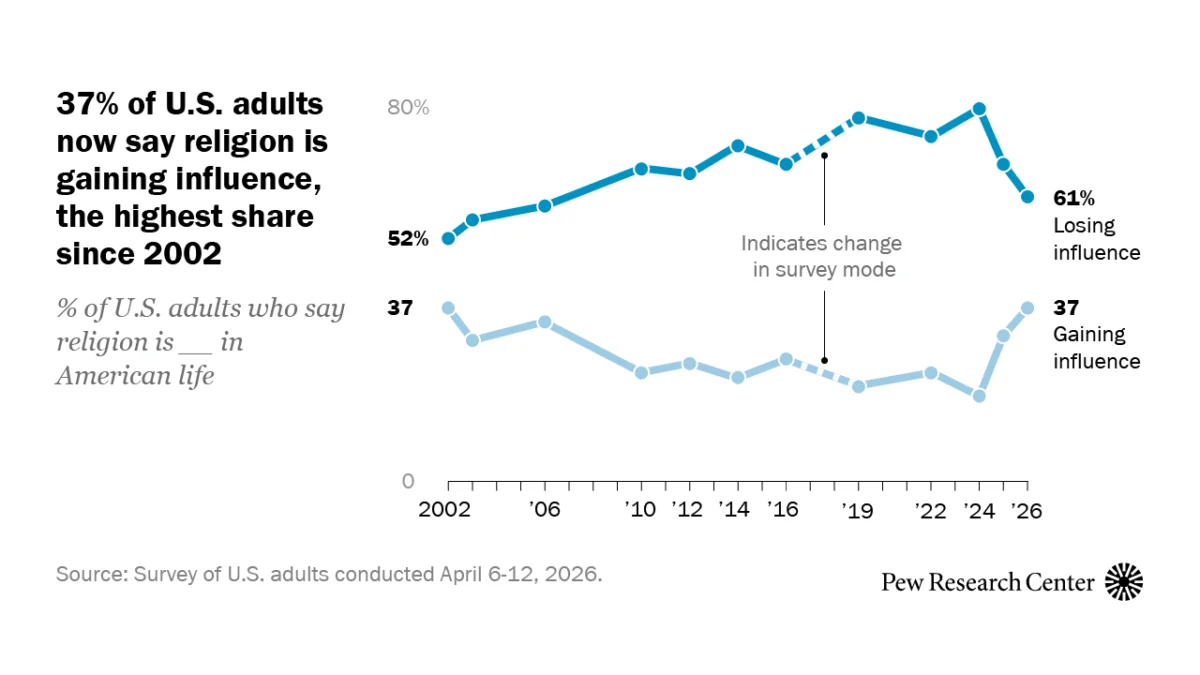
The timing of the report’s release is particularly salient, coinciding with the lead-up to a significant event aimed at national spiritual renewal. This planned gathering underscores a broader societal conversation about faith and its place in the public square. The Pew study directly addresses this by highlighting that 37% of U.S. adults now believe religion is gaining influence in American life. This figure represents the highest share recorded since 2002, signaling a departure from previous decades where a perception of declining religious influence was more prevalent. In contrast, 61% of U.S. adults currently feel that religion is losing influence, a sentiment that has seen a notable decrease from previous surveys.
This perceived shift in religious influence is further contextualized by an examination of overall sentiment. Slightly more than half of U.S. adults, precisely 55%, express a positive view of religion’s role in American life. This positive sentiment is composed of those who believe religion’s influence is growing and view this as a good thing (21%), and those who believe its influence is declining but see this as a bad thing (34%). Conversely, 22% hold a negative view, with 11% believing religion’s influence is growing and seeing this as detrimental, and another 11% believing its influence is declining while viewing this as positive. The remaining 23% fall into a neutral or unclear category.
Growing Familiarity with Christian Nationalism
The survey also illuminates a significant increase in public awareness of the term "Christian nationalism." Since the last comparable survey approximately two years prior, there has been a 14 percentage point rise in the number of U.S. adults who report having heard or read at least a little about Christian nationalism, moving from 45% to 59%. This heightened awareness comes amidst ongoing public and academic discussions about the movement’s ideology and its potential impact on American politics and society.

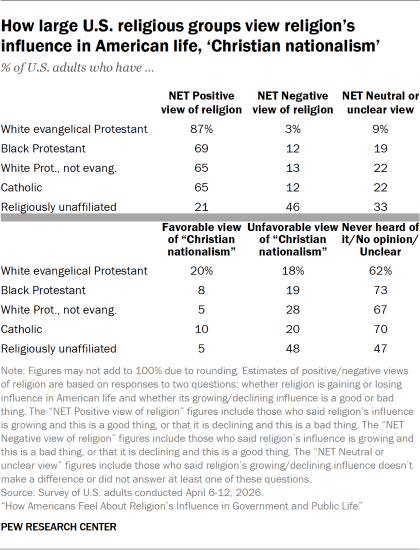
Despite this growing familiarity, sentiment towards Christian nationalism remains complex and largely negative. Currently, 31% of U.S. adults express an unfavorable view of Christian nationalism, a six-point increase since 2024. Concurrently, 10% view it favorably, a five-point increase. However, a substantial portion of the population, 59%, remains unfamiliar or undecided, with 40% stating they have never heard of it, 11% unsure how to feel, and 8% holding neither a favorable nor unfavorable view.
Evolving Views on Church-State Relations
The Pew Research Center’s findings also provide critical insights into American attitudes regarding the separation of church and state and the extent to which religious institutions should engage in political discourse. While a majority of Americans (79%) believe that churches and other houses of worship should not endorse specific candidates during elections, and two-thirds (66%) feel these institutions should generally stay out of political matters, there are subtle shifts in opinion on related issues.
A concerning trend for proponents of strict church-state separation is a small but notable increase in the percentage of U.S. adults who believe the federal government should declare Christianity the nation’s official religion. This figure now stands at 17%, up from 13% in 2024. This rise is particularly pronounced among Republicans and independents who lean Republican, where 27% now favor establishing Christianity as the official religion, an increase of six percentage points in two years.
However, the majority of Americans continue to reject the idea of an official state religion. A substantial 43% believe the government should promote Christian moral values without establishing Christianity as the official religion, while 38% advocate for neither an official religion nor the promotion of Christian values.
On other questions touching on themes sometimes associated with Christian nationalism, public opinion has shown minimal movement. The proportion of Americans who believe the Bible should influence U.S. laws, and take precedence over the will of the people, has remained consistent since 2020. Similarly, the belief that God favors the U.S. over other nations has not changed significantly since 2021.
A slight decline is observed in the percentage of Americans who wish for the government to cease enforcing the separation of church and state, dropping from 19% in 2021 to 13% in 2026. This coincides with a rise in those holding a neutral view or no opinion on the matter. Nevertheless, the majority of Americans (54%) continue to support the enforcement of church-state separation.
Partisan Divides and Areas of Agreement
The survey underscores deep partisan divisions on many facets of religion’s role in public life. Republicans are significantly more likely than Democrats to perceive religion’s influence positively and to advocate for its prominent role in government and policy. For instance, 75% of Republicans and GOP-leaning independents express a positive view of religion’s influence, compared to only 38% of Democrats and Democratic-leaning individuals. Democrats are nearly as likely to hold a negative view (37%) as a positive one (38%).
These disparities extend to views on the Bible’s influence on U.S. laws. A majority of Republicans believe the Bible should hold significant sway, with 45% asserting that the Bible should take precedence if it conflicts with the will of the people. In stark contrast, two-thirds of Democrats believe the Bible should have little to no influence on U.S. laws.
The partisan gap is also evident in opinions about whether Christianity should be the nation’s official religion. Most Republicans favor either establishing Christianity as the official religion or promoting Christian moral values, while a majority of Democrats believe the government should neither establish an official religion nor promote Christian values.
Despite these ideological chasms, significant consensus emerges on certain issues. Large majorities across the political spectrum agree that churches should not endorse political candidates and should generally remain aloof from day-to-day political matters. Furthermore, relatively few individuals in either party subscribe to the idea that God favors the U.S. above all other nations, with majorities in both camps believing God does not play favorites among countries.
Religious Group Perspectives
The study also offers granular insights into how different religious demographics perceive religion’s influence. White evangelical Protestants emerge as the group most consistently expressing positive views on religion’s societal role, advocating for the Bible’s significant influence on lawmaking, supporting Christianity as the official religion, and holding favorable views towards Christian nationalism.
However, White evangelicals are not alone in their positive outlook. Most Catholics, White nonevangelical Protestants, and Black Protestants also share positive views on religion’s societal contribution. The data reveals that nearly half of Black Protestants, and a quarter of Catholics and White nonevangelical Protestants, believe the Bible should hold precedence over the popular will when conflicts arise. Moreover, a significant portion across these Christian denominations indicate support for the government at least promoting Christian moral values, even if not establishing a Christian nation.
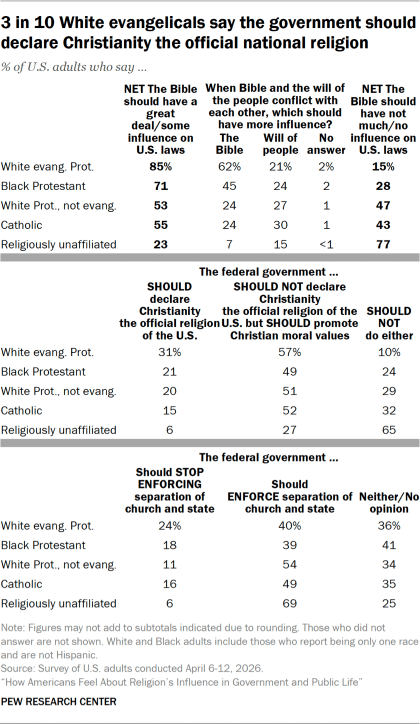
The survey also highlights that majorities across virtually all analyzed religious groups believe churches should refrain from endorsing political candidates. Notably, a majority of religiously unaffiliated individuals (atheists, agnostics, and those with "nothing in particular" for religion) share this sentiment, along with most Catholics and White nonevangelical Protestants, who believe churches should stay out of day-to-day political issues. This contrasts with White evangelicals and Black Protestants, who exhibit a more divided opinion, with substantial segments believing churches should engage with social and political matters.
The Pew Research Center’s methodology acknowledges limitations regarding smaller religious groups such as Jews, Muslims, Hindus, and Buddhists, where sample sizes are insufficient for separate reporting.
Broader Implications and Context
This comprehensive report from the Pew Research Center arrives at a pivotal moment, offering a nuanced snapshot of American attitudes towards religion in an increasingly diverse and secularizing society. The findings suggest a complex interplay of forces shaping public opinion, including a growing perception of religious resurgence, heightened awareness of Christian nationalism, and persistent debates over the boundaries between faith and governance.
The data implies that while many Americans value religion’s contribution to society, there remains a strong underlying sentiment for maintaining a clear separation between religious institutions and partisan politics. The increasing visibility of Christian nationalism, coupled with shifts in attitudes towards an official state religion, indicates a potential fault line in American public life that will likely continue to be a subject of intense debate and political engagement in the coming years. The report serves as a crucial resource for understanding these evolving dynamics and their potential impact on the nation’s civic fabric.