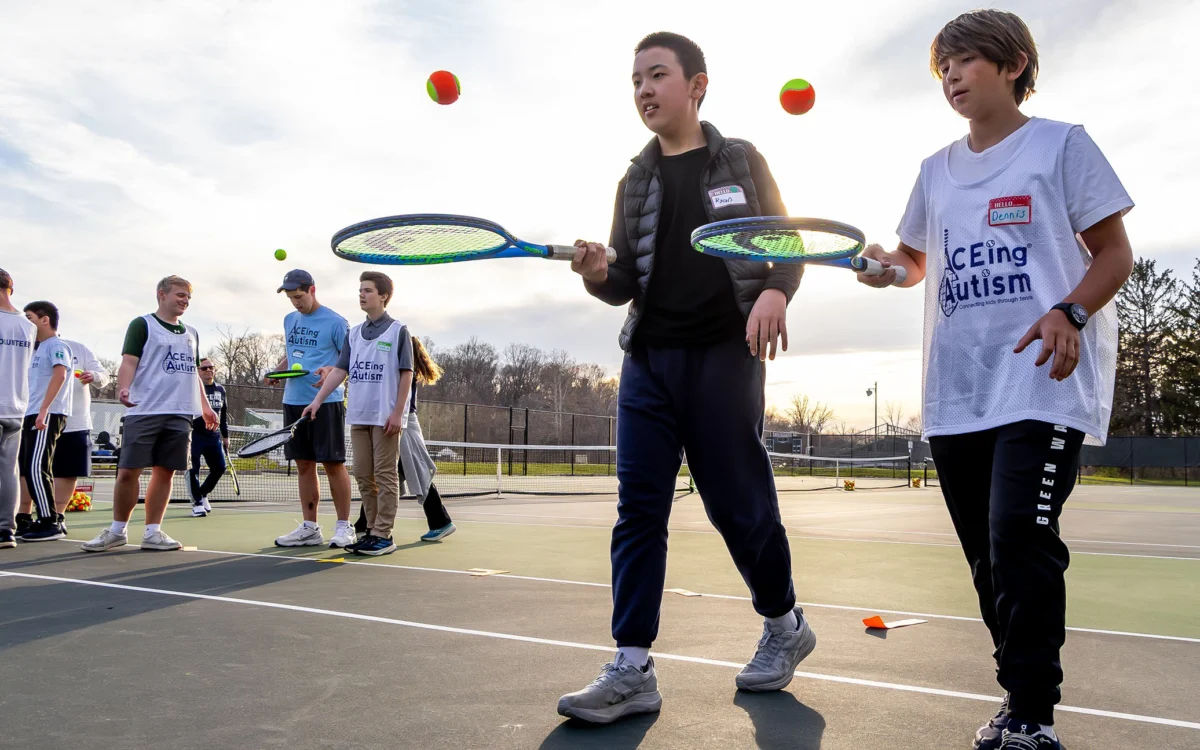
On the meticulously maintained tennis courts of New Jersey’s elite high schools, the familiar rhythm of volleys, the sharp crack of a serve, and the squeak of sneakers typically signal fierce competition. Programs at Rutgers Prep, Delbarton, and Newark Academy, consistently ranked among the state’s top girls’ and boys’ tennis powerhouses, are usually arenas where every point is a battle and every match is a testament to dedication and skill. However, for a few transformative hours on select days each year, this same energetic atmosphere shifts, heralding an opportunity for connection, empathy, inclusion, and, above all, profound fun. This transformation is driven by student-led chapters of ACEing Autism, a national nonprofit organization that harnesses the power of tennis to foster development and social connections for children and teenagers on the autism spectrum.
ACEing Autism, founded in 2008, operates on a national scale, utilizing a volunteer-driven model to provide accessible tennis programming for individuals aged 5 to 18. The organization’s mission extends beyond athletic development, aiming to cultivate social skills, promote fitness, and build self-confidence within a supportive and encouraging environment. What makes the New Jersey initiative particularly noteworthy is its student-led genesis. These chapters are not established by coaches, parents, or external organizations, but are conceived, founded, and meticulously organized by the high school students themselves. This student ownership infuses the programs with a unique blend of youthful energy and mature commitment.
Across the nation, ACEing Autism boasts an impressive reach, with 227 programs active in 32 states, serving over 7,000 children. New Jersey, with its vibrant tennis culture and engaged youth, has emerged as a significant hub for the organization, currently hosting 13 active chapters. These chapters represent a growing commitment among New Jersey’s student athletes to leverage their passion for tennis for a greater social good.
Student-Led Initiatives Drive ACEing Autism’s Expansion in New Jersey
The establishment of these vital programs is a testament to the initiative and leadership of individual students. Hudson Bonetti, a sophomore at Delbarton, spearheaded the launch of an ACEing Autism chapter at his school in 2023. Raghavi Aiyer, a freshman at Rutgers Prep, initiated her program’s first session in early 2024. In the fall of 2025, Evan Lai and Sebastian Topor joined forces to establish a chapter at Newark Academy. Their efforts are echoed by Sam and Eli Zausner from Tenafly and Amina Rachidi from Ridge, who also direct successful ACEing Autism programs.
These student leaders are not merely volunteers; they are the architects of these inclusive spaces. Their motivation often stems from personal experiences and a deep-seated desire to make a tangible difference in their communities. For Hudson Bonetti, the seed of this endeavor was planted during a middle school field trip to P.G. Chambers School, an institution dedicated to students with disabilities.
"That was my first time experiencing kids with disabilities," Bonetti recounted. "It was very simple. We played board games and just hung out with the kids. But seeing them smile really brought a lot of joy to me, and I’m happy that I was able to hopefully bring them joy for one day." This initial encounter sparked a realization of the profound impact simple human connection could have, and the idea of integrating that connection with a sport he loved began to take shape.
Raghavi Aiyer’s involvement is deeply personal, as autism affects her family directly. Her younger brother, who was nonverbal until the age of eight, and other family members are on the autism spectrum. Having played tennis since preschool, Aiyer has witnessed firsthand the challenges and triumphs associated with autism. After volunteering at an existing ACEing Autism program at Delbarton, she felt compelled to create her own chapter.
"It was just a thought at first," Aiyer explained. "I always knew I wanted to do something related to autism to help the community. That is important to me. As someone just entering into high school, I knew I needed to make myself grow. I was a very timid freshman, and this was a perfect opportunity. I can play tennis, I know how to deal with special-needs kids, so this is something for me that I should start." Her journey with ACEing Autism has been one of personal growth and empowerment, mirroring the development she aims to foster in the program’s participants.
Similarly, Evan Lai and Sebastian Topor, before founding the Newark Academy chapter, gained valuable experience volunteering with existing ACEing Autism programs and participating in Special Olympics initiatives. Their desire to bring this impactful program to their school led them to collaborate. "You kind of get to understand how they function and what they may struggle with and what they may be good at," Lai observed. "Seeing that for the first time also helps develop your sense of empathy and wanting to help them build the best lives for them." This sentiment underscores the reciprocal nature of the program, where volunteers not only teach but also learn and grow in their understanding and empathy.
The Structure of Success: ACEing Autism Program Delivery
The ACEing Autism programs, regardless of location, adhere to a structured yet adaptable curriculum designed to maximize engagement and learning. Each hour-long session typically begins with a warm-up to prepare participants for physical activity. This is followed by drills focused on fundamental racket skills, movement, and hand-eye coordination. The sessions then progress to more specific tennis skills, including volleys, forehands, backhands, and serves.
A cornerstone of the program’s success lies in the pairing of participants with the same volunteers each week. This consistent pairing fosters rapport, allows for a deeper understanding of individual communication styles and needs, and builds trust between the athletes and their mentors. This consistent interaction is crucial for both the athletes’ progress and the volunteers’ development of meaningful relationships.
"These connections are as important to the athletes as they are to the volunteers and with us," noted Brayden Bonetti, a program director at Delbarton and Hudson’s younger brother. His sentiment is echoed by Sebastian Topor, who stated, "When the volunteers and the athletes are being paired up every session, they create a bond and that is one of the main goals for them to take out of this experience." This focus on building strong interpersonal connections highlights the holistic approach of ACEing Autism, recognizing that social and emotional development are as vital as athletic skills.
Tangible Progress: Measuring Impact On and Off the Court
The impact of ACEing Autism programs is evident in the remarkable progress witnessed both on the tennis court and in the broader lives of the participants. "It’s amazing because there’s kids who have been going to the program since I started it," shared Raghavi Aiyer. "I’ve kind of grown up with them. They’ve all grown a lot and they’ve become so much better at tennis. They’ve become so much more confident. Their parents are really happy. Everyone has fun and it is worth the work." This long-term observation speaks volumes about the sustained positive influence of the program.
Anecdotal evidence further illustrates this progress. One athlete who regularly attended sessions at Delbarton has since become a junior varsity tennis player at Madison High School, participating as a senior. Another participant, who initially struggled with basic court movement, now incorporates shuffling as a regular expression of excitement and appreciation during sessions.
"A lot of these kids have become my friends," said Brayden Bonetti. "We always have a party at the end of our sixth session and we’ll play tag. I enjoy those moments. I enjoy seeing our work pay off and seeing how happy they get." These personal connections and shared moments of joy underscore the program’s success in creating a vibrant and inclusive community.
The program’s inclusive nature extends to its volunteer recruitment. No prior tennis experience or experience working with individuals with disabilities is required. Program directors provide comprehensive training to volunteers, equipping them with the skills and guidance necessary to effectively support and connect with the athletes. "We really focus on training the volunteers to be able to work and adapt to the athlete that they’re paired up with and they support in their tennis lessons," explained Sebastian Topor, highlighting the organization’s commitment to providing a high-quality experience for all involved.
Community and Family: The Heartbeat of ACEing Autism
The success of ACEing Autism chapters is often amplified by the involvement of families, creating a strong sense of community and shared purpose. The Bonetti family’s dedication to the Delbarton program is a prime example. Hudson Bonetti, now a freshman at Georgetown University, continues to direct the program alongside his younger brother Brayden. Their mother, Kirstyn, and grandfather, Robert Perkins, are also integral to its operation, with their father and grandmother providing additional support. This family-wide commitment was recognized when the Bonetti family was named the 2024 USTA Eastern Family of the Year for their extensive community service, largely driven by their involvement with ACEing Autism.
The positive impact of these programs is consistently praised by parents. Mandy Tin, whose son attends the Newark Academy program, shared her heartfelt appreciation: "It was truly inspiring to see the kids’ smiles, their energy, and how quickly they engaged with the activities. I’m grateful that there is a space where every child feels supported, encouraged, and celebrated. I’m truly grateful for the chance for my son to be part of this program. The staff have such big hearts, and I hope life brings every one of you great things and countless blessings." This testimonial underscores the profound gratitude and positive experiences felt by families who have found a supportive and enriching environment through ACEing Autism.
Future Growth and Fundraising: ACEing for Impact
The momentum behind ACEing Autism in New Jersey is not only fueling program expansion but also driving fundraising initiatives to sustain and grow its reach. ACEing Autism has partnered with the USTA Eastern Junior Council and the USTA New Jersey Junior Council to organize the "ACEing for Impact" fundraiser. This initiative encourages participants to raise money through match play, soliciting donations on a one-time basis or per game won, running from April 1 to June 15.
Brayden Bonetti expressed optimism about the fundraising goals: "I’m hoping for around $25,000 this year. It would be great to double what we got last year, and I think we could blow that out of the water. I hope that more teams can sign up because it’s really easy and it could be super impactful for ACEing Autism." This ambitious goal highlights the organization’s commitment to financial sustainability and its vision for broader impact.
The student program directors are actively encouraging other high school tennis players across the state to consider establishing their own ACEing Autism chapters. "I really hope it grows to a lot more locations in New Jersey," stated Hudson Bonetti. "I just hope that everybody who wants to do it is able to do it. New Jersey is probably now one of the hot spots, and I hope it grows around the country too." This call to action reflects a desire to replicate the success seen in New Jersey and expand the positive influence of ACEing Autism nationwide.
Raghavi Aiyer emphasized the ripple effect of student leadership: "It takes one volunteer at a time. Starting these programs young can have an influence on so many other young people. They want to do what they see others do and it’s great to share that impact. Like I said, it’s given me a purpose, and I’m sure it’ll give a lot other people a sense of purpose as well." This sentiment encapsulates the enduring legacy and purpose that these student-led initiatives are creating, transforming not only the lives of the participants but also the lives of the young leaders themselves.
For those interested in learning more or finding an ACEing Autism program, information is available through their official website, with a direct link provided for program locations at parks and tennis facilities nationwide. The dedication of these young athletes in New Jersey is not just about the game of tennis; it’s about building bridges, fostering understanding, and creating a more inclusive and empathetic world, one ace at a time.