The traditional image of the American family is undergoing a profound transformation, with work arrangements for parents shifting dramatically over the past half-century. A comprehensive new report from the Pew Research Center, analyzing data up to 2025, reveals a significant rise in dual-income households, a trend that is reshaping financial well-being, parental perceptions, and the very fabric of family life. This extensive research, based on a survey of 2,242 U.S. working parents conducted in March 2026 and supplemented with U.S. Census Bureau data, offers critical insights into how modern parents navigate the intricate demands of both professional careers and family responsibilities.
The Rise of the Dual-Income Family: A Statistical Snapshot
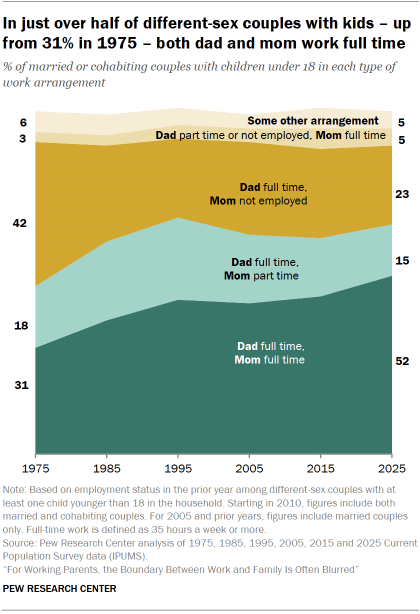
The most striking finding from the Pew Research Center’s analysis is the substantial increase in couples where both partners are employed full-time. As of 2025, just over half (52%) of different-sex couples with children under 18 now consist of two full-time working parents. This figure represents a significant leap from 46% a decade prior and a dramatic increase from a mere 31% in 1975. This upward trajectory indicates a fundamental shift in the economic and social norms surrounding parenthood and employment.
Conversely, the traditional model of a sole breadwinner, with the father working full-time and the mother not employed, has seen a considerable decline. In 1975, this arrangement accounted for 42% of couples with children. By 2025, this figure had shrunk to 23%. This substantial decrease underscores the growing necessity and societal acceptance of women’s participation in the full-time workforce.
The report also acknowledges that not all working parents are part of a couple. As of 2025, a notable 14% of working parents are neither married nor living with a partner, highlighting the diverse family structures that characterize contemporary American society.
Perceptions of Impact: Financial Health vs. Child Well-being

The changing work arrangements have tangible impacts on how parents perceive their family’s situation, particularly concerning financial well-being and the welfare of their children. The Pew Research Center’s survey delved into these perceptions, revealing nuanced differences based on parental employment status.
Parents in families where both partners work full-time are overwhelmingly likely to report positive financial impacts. A substantial 83% of these parents stated that their work arrangement has benefited their family’s finances. This strong consensus suggests that the economic advantages of dual full-time employment are widely recognized and experienced.
In families where the father works full-time and the mother works part-time, the perception of financial benefit is also positive, albeit less pronounced. Sixty-two percent of parents in this configuration report a positive financial impact.
However, a stark contrast emerges for families where the father works full-time and the mother is not employed. Only 19% of parents in this scenario reported financial benefits. Alarmingly, 41% stated that this arrangement had a negative impact on their family’s finances. It is crucial to note that these perceptions regarding financial impact, particularly for this group, reflect the opinions of the employed fathers surveyed, as the survey specifically targeted working parents.
When the conversation shifts to children’s well-being, the perceptions diverge further. In families where the father works full-time and the mother is not employed, a significant majority (85% of fathers surveyed) believe this arrangement is beneficial for their children. This sentiment highlights a potential prioritization of a parent’s full-time presence at home for child-rearing, even at a potential financial cost.
In dual-income households where the father works full-time and the mother works part-time, 59% of parents view the arrangement as positive for their children’s well-being.
The picture is less uniformly positive for families where both parents work full-time. While nearly half (49%) of these parents perceive a positive impact on their children’s well-being, a notable 22% report a negative impact, and 29% believe it has had neither a positive nor negative effect. This suggests that while financial gains are clear, the demands of two full-time careers can present challenges to family time and parental availability, leading to mixed views on child-rearing outcomes.
The impact on the parental relationship also came under scrutiny. Across all surveyed groups, more parents reported positive impacts on their relationship with their spouse or partner than negative ones. Parents in situations where the father works full-time and the mother works part-time or is not employed were more likely to express positive views regarding their relationship dynamics.
Regarding career advancement, the majority of parents across all configurations reported that their family work arrangement had neither a positive nor negative impact on their ability to advance in their job or career. This suggests that while work-life balance is a significant concern, direct career progression may not be as heavily influenced by these specific arrangements, or that parents have found ways to manage these aspects independently.
Demographic Variations in Family Work Arrangements
The Pew Research Center’s analysis also sheds light on how family work arrangements differ across racial and ethnic lines, as well as by educational attainment. These demographic factors reveal distinct patterns in how families are structured and how parents participate in the workforce.
Race and Ethnicity:
Among partnered Black mothers, a significant majority (60%) are in couples where both parents work full-time. This high rate of dual full-time employment has been a consistent trend, with 64% of partnered Black mothers in such arrangements in 2000.
For other racial and ethnic groups, the prevalence of two full-time working parents varies:
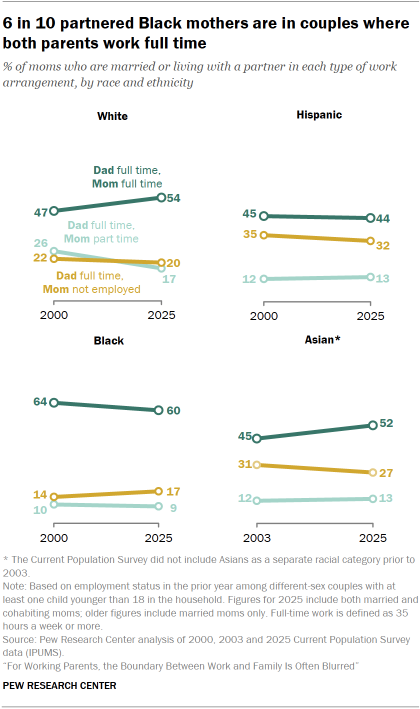
- White mothers in different-sex couples: 54%
- Asian mothers in different-sex couples: 52%
- Hispanic mothers in different-sex couples: 44%
The shares of White and Asian mothers in dual full-time working arrangements have seen an increase over the past 25 years. In contrast, the family work arrangements for Hispanic mothers have remained relatively stable since 2000. A notable proportion of Hispanic mothers (32%) are in families where the father works full-time and the mother is not employed. This rate is higher than that of Black (17%), White (20%), and Asian (27%) mothers in similar arrangements. This suggests that traditional gender roles in workforce participation may persist to a greater extent in some Hispanic communities.
Education Level:
Educational attainment plays a significant role in shaping family work arrangements, particularly for mothers. Among mothers married to or living with a male partner:
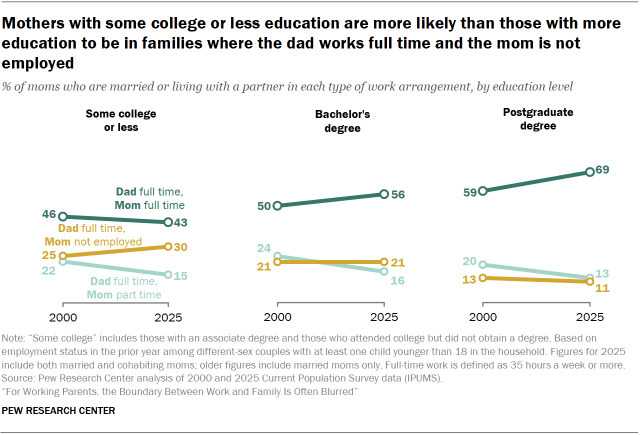
- Mothers with a postgraduate degree: Approximately seven-in-ten (69%) are in families where both parents work full-time.
- Mothers with a bachelor’s degree: A smaller majority (56%) are in dual full-time working families.
- Mothers with some college or less education: Fewer than half (43%) are in couples where both parents work full-time.
Furthermore, mothers with less formal education are more likely to be in arrangements where the father is the sole full-time earner. Three-in-ten mothers with some college or less education are in families where the dad works full-time and the mom is not employed. This contrasts with 21% of mothers with a bachelor’s degree and 11% of mothers with a postgraduate degree. This disparity is likely linked to broader trends in labor force participation, where higher educational attainment among women generally correlates with increased workforce engagement.
Methodology and Research Context
This extensive report is the product of rigorous research by the Pew Research Center, an independent, nonpartisan think tank dedicated to informing the public, media, and policymakers on important societal issues. The research is part of an ongoing initiative by the Center to understand the evolving dynamics of work and family life for Americans, particularly parents.
The primary data for this report was collected through a survey of 2,242 U.S. working parents conducted between March 2 and March 15, 2026. All participants were members of the Pew Research Center’s American Trends Panel, a nationally representative online survey panel. The survey was designed to capture the diverse experiences and perspectives of working parents across the United States. The survey questions, detailed responses, and methodology are publicly available, ensuring transparency and allowing for further academic scrutiny.
In addition to the survey data, the report incorporates an analysis of parents in the labor force using data from the U.S. Census Bureau’s Current Population Survey. This combination of primary survey data and official government statistics provides a robust foundation for the findings presented.
Implications and Future Outlook
The findings of this Pew Research Center report carry significant implications for policymakers, employers, and families themselves. The clear trend towards dual-income households suggests that societal and workplace structures must continue to adapt to support this reality. This includes the provision of accessible and affordable childcare, flexible work arrangements, and robust parental leave policies.
The divergence in perceptions regarding children’s well-being based on parental work arrangements highlights the ongoing societal debate about optimal child-rearing strategies. While financial stability is a clear benefit of dual-income families, the potential trade-offs in terms of parental time and involvement warrant continued attention and support for families seeking to balance career aspirations with nurturing their children.
The demographic variations underscore the need for tailored approaches to policy and support. Addressing the specific challenges and opportunities faced by different racial, ethnic, and educational groups is crucial for fostering equitable outcomes for all working parents. As the American family continues to evolve, research like this provides an essential roadmap for understanding these changes and for developing strategies that promote both economic prosperity and family well-being. The ongoing dialogue about work-life balance, gender roles in the home, and the impact of employment on child development will undoubtedly remain central to the American experience for years to come.