In an era characterized by unprecedented global challenges, from pandemics and economic volatility to rapid technological shifts, the imperative for robust and adaptable organizational teams has never been more acute. While discussions around diversity, equity, and inclusion (DEI) have rightfully gained prominence, a critical dimension often remains in the shadows: cognitive diversity. This distinct form of diversity, which encompasses varied ways of thinking, processing information, and approaching problems, is increasingly recognized by research as a paramount differentiator for innovation, problem-solving, and risk mitigation, extending beyond the well-established benefits of demographic representation.
The journey toward understanding and leveraging diversity within organizations has evolved significantly over the past half-century. Initially, the focus in the mid-20th century was largely on compliance with anti-discrimination laws, emphasizing affirmative action and basic representation in the workforce. This period laid the groundwork for addressing historical injustices and ensuring equal opportunities, primarily targeting visible attributes such as race, gender, and disability. As the 1980s and 1990s progressed, the narrative expanded to include the "business case for diversity," arguing that diverse workforces could improve market understanding, enhance creativity, and boost employee morale. Early studies, notably from institutions like Catalyst and later McKinsey & Company, began to quantify the positive correlations between demographic diversity (especially gender and ethnic diversity in leadership) and financial performance, innovation, and employee engagement. However, these initial frameworks often conflated visible diversity with the deeper cognitive variations that truly drive distinct perspectives. The current landscape, marked by a volatile, uncertain, complex, and ambiguous (VUCA) — or even brittle, anxious, non-linear, and incomprehensible (BANI) — environment, necessitates a more nuanced approach, one that deliberately seeks out and cultivates diversity of thought.
Leading researchers Alison Reynolds and David Lewis have dedicated decades to investigating how individuals and teams navigate new, uncertain, and complex situations. Their extensive studies consistently highlight a pivotal finding: the most effective and agile problem-solving teams are not merely demographically diverse, but are fundamentally cognitively diverse and operate within a culture of psychological safety. Teams lacking either of these foundational elements often succumb to groupthink, characterized by conformity, or become counterproductively combative, hindering progress and innovation. This research underscores that while demographic diversity can be a catalyst for cognitive diversity, it does not guarantee it. A team of individuals from diverse backgrounds might still approach problems with a similar cognitive framework if their professional training, personal experiences, or inherent thinking styles are homogeneous.
Reynolds and Lewis, building upon an assessment tool developed by psychiatrist Peter Robertson, delineate cognitive diversity into two primary dimensions critical for team performance:
-
Knowledge and Information Processing: This dimension assesses an individual’s preference when confronted with novel, uncertain, or complex situations. Some individuals predominantly prefer to consolidate, apply, and implement existing knowledge and proven methodologies. They excel at optimizing current systems, refining established processes, and leveraging historical data. Conversely, others are inclined to generate new knowledge, explore uncharted territories, and experiment with novel approaches. They thrive on ideation, challenging assumptions, and seeking out alternative solutions. A team balanced across this spectrum ensures both efficient execution and innovative exploration.
-
Perspective and Expertise Facilitation: This second dimension examines how individuals leverage expertise within a team context. One end of the spectrum comprises individuals who primarily prefer to apply their own specialized expertise and insights to problems. They are often deep specialists, providing authoritative guidance based on their specific domain knowledge. The other end consists of those who prefer to orchestrate and synthesize the ideas and expertise of others. These individuals act as facilitators, connectors, and integrators, adept at drawing out varied viewpoints, identifying synergies, and building consensus across diverse specializations. A blend of these approaches ensures that deep expertise is both effectively utilized and broadly integrated.
The synergy of these two dimensions, combined with a robust culture of psychological safety, forms the bedrock of high-performing teams. Psychological safety, a concept extensively researched by Harvard Business School professor Amy Edmondson, refers to a shared belief held by members of a team that the team is safe for interpersonal risk-taking. In a psychologically safe environment, team members feel comfortable expressing dissenting opinions, admitting mistakes, asking "naïve" questions, and offering unconventional ideas without fear of embarrassment, rejection, or punishment. This culture is not merely a "nice-to-have"; it is the essential catalyst that unlocks the potential of cognitive diversity. Without it, even the most cognitively diverse team risks remaining silent, stifling the very differences it possesses. When psychological safety is present, the varied knowledge processing styles and expertise facilitation preferences are actively encouraged, leading to constructive conflict, rigorous exploration of alternatives, and ultimately, superior outcomes in complex environments.
Beyond these two defined parameters, cognitive diversity also encompasses a broader spectrum of individual differences, including personality styles (such as introversion and extroversion), mental frameworks, learning styles, and approaches to risk, ambiguity, and process. For instance, an extroverted team member might be adept at brainstorming and externalizing ideas, while an introverted colleague might excel at deep, contemplative analysis. A risk-averse individual might identify potential pitfalls, while a risk-tolerant member might champion bold new ventures. These complementary traits, when intentionally curated and leveraged, ensure that a team possesses a comprehensive toolkit for addressing multi-faceted challenges.
The prevailing challenge, however, lies in the persistent oversight of cognitive diversity in favor of more readily observable demographic characteristics. While demographic diversity remains fundamentally important for ethical, social, and business reasons, an exclusive focus can create a superficial sense of diversity without achieving true diversity of thought. Organizations frequently prioritize achieving demographic parity, which, while crucial for fairness and representation, does not automatically translate into varied cognitive approaches. This can lead to "diversity fatigue" if the promised benefits of diversity fail to materialize because the deeper cognitive differences are not actively identified, valued, and integrated. The human tendency towards homophily – the preference for associating with individuals who are similar to oneself – further complicates the intentional cultivation of cognitive diversity, often leading to homogeneous teams despite diverse talent pools.
To truly harness the potential of all forms of diversity, organizations must embed inclusive leadership and foster an inclusive culture. Inclusive leadership transcends mere tolerance; it actively ensures that all team members feel treated with fairness and respect, feel valued for their unique contributions, feel a genuine sense of belonging, are explicitly invited and encouraged to speak up, and feel empowered to take initiative. This requires leaders to not only acknowledge differences but to actively seek them out, mediate constructive disagreements, and champion psychological safety. Deloitte Australia’s research highlights the profound impact of inclusive leadership, indicating that leaders’ behaviors can account for up to a 70 percentage-point difference in the proportion of employees who feel highly included versus those who do not. For members of minority groups, the effect of inclusive leadership is even more pronounced, serving as a critical buffer against feelings of isolation and discrimination.
Despite the growing executive-level advocacy for DEI, a significant chasm persists between top-down support and consistent, effective action at all levels of management. Many leaders, while acknowledging the importance of inclusion, often express feeling "ill-equipped" to act inclusively, particularly when navigating sensitive conversations about exclusion or discrimination. This lack of practical know-how can lead to inaction, perpetuating existing cultural norms and hindering the integration of diverse perspectives. This gap points to a critical need for accessible, actionable frameworks and tools that empower leaders to translate intent into tangible inclusive behaviors.
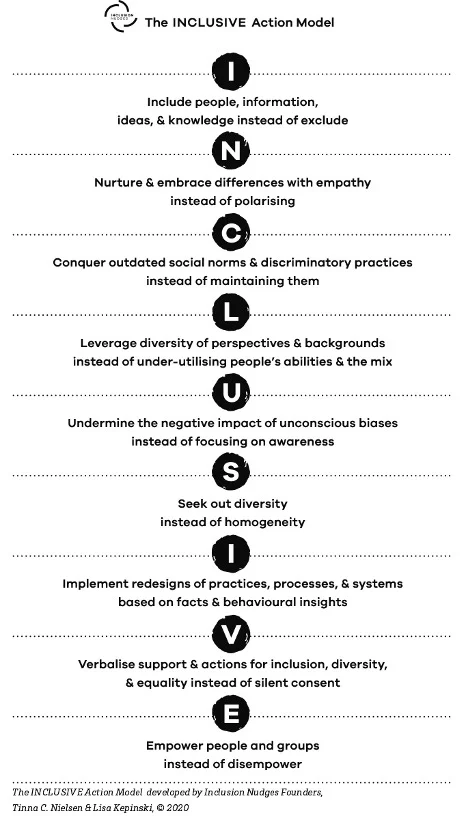
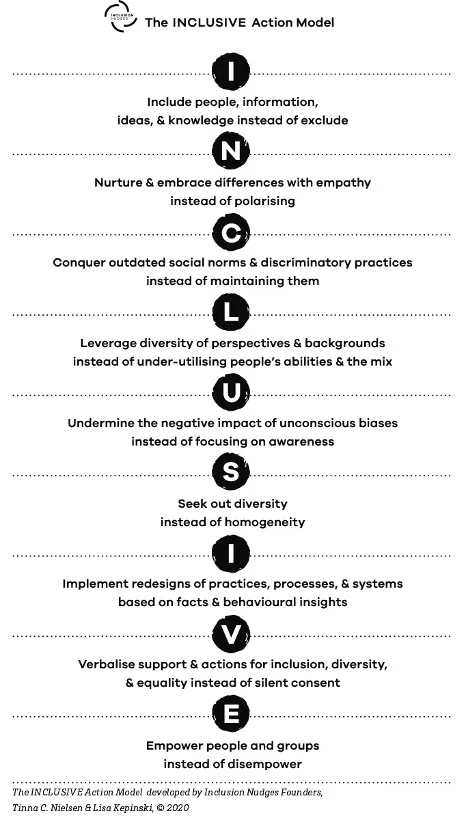
Recognizing this critical need, practitioners like Tinna Nielsen and Lisa Rasmussen, creators of the Inclusion Nudges Inclusive Action Model, have developed practical methodologies to guide organizations toward more inclusive cultures, structures, and behaviors. Their holistic approach acknowledges that cultural change requires simultaneous effort across multiple dimensions, moving beyond abstract principles to concrete, behavioral interventions. The "Inclusion Nudges for Leaders" Action Guide, for example, provides 30 easy-to-apply inclusive actions designed to make inclusion the default and norm in daily leadership. By offering step-by-step descriptions of proven behavioral designs, these guides empower leaders to build confidence, take initial steps, and progressively embed inclusive practices. This approach aims to dismantle the common barriers of uncertainty and fear of missteps, thereby sparking a wider, self-sustaining culture change.
The implications of prioritizing cognitive diversity are far-reaching. For recruitment, it means moving beyond traditional resume screening to incorporate assessments that reveal cognitive styles, problem-solving approaches, and intellectual curiosity. For team formation, it necessitates intentional design rather than ad-hoc assembly, ensuring a deliberate mix of consolidators and generators, expert-appliers and orchestrators. For leadership development, it requires training leaders not just to manage diverse teams, but to actively identify, value, and leverage the cognitive differences within them, fostering environments where constructive dissent is encouraged, and varied viewpoints are synthesized. This strategic shift is vital for organizational resilience, agility, and long-term sustainability in a rapidly changing global landscape, enabling organizations to anticipate unforeseen challenges, innovate breakthrough solutions, and navigate complex ethical dilemmas with greater foresight and integrity.
In conclusion, while demographic diversity remains a fundamental pillar of equitable and effective organizations, the current global climate demands a deeper, more intentional focus on cognitive diversity. By understanding and actively cultivating diverse ways of thinking, processing information, and applying expertise, and by embedding this within a culture of psychological safety and inclusive leadership, organizations can unlock unparalleled potential. This holistic approach, integrating both visible and invisible forms of diversity, is not merely an aspirational ideal but a strategic imperative for navigating uncertainty and securing a competitive edge in the 21st century.