The production of high-stakes public opinion research and demographic analysis is an exercise in rigorous methodology, interdisciplinary collaboration, and structural transparency. At the heart of this process for the Pew Research Center—a subsidiary of The Pew Charitable Trusts—lies a sophisticated operational framework that balances technical precision with clear communication strategies. This report examines the foundational infrastructure that supports such extensive data-gathering efforts, detailing the roles of the research team, the methodological standards employed, and the broader implications for the transparency of nonpartisan social science.
The Institutional Architecture of Data Integrity
The Pew Research Center functions as a subsidiary of The Pew Charitable Trusts, which serves as its primary benefactor. This financial relationship is central to its operational model, providing the fiscal stability necessary to conduct longitudinal studies and large-scale public opinion polling without the influence of commercial interests or political lobbying. In the world of social science, the independence of the research entity is paramount, and the center’s reliance on The Pew Charitable Trusts allows it to maintain a nonpartisan stance, focusing on the "what" and "how" of public behavior rather than advocating for specific policy outcomes.
However, the reputation of such an institution rests not only on its funding structure but on the collective expertise of its staff. The production of a major research report is rarely the work of a single analyst; rather, it is a multi-stage operation involving senior survey advisors, methodologists, and digital communications specialists.
The Research and Methodological Engine
The technical rigor of the Center is overseen by a core group of subject matter experts. Scott Keeter, serving as Senior Survey Advisor, brings decades of experience to the design of complex surveys, ensuring that questions are phrased to avoid bias—a common pitfall in polling. Alongside him, the late-tenure contributions of former Vice President of Methods and Innovation, Courtney Kennedy, and the current work of Principal Methodologist Andrew Mercer and Research Methodologist Arnold Lau, form the bedrock of the center’s statistical validity.
Methodology is the cornerstone of any credible survey organization. In an era where traditional landline telephone polling has become increasingly ineffective due to declining response rates, the transition to mixed-mode and online panel methodologies has been a significant shift. Ashley Amaya, as Associate Director of Survey Methods, and Senior Survey Manager Anna Brown, are tasked with navigating these transitions. Their role is to ensure that the samples generated are representative of the U.S. population, accounting for demographic shifts, educational attainment, and geographic diversity.
Chronology of a Research Project
A standard research lifecycle at the center follows a structured, iterative path:
- Conceptualization and Hypothesis Development: Before a survey is drafted, researchers identify a gap in the public understanding of a specific topic. This phase involves extensive literature reviews to ensure that new data will add value to existing discourse.
- Methodological Design: The team determines the sampling frame and the mode of delivery. This includes deciding whether to utilize probability-based panels or address-based sampling (ABS).
- Drafting and Pilot Testing: Questions are drafted and tested in pilot studies to identify ambiguity or respondent confusion.
- Data Collection: The field period begins. During this time, the methodology team monitors response rates and ensures that quotas for age, race, and socioeconomic status are being met.
- Data Cleaning and Weighting: Once raw data is collected, it undergoes rigorous cleaning. Statistical weighting is applied to align the sample with U.S. Census Bureau benchmarks.
- Editorial and Design Synthesis: The technical data is translated into accessible narratives and visualizations, a process led by communications specialists and designers.
The Role of Editorial and Visual Communication
The dissemination of research is as critical as its collection. Data, no matter how robust, is ineffective if it cannot be clearly communicated to policymakers, journalists, and the general public. Nida Asheer, Senior Communications Manager, and Zoë McMahon, Communications Associate, act as the bridge between technical findings and public consumption. Their role involves synthesizing complex statistical outputs into cohesive reports that maintain scientific accuracy while remaining legible to a non-expert audience.
Furthermore, the visual representation of data has become a defining feature of modern journalism. Bill Webster, as a Senior Information Graphics Designer, and Reem Nadeem, Digital Producer, are responsible for creating the charts, interactive maps, and web modules that accompany these reports. In the digital age, these visual assets often become the primary way that the public interacts with the data, making the design process a vital component of the Center’s output.
Supporting Data and Statistical Standards
The Pew Research Center maintains strict adherence to the standards set forth by the American Association for Public Opinion Research (AAPOR). Their methodologies often involve large sample sizes, frequently exceeding 5,000 respondents for national surveys, which allows for the sub-group analysis necessary to understand political and social polarization.
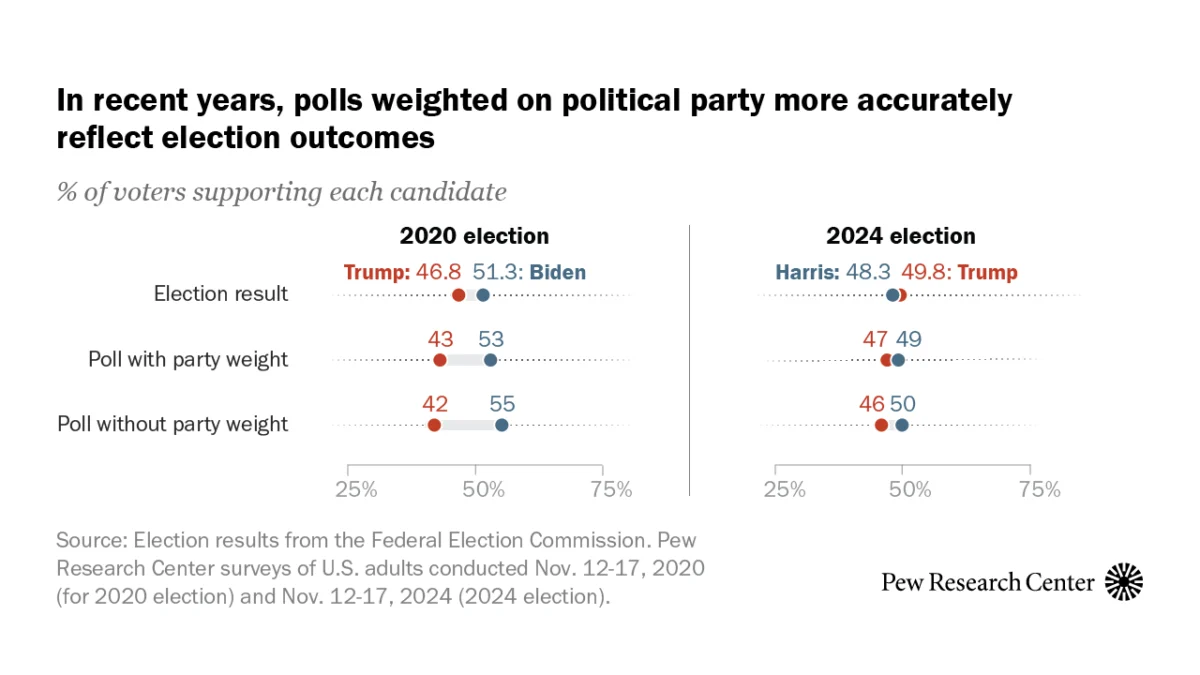
For instance, in studies involving election polling, the center utilizes "post-stratification weighting." This technique compensates for the fact that certain groups—such as younger voters or those with lower levels of formal education—are historically underrepresented in surveys. By weighting the data, the research team can produce results that more accurately reflect the true composition of the electorate, mitigating the "non-response bias" that has plagued modern polling.
Broader Impact and Ethical Implications
The implications of this research are profound. Policymakers rely on these data sets to craft legislation regarding immigration, education, and economic development. When the methodology is transparent—as it is when the center publishes its full survey design and margin of error—it invites scrutiny, which is a hallmark of healthy scientific inquiry.
There is, however, an inherent tension in public polling: the risk of "pollster bias." The center addresses this by consistently publishing the "topline" results alongside the methodology, allowing third-party researchers to replicate their findings. This transparency is the primary safeguard against the weaponization of data in political discourse.
Official Responses and Industry Standards
While the center does not typically issue "official responses" to individual political events, it does provide periodic methodological updates to the research community. These updates serve as a feedback loop, informing other organizations on how to handle challenges such as declining response rates or the proliferation of automated bot traffic in online surveys.
Industry peers frequently cite the center’s work as a gold standard for transparency. By documenting the exact contribution of each staff member—from the methodologists who ensure statistical integrity to the designers who visualize the final output—the organization reinforces the idea that high-quality data is the result of a collaborative, multifaceted effort.
Conclusion: The Future of Survey Research
As the landscape of American public opinion becomes increasingly fragmented, the necessity for neutral, methodologically sound research becomes more acute. The infrastructure built by the Pew Research Center, supported by The Pew Charitable Trusts, provides a model for how non-profit, nonpartisan organizations can serve the public interest.
The future of this work will likely involve further integration of machine learning to assist in data cleaning and more sophisticated methods for modeling non-respondents. Yet, the core tenets remain the same: rigorous methodological design, transparent communication, and a commitment to objective analysis. By acknowledging the various roles—from the survey advisor to the digital producer—the public gains a better appreciation for the labor-intensive process required to capture the shifting sentiments of a complex nation. This internal structure is not merely administrative; it is the institutional guarantee of the accuracy and integrity upon which the center’s reputation is built.