
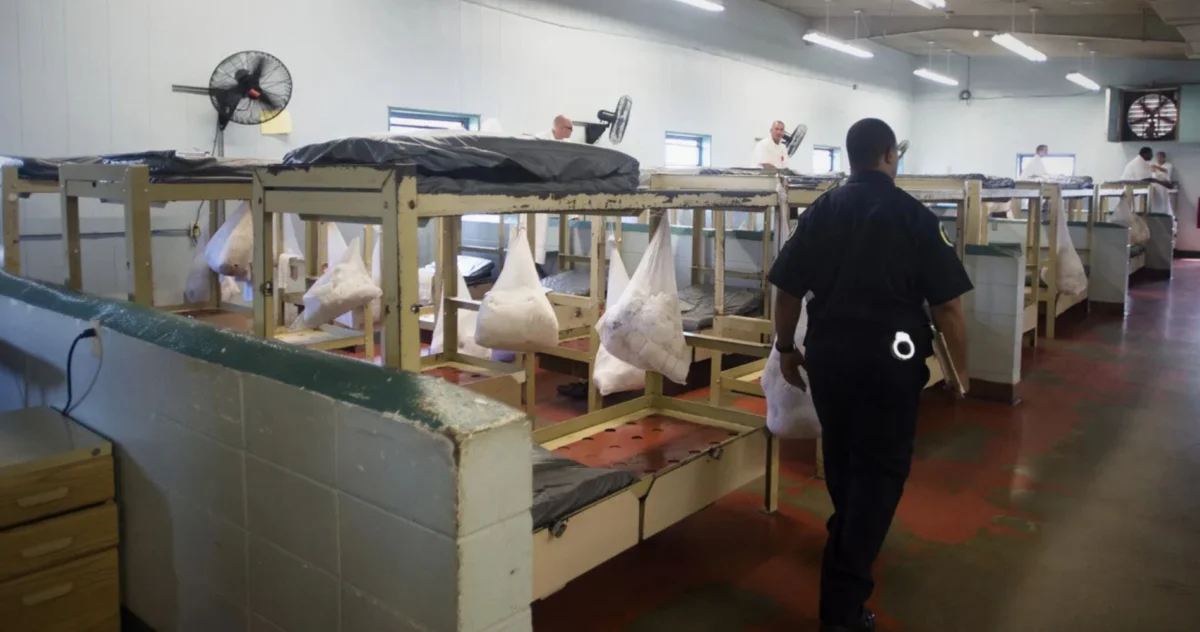
The indictment, returned on December 5, 2025, represents a significant development in the ongoing scrutiny of the Alabama Department of Corrections (ADOC). Melvin Ledarrius Thomas, 35, faces two counts: reckless manslaughter and failure to perform a legal duty concerning a person in custody. These charges stem from the September 12, 2025, death of 45-year-old Antwion Webb, who was serving time at the Donaldson Correctional Facility in Bessemer, Alabama—a facility that has long been identified as a flashpoint for institutional violence.
The Chronology of the Incident
The events leading to the death of Antwion Webb began late on the night of Friday, September 12, 2025. According to investigative reports and the subsequent indictment, Webb was involved in an altercation within the prison housing unit. During the assault, Webb sustained a severe stab wound to the chest.
The indictment alleges that Thomas, who was on duty at the time, failed to intervene or provide necessary medical intervention. Specifically, the prosecution contends that Thomas was aware of the injury but took actions that contributed to the fatal outcome, including the alleged decision to return the victim to the general population rather than securing immediate medical assistance.
Following the stabbing, Webb remained in distress for several hours. Medical personnel were eventually summoned, but the severity of the wound proved insurmountable. Webb was pronounced dead at 4:36 a.m. on Saturday, September 13, 2025. One week after the incident, on September 20, 2025, Thomas’s employment with the ADOC was terminated. Nearly a year later, on August 26, 2026, he was booked into the Jefferson County Jail and released on a $20,000 bond. His arraignment is currently set for October 26, 2026, marking a pivotal moment in the legal accountability of correctional staff in Alabama.
A System Under Federal Scrutiny
The death of Antwion Webb is not an isolated event but rather a continuation of a systemic crisis within Alabama’s penal system. In April 2019, the United States Department of Justice (DOJ) issued a scathing report notifying the ADOC that the state’s prisons were unconstitutionally violent. The DOJ findings highlighted a pervasive culture of staff-on-inmate violence, inmate-on-inmate violence, and a critical lack of supervision that allowed dangerous conditions to fester.
Since that notification, the state has struggled to implement meaningful reforms. Data documented by organizations such as the Equal Justice Initiative (EJI) indicates that more than 100 individuals have been killed in Alabama prisons since the 2019 DOJ intervention. This record establishes Alabama as having one of the highest prison homicide rates in the United States, raising difficult questions regarding the state’s capacity to ensure the safety of those it incarcerates.
Allegations of Negligence and Complicity
The charges against Thomas highlight a long-standing grievance among advocates and those currently incarcerated in Alabama: the assertion that prison violence is often facilitated, if not actively encouraged, by staff negligence or mismanagement.
Critics argue that when correctional officers fail to maintain order, secure housing units, or address threats of violence, they effectively abandon their duty of care. More serious allegations, often voiced by inmates and their legal representatives, suggest that some staff members may engage in "facilitation," where officers turn a blind eye to—or even conspire with—specific groups of inmates to settle scores or exert control through violence. While such claims are difficult to prove, the indictment of a correctional officer for failing to act in a life-or-death situation lends credence to the broader narrative that the ADOC faces deep-seated personnel issues that go beyond simple staffing shortages.
Analysis of Legal Implications
The indictment of a correctional officer for reckless manslaughter and failure to perform a legal duty is a relatively rare legal maneuver, yet it reflects an increasing appetite among prosecutors to hold individual state actors accountable for institutional failures. Under Alabama law, the charge of reckless manslaughter implies that the defendant was aware of a substantial and unjustifiable risk and consciously disregarded it, resulting in the death of another.
The legal strategy in this case hinges on the "duty of care." Because individuals in custody are stripped of their ability to protect themselves or seek their own medical help, the state assumes an absolute legal responsibility for their safety. When an officer ignores a stab wound or returns a victim to a volatile environment, the state’s legal experts argue that the officer has breached that fundamental contract.
If convicted, Thomas faces significant prison time. Beyond the personal consequences for the defendant, the trial is expected to draw renewed attention to the training protocols and oversight mechanisms within the ADOC. Legal observers suggest that the outcome of this case could set a precedent for how future incidents of staff negligence are handled, potentially pressuring the department to implement more rigorous oversight and accountability measures for its guards.
The Broader Context of Prison Reform
The case against Thomas serves as a microcosm of the larger battle over prison reform in Alabama. For years, the state has been embroiled in litigation regarding the conditions of its facilities. Issues such as overcrowding, understaffing, and deteriorating infrastructure are frequently cited as the root causes of the high homicide rate.
State officials have often pointed to recruitment and retention difficulties as the primary hurdles to improving safety. However, advocates argue that the culture of the institution is just as critical as the number of bodies on the floor. Without a fundamental shift in how correctional officers are trained to handle conflict and how the state monitors internal violence, critics maintain that incidents like the death of Antwion Webb will remain an inevitable feature of the Alabama prison experience.
The family of Antwion Webb and various advocacy groups have viewed the indictment as a necessary first step toward justice. For many, the focus remains on ensuring that the state is not merely penalizing a single "bad actor" but is also addressing the systemic conditions that allowed such conduct to occur in the first place.
Moving Forward
As the October 2026 arraignment approaches, the legal proceedings against Melvin Ledarrius Thomas will be closely watched by state legislators, federal monitors, and the families of those incarcerated in Alabama. The case represents a rare intersection of criminal law and civil rights accountability.
With the ADOC continuing to operate under intense pressure from federal oversight, the testimony and evidence brought forth in the trial could force a more transparent accounting of the events of September 2025. Whether this indictment leads to a broader institutional reckoning remains to be seen, but the case undoubtedly underscores the fragility of life within the state’s facilities and the ongoing struggle to hold those in positions of authority to the standard of care required by law.
As the state of Alabama attempts to navigate the complexities of prison reform, the death of Antwion Webb serves as a stark reminder of the human cost of institutional failure. For the victims of prison violence and their families, the search for accountability continues, driven by the belief that incarceration should not, by default, become a sentence to violence or neglect at the hands of the state.




