The release of the Age Action Annual Report 2025, unveiled during the organization’s recent Annual General Meeting, marks a significant milestone in the ongoing effort to redefine the landscape of ageing in Ireland. The comprehensive document serves as both a reflection of the past year’s operational achievements and a strategic roadmap for addressing the systemic challenges faced by an ageing demographic. Throughout 2025, Age Action intensified its dual mandate: providing direct, essential services to thousands of older citizens while simultaneously operating as a robust policy advocate at the national level. The report underscores a fundamental commitment to a society where chronological age does not determine one’s access to dignity, security, or social equality.
A Year of Strategic Advocacy and Operational Growth
The 2025 reporting period was characterized by a concerted effort to move beyond surface-level support, focusing instead on the root causes of marginalization. Age Action’s activities throughout the year were categorized by four key pillars: direct assistance, policy engagement, community outreach, and digital integration.
At the legislative level, the organization emerged as a critical stakeholder in national discourse. Through formal submissions and direct engagement with policymakers, Age Action representatives challenged existing frameworks regarding income adequacy, the housing crisis, healthcare accessibility, and the pressing issue of digital exclusion. The report details a series of high-level meetings between Age Action advocacy teams and government departments, where the organization pushed for reforms in the pension system and the implementation of more robust adult safeguarding protocols.
Chronology of Key Initiatives in 2025
The trajectory of the year was marked by several high-profile initiatives that served to catalyze public awareness and institutional change:
- Q1: Strategic Planning and Resource Allocation: The year began with the consolidation of regional support services, ensuring that rural areas with high concentrations of older residents received prioritized care.
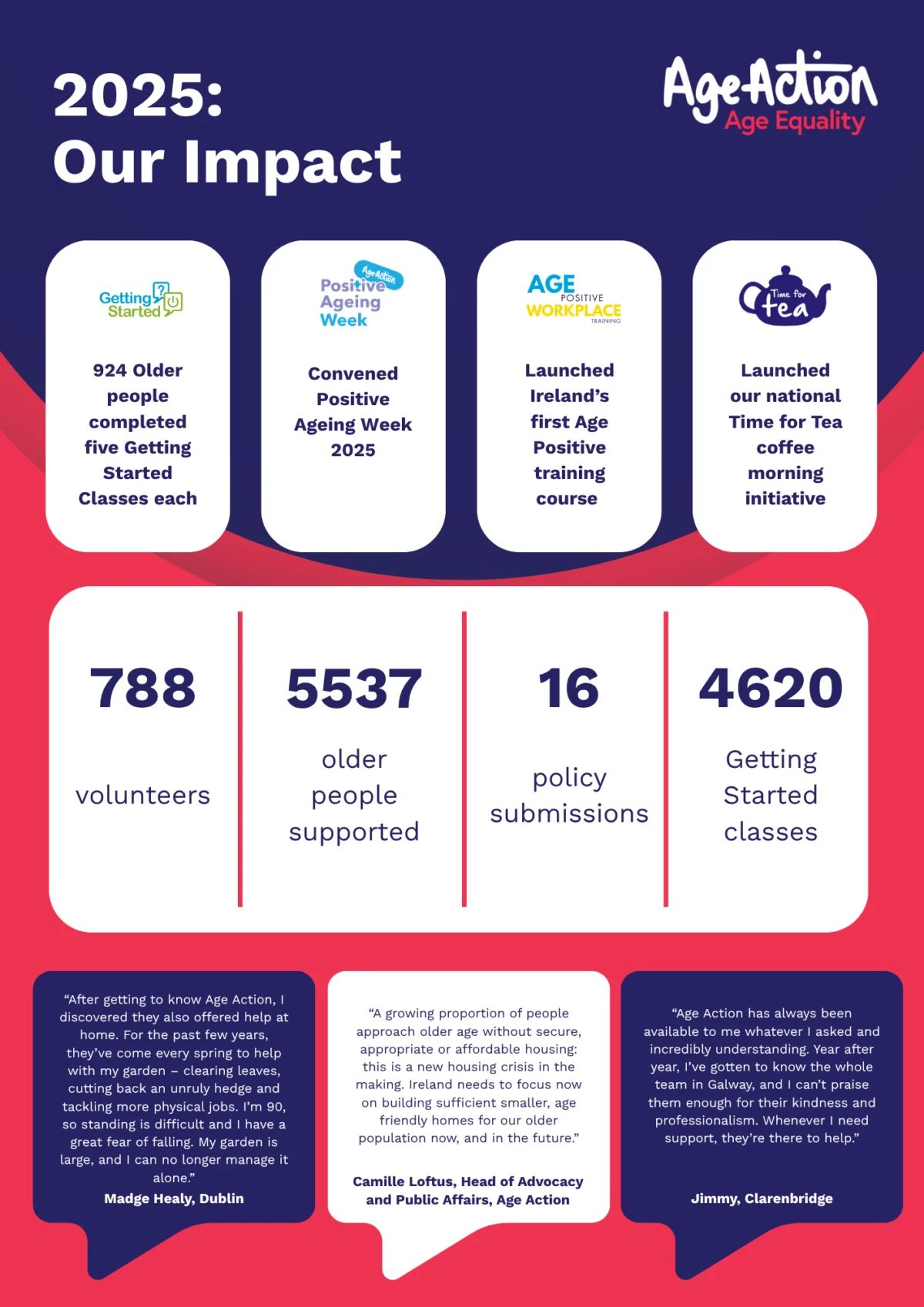
- Q2: Launch of Age Positive Training: In a landmark development, the organization introduced Ireland’s first Age Positive training course. This initiative was designed to combat ageism in the workplace and public services by fostering a deeper understanding of the diverse contributions older people bring to society.
- Q3: The Time for Tea Campaign: The nationwide Time for Tea initiative successfully mobilized local communities, providing a platform to reduce social isolation—a critical factor in the mental health of the elderly.
- Q4: Positive Ageing Week 2025: The year culminated in the highly successful Positive Ageing Week, which saw record participation levels. The event focused on intergenerational dialogue, effectively bridging the gap between younger and older citizens.
Data-Driven Impact and Service Delivery
The effectiveness of Age Action’s 2025 efforts is reflected in the quantitative data presented in the report. By leveraging a vast network of volunteers, the organization was able to scale its operations to reach thousands of individuals who might otherwise have faced significant barriers to essential services.
Internal audit figures suggest that the demand for digital literacy programs surged in 2025, driven by the increasing digitization of essential government services. Age Action responded by scaling its digital skills workshops, ensuring that participants could independently navigate online health portals and banking systems. This is particularly relevant given that the Central Statistics Office (CSO) data continues to show an upward trend in the proportion of the population aged 65 and over, necessitating a proactive approach to technology integration.
Furthermore, the report highlights the efficacy of the "Care and Repair" service model, which provides minor home maintenance to older people. By facilitating these repairs, Age Action has played a role in preventing accidents and facilitating "ageing in place," which remains the preferred and most cost-effective model for the State’s social care infrastructure.

Institutional Perspectives and Stakeholder Commentary
While the report is an internal document, the activities detailed within it have drawn positive recognition from stakeholders in the health and social care sectors. Representatives from community health organizations have noted that the collaborative approach taken by Age Action throughout 2025 has been instrumental in aligning disparate social services.
"The work accomplished this year is a testament to the resilience of our volunteer base and the clarity of our advocacy mission," noted a spokesperson close to the organization. "By centering the voices of older people in our policy submissions, we have forced a shift in the conversation—from treating ageing as a burden to recognizing it as an essential pillar of national development."
The report also highlights the necessity of "listening sessions" held throughout the year, where the direct experiences of service users were documented. These narratives serve as the emotional and moral backbone of the report, illustrating that statistics on "housing security" or "digital inclusion" translate to the lived realities of individuals who require autonomy and respect.
The Broader Impact: Challenges and Future Implications
Despite the successes outlined in the 2025 report, Age Action remains pragmatic about the challenges that persist. The document acknowledges that the structural challenges facing older people in Ireland are deeply ingrained. Income poverty remains a significant concern, particularly with the rising cost of living, which disproportionately affects those on fixed pensions.
Furthermore, the housing crisis has emerged as a critical threat to the security of older tenants. The report calls for urgent, sustained government intervention to protect older renters from eviction and to ensure that housing stock is appropriately retrofitted to meet the needs of an ageing population.
The analysis provided in the report suggests that the "demographic shift" is no longer a future concern but a present reality. The implication for policymakers is clear: current social systems must be redesigned for longevity. This includes everything from the built environment to the way public transport is configured. Age Action’s role in 2025 has been to act as a bridge, ensuring that the needs of older citizens are not ignored as the State grapples with other competing budgetary priorities.
A Call for Continued Collaboration
The conclusion of the report serves as an invitation to stakeholders, including government bodies, private sector partners, and individual citizens, to continue the momentum generated in 2025. The success of the initiatives launched—specifically the Age Positive training and the various community engagement programs—proves that when resources are directed toward inclusive design and support, the societal return is significant.
The organization explicitly acknowledges the role of its staff, whose dedication underpins the operational successes of the year. Furthermore, the report serves as a formal acknowledgment of the volunteers, whose time and labor are the lifeblood of Age Action’s service delivery.

Evaluating the Strategic Roadmap
Looking toward the future, the 2025 report establishes a baseline for what can be achieved through disciplined advocacy and community-based support. The focus on "dignity, security, and equality" is not merely a mission statement but a standard by which the organization measures its progress.
For policymakers, the report provides a blueprint for what a "society for all ages" looks like in practice. By addressing issues like digital exclusion, the organization is not just helping individuals; it is preventing the creation of a permanent underclass of digitally illiterate citizens. By advocating for improved health outcomes, it is reducing the long-term strain on the public hospital system.
The Age Action Annual Report 2025 is more than a summary of activities; it is a call to action. It posits that the true measure of a nation’s development is how it treats its most vulnerable members, including its oldest. As Ireland continues to navigate the complexities of the 21st century, the insights provided in this report will likely prove invaluable for future planning.
For those interested in the granular details of the organization’s financial health, project outcomes, and specific policy recommendations, the full report is available for public review on the Age Action website. The documentation provides a transparent look at how the organization manages its resources to achieve the greatest possible impact for the ageing population.
In summary, 2025 was a year of consolidation and expansion for Age Action. Through the convergence of advocacy, community support, and public education, the organization has solidified its position as the leading voice for older people in Ireland. The lessons learned throughout this year, and the initiatives successfully implemented, provide a robust foundation for the challenges and opportunities that lie ahead. The organization remains committed to its core belief that a society that values its older citizens is a society that is better for everyone, regardless of age.
As the findings of the 2025 report are disseminated, the hope is that they will encourage further dialogue between the State and the third sector. The collaboration between these two entities is essential for creating the policy shifts necessary to sustain an ageing society. With the conclusion of the 2025 cycle, Age Action looks forward to a new period of progress, armed with the evidence and the public support needed to continue its vital work.