
The geography of American civic life is neither monolithic nor uniform. While the broad metrics of participation—such as voting, volunteering, and religious attendance—remain relatively stable across the nation’s diverse landscapes, a granular analysis reveals that where an American lives significantly influences how they manifest their citizenship. A new study by the Pew-Knight Initiative, which synthesized data from over 10,000 U.S. adults surveyed throughout 2025, suggests that the "where" of American life acts as a subtle but powerful filter for political, social, and community engagement.

The study categorizes the American populace into four distinct archetypes based on 19 specific measures of civic participation: Mobilizers, who are highly active across all spheres; Connectors, who focus on community-building and organizational life; Spectators, who primarily consume news; and Outsiders, who maintain the lowest levels of civic involvement. While the distribution of these groups is remarkably consistent across community types, the specific methodologies of engagement diverge sharply between urban centers, suburban tracts, and rural expanses.
The Landscape of Civic Participation
At the core of these findings is the observation that suburban residents are uniquely predisposed to becoming "Connectors." Nearly 34% of suburban adults fall into this category, compared to 30% in rural areas and 23% in urban centers. This demographic leans into the traditional pillars of community life—volunteering, joining local clubs, and contributing to community organizations—while often opting for a lower profile in the more polarized arena of national political action.
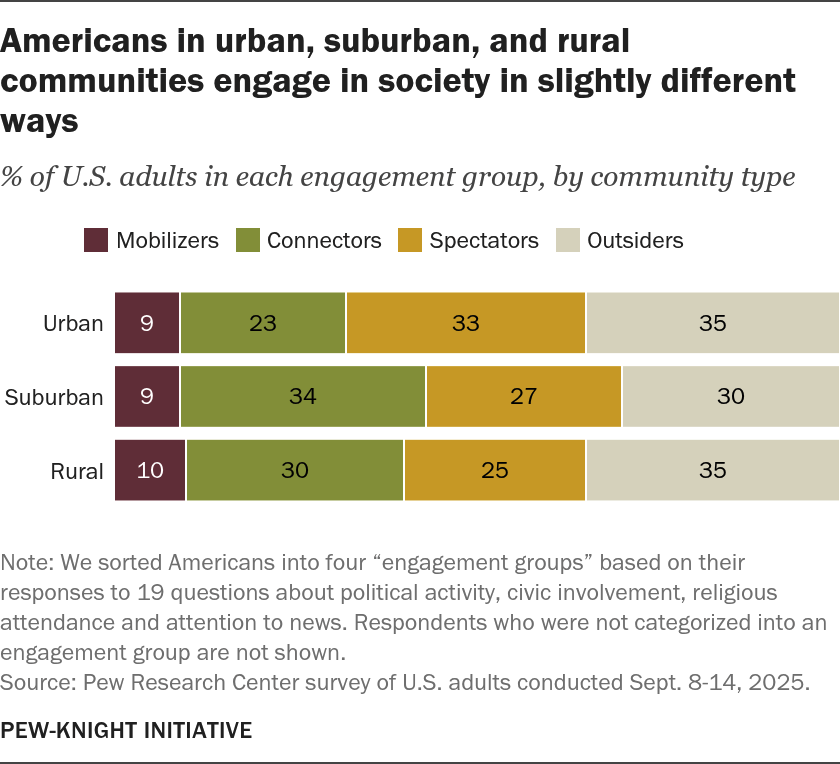
Conversely, urban centers act as a hub for "Spectators." Approximately 33% of urban dwellers are classified as those who prioritize news consumption and awareness over active participation. This cohort remains informed but less likely to engage in direct advocacy or group organization. The "Outsider" demographic, representing those least involved in civic life, remains a constant challenge across all regions, hovering between 30% and 35% regardless of population density.
Chronology and Context: The 2025 Political Climate
The data, collected between September 8 and 14, 2025, offers a snapshot of a nation still processing the fallout of the 2024 presidential election cycle. To understand the behavioral shifts observed in the survey, one must consider the historical context of the period. By late 2025, the national mood was heavily influenced by the aftermath of the "No Kings" protests—a series of demonstrations that erupted following executive actions taken by the Trump administration.

The survey results regarding protest participation are a direct reflection of this timeline. Urban residents, who were more likely to have participated in a march or demonstration in the 12 months prior to the survey, were responding to a political landscape that disproportionately concentrated activists in major metropolitan areas. This geographic concentration of political sentiment—where urban centers often skew toward the Democratic party and rural areas toward the Republican party—creates a distinct divide in the types of political actions taken by citizens.
Divergent Paths of Expression
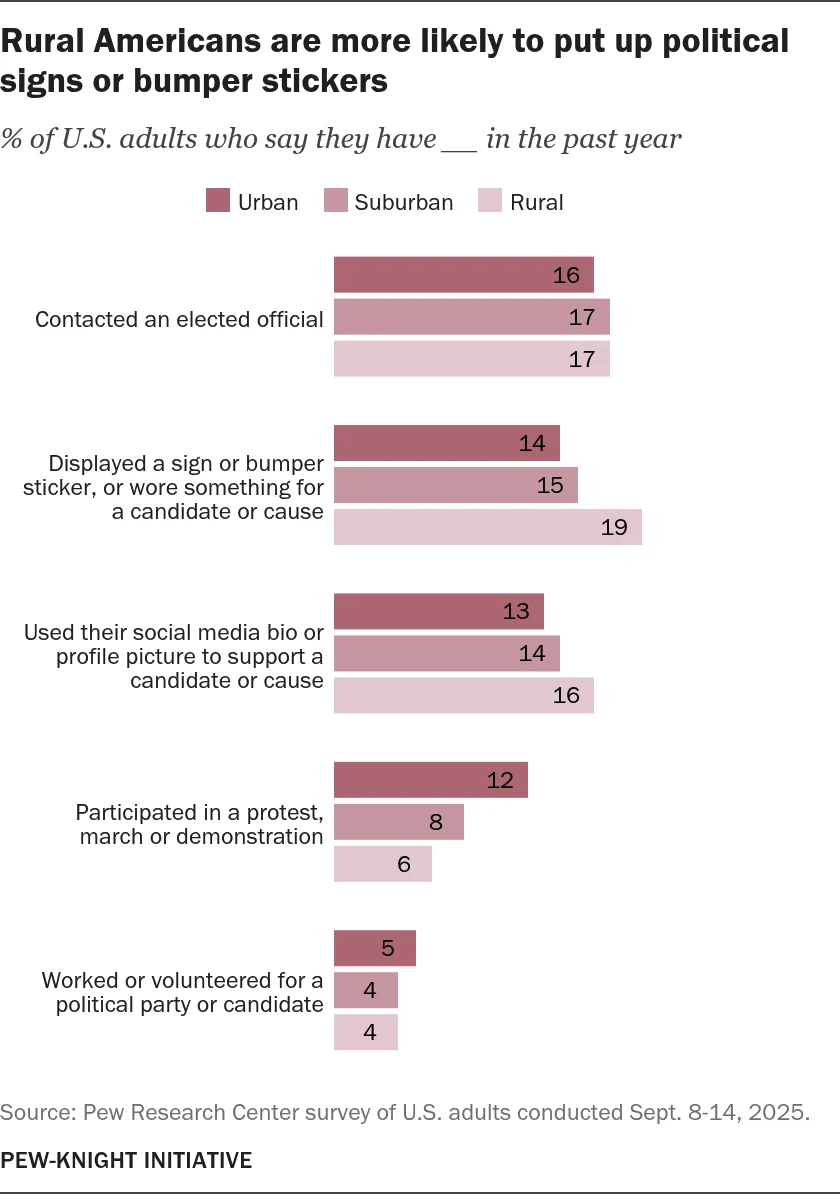
When examining specific political actions, the data reveals a fascinating divergence between the "yard sign" culture of rural America and the "protest" culture of urban centers.

Rural Americans, while equally as likely to contact elected officials as their urban counterparts, are markedly more prone to visible, individualistic forms of political expression. Approximately 19% of rural adults reported displaying a political sign, bumper sticker, or wearing candidate-related apparel in the past year, compared to just 14% of urban residents. This behavior suggests that in less densely populated areas, the individual display of affiliation serves as a primary mode of political signaling, whereas in urban centers, collective action—such as participating in a march—is the preferred, and perhaps more accessible, avenue for civic engagement.
The Role of Community and Faith
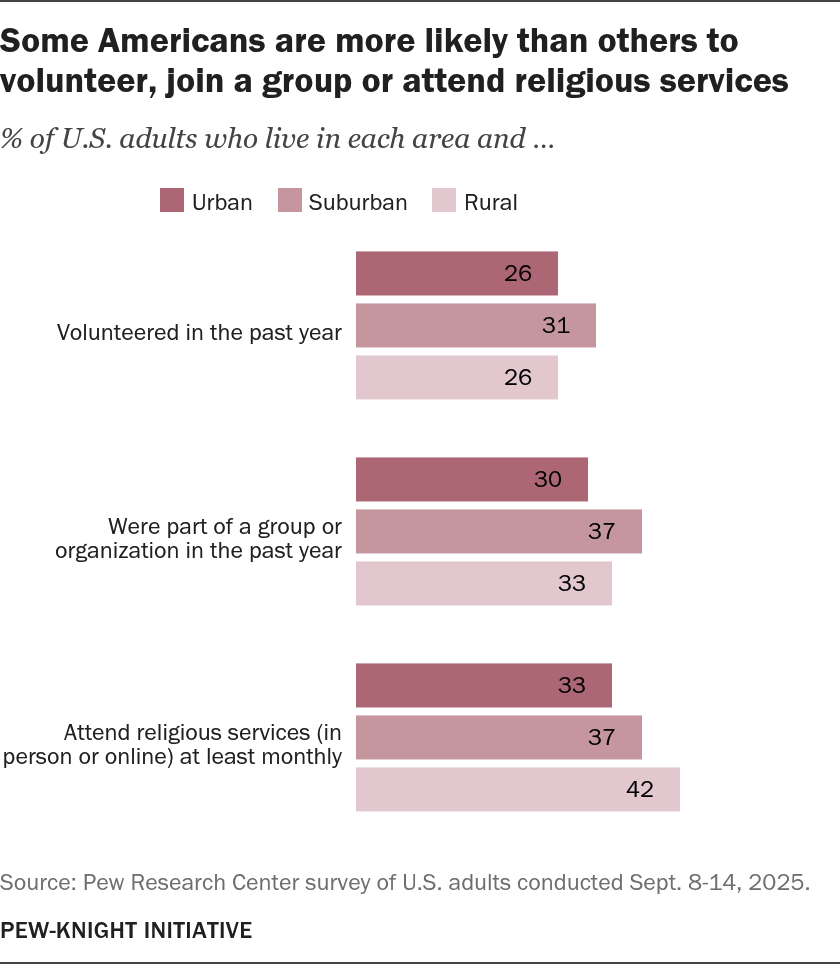
Beyond the political sphere, the social architecture of these communities also varies. Rural Americans exhibit significantly higher levels of religious engagement. With 42% of rural adults attending religious services at least monthly—whether in person or via digital platforms—they outpace both suburban (37%) and urban (33%) residents.

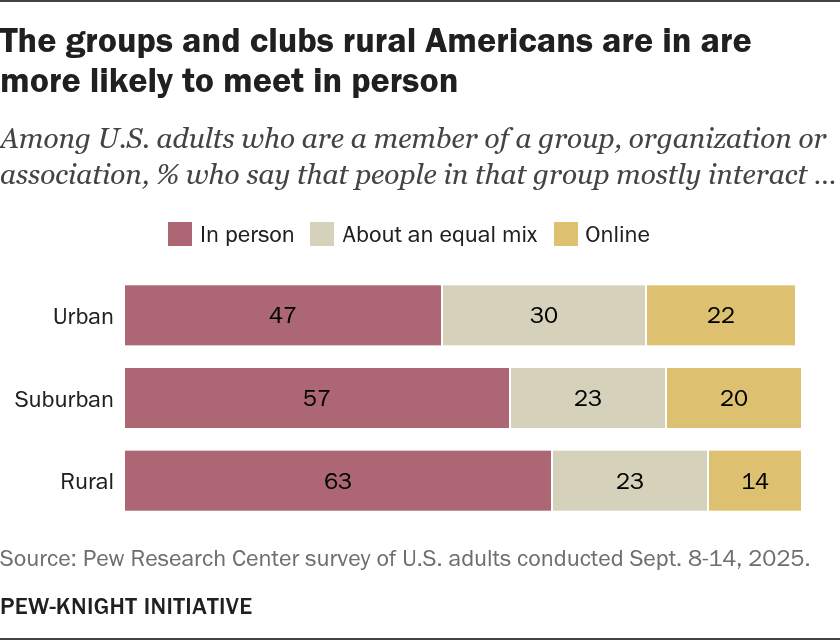
Furthermore, the nature of these groups is shifting. While urban organizations are increasingly moving toward digital-first interactions, with 22% of urbanites saying their group meets mostly online, rural communities remain deeply rooted in face-to-face interaction. A full 63% of rural group members reported that their clubs and organizations interact primarily in person, compared to only 47% of urbanites. This indicates that while technology has shrunk the geographic distance for many Americans, the "local" experience of community remains tethered to physical presence in rural areas, fostering a different quality of social capital.
Institutional Responses and Expert Analysis
The Pew-Knight Initiative, a collaborative project between the Pew Research Center and the Knight Foundation, was designed specifically to bridge the gap in our understanding of how civic information translates into real-world behavior. By moving away from viewing "engagement" as a single metric, researchers are now able to provide policymakers with a clearer picture of why certain outreach efforts succeed in one locale but fail in another.

Political analysts note that the findings highlight a persistent challenge for national campaigns: the "one-size-fits-all" communication strategy. If rural voters are more likely to be influenced by local presence and traditional signage, while urban voters are more responsive to organized, high-visibility digital campaigns or mass protests, parties that fail to adapt their strategies to these geographic realities risk alienating significant portions of their base.
Implications for Future Civic Health
The data does not suggest that geography is destiny. People of all backgrounds, incomes, and political leanings live in all three types of settings, and researchers emphasized that individual characteristics—such as age, socioeconomic status, and education—often remain stronger predictors of behavior than community type. However, the consistent trends identified by the study provide a roadmap for the future of civic education and community development.
As the United States moves further into the second half of the decade, the divide between digital engagement and in-person activity will likely continue to evolve. For institutions seeking to foster a more engaged citizenry, the takeaway is clear: local context matters. Programs designed to increase participation must account for the reality that a rural resident’s "community" is defined by in-person religious and social ties, whereas an urban resident’s engagement is increasingly mediated by digital platforms and issue-based collective action.
The stability of the "Mobilizer" group—the roughly 9% to 10% of the population that is highly active in every facet of civic life—across all regions suggests that there is a core group of Americans whose commitment to democracy is independent of their environment. The challenge for the next decade lies in reaching the "Spectators" and "Outsiders," whose lack of involvement is not necessarily a lack of interest, but perhaps a lack of connection to the specific, locally-relevant forms of engagement that define their communities.
In sum, the American civic experience is a patchwork. Understanding the nuances of this map is essential for anyone interested in the health of the republic. As the country navigates future cycles of political intensity and social change, the ability to adapt to these geographic differences may prove as important as the policies themselves in maintaining a functional, participatory democracy.




