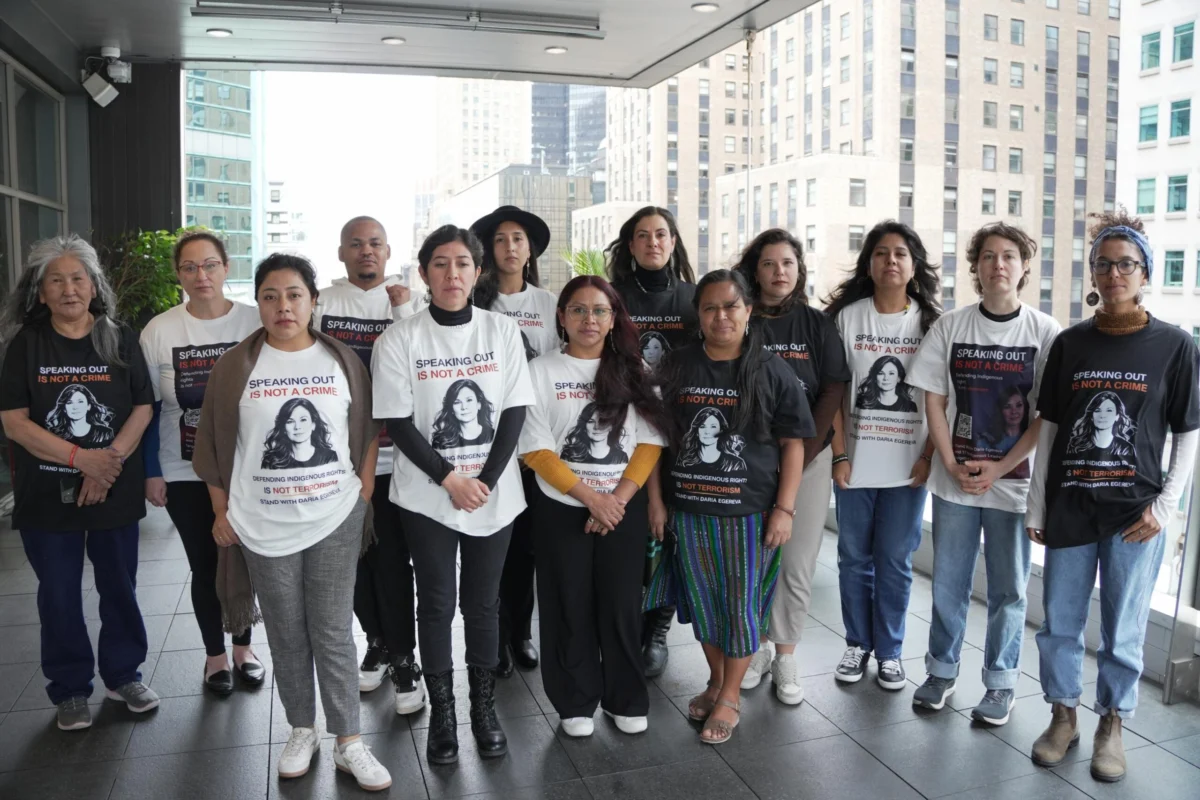
New York, NY – As the United Nations Permanent Forum on Indigenous Issues commenced its proceedings, a powerful chorus of international voices rose in unison, demanding the immediate and unconditional release of Daria Egereva and Natalia Leongardt, Indigenous rights advocates currently detained in Russia. Over 100 human rights and environmental organizations have formally appealed to Russian authorities to drop all charges against the two women, who face severe penalties under Article 205.5 of the Russian Criminal Code, a charge that carries a potential prison sentence of 10 to 20 years for "participating in the activities of a terrorist organization."
The detention of Ms. Egereva, an ethnic Selkup and a respected member of the UN Permanent Forum on Indigenous Issues (UNPFII) and co-chair of the International Indigenous Peoples Forum on Climate Change (IIPFCC), and Ms. Leongardt, a seasoned Russian human rights defender with two decades of dedicated work protecting the rights of Indigenous Peoples of the North, Siberia, and the Far East, has sent shockwaves through the global Indigenous and human rights communities. Their arrest and subsequent charges are seen as a direct assault on the fundamental rights of Indigenous Peoples to express themselves, associate freely, and participate in shaping their own futures and the global agenda.
A United Front: International Appeals for Release
The appeal from over 100 organizations, including prominent entities such as the International Federation for Human Rights, Amnesty International, the Center for International Environmental Law (CIEL), and Greenpeace, underscores the gravity of the situation. Their joint statement not only calls for the immediate release of Egereva and Leongardt but also urges Russian authorities to cease the broader crackdown on Indigenous human rights defenders. Furthermore, the statement implores other nations to "unequivocally condemn the ongoing crackdown on human rights defenders and Indigenous leaders in Russia, and to exert their diplomatic leverage to push for an end to these arbitrary detentions."
Adding further weight to these calls, a separate letter, signed by over 70 Indigenous Peoples’ organizations and their allies, was directly addressed to Russian President Vladimir Putin. This letter implores the Russian President to "uphold its international human rights obligations, including those related to freedom of expression, association, and participation in public affairs." The signatories articulated their deep concern that the detention of Ms. Egereva and Ms. Leongardt "represents a broader threat to the protection of human rights defenders and the ability of Indigenous Peoples to participate in shaping our shared future."
The "Crime" of Being Indigenous: A Growing Pattern of Repression
The arrests come at a time of escalating pressure on Indigenous leaders in Russia. A new report, titled "The Crime of Being Indigenous," released concurrently with the international appeals, meticulously documents a disturbing pattern of repriskerived from 2019 to 2026. This comprehensive study sheds light on the intensified repression and pressure exerted by Russian authorities against leaders of small-numbered Indigenous Peoples of the North, Siberia, and the Far East. The report identifies key tactics employed by the state, highlighting the systematic silencing of voices advocating for Indigenous rights and environmental protection.
The report’s findings are particularly alarming given the precarious situation of many Indigenous communities in Russia. For instance, the Selkup people, to which Daria Egereva belongs, number fewer than 3,500 individuals. Similarly, the Yupik people of Chukotka, represented by rights activist Luda Kinok, number approximately 1,600. These small populations are often at the forefront of defending their ancestral lands and traditional ways of life against resource extraction and environmental degradation.
Voices from the Frontlines: Testimonies of Solidarity and Concern
The urgency of the situation is amplified by the poignant testimonies of Indigenous leaders and human rights advocates. Alicia Moncada, Director of Advocacy and Communications at Cultural Survival, a long-standing Indigenous rights organization, stated, "Daria Egereva was arbitrarily detained for doing exactly what the world asks of Indigenous leaders: engaging peacefully in international forums to defend her people’s future. Her continued detention is a direct attack on Indigenous Peoples’ right to participate in global decision-making. We call on all states to demand her immediate and unconditional release."
Luda Kinok, a Yupik rights activist from Chukotka, shared a deeply personal reflection: "I am Yupik from Chukotka, Russia. There are approximately 1,600 of us left. I know what it means to belong to a people whose continued existence the world has not yet decided to protect. The Selkup people number fewer than 3,500. Daria Egereva spent her life making sure that number was known in the rooms where it might matter. Russia lists endangered species in its Red Book, like the Siberian tiger, and protects them under law, as it should. We ask only for the same coherence: that speaking for a people on the edge of disappearance should not be treated as a crime. I stand with Daria Egereva and Natalia Leongardt. I call for their immediate and unconditional release."
The Center for International Environmental Law (CIEL) also voiced its strong condemnation. Camilla Pollera, a Program Associate at CIEL, remarked, "CIEL joins more than 100 civil society organizations in strongly condemning the arbitrary detention of Indigenous leader Daria Egereva and human rights defender Natalia Leongardt for their peaceful work defending human rights and the environment. Charging them with ‘terrorism’ is not justice – it’s a clear attack on those who stand up for Indigenous rights and climate action. Their work reflects the courage of countless defenders, especially women, who face disproportionate repression for challenging environmental harm and demanding accountability. When defenders are targeted, it undermines the integrity of global climate efforts and sets a dangerous precedent. We call for the immediate and unconditional release of Daria and Natalia with all charges dropped – because there can not be climate justice without human rights."
Context and Implications: A Global Threat to Human Rights and Climate Action
The detention of Daria Egereva and Natalia Leongardt is not an isolated incident but rather symptomatic of a broader trend of shrinking civic space and increased repression against environmental and human rights defenders globally. Russia, in particular, has faced increasing scrutiny for its treatment of activists, journalists, and civil society organizations. The use of broad anti-terrorism legislation to silence dissent is a tactic that has been employed by various states, often with devastating consequences for those targeted.
Daria Egereva’s role within the UNPFII and IIPFCC signifies her importance in international climate and Indigenous rights discourse. Her participation in these forums is crucial for ensuring that the perspectives and rights of Indigenous Peoples are integrated into global policy-making. Her detention effectively silences a vital voice in these critical discussions. Natalia Leongardt’s expertise in supporting Indigenous Peoples of the North, Siberia, and the Far East is also invaluable, given the significant environmental and cultural challenges faced by these communities.
The implications of this situation extend far beyond Russia’s borders. The targeting of Indigenous rights defenders undermines the international framework designed to protect these rights, including the UN Declaration on the Rights of Indigenous Peoples. It also sends a chilling message to other activists who are working to protect the environment and hold corporations and governments accountable for their actions. In the context of the climate crisis, where Indigenous Peoples are often the first and most severely affected, the silencing of their advocates represents a significant setback for global efforts to achieve climate justice and environmental sustainability.
A Call to Action: Diplomatic Leverage and Sustained Advocacy
The coordinated international response highlights a growing awareness of the interconnectedness of human rights, Indigenous rights, and environmental protection. The calls for diplomatic intervention and the exertion of leverage by other states underscore the belief that sustained international pressure can indeed effect change. The solidarity expressed by Indigenous groups and human rights organizations worldwide demonstrates a commitment to ensuring that the voices of Egereva, Leongardt, and all other targeted defenders are heard and amplified.
The coming days and weeks will be crucial in determining the fate of Daria Egereva and Natalia Leongardt. The international community’s continued advocacy, coupled with diplomatic efforts, will be essential in pressing for their release and ensuring that the fundamental rights of Indigenous Peoples to speak freely and advocate for their communities are upheld. The message from over 100 organizations and 70 Indigenous groups is clear and unwavering: "Speaking out is not a crime."
For further media inquiries, please contact Tatiana Shauro, Solidarity Campaign Communications Coordinator, at [email protected]. Updates can be followed on Signal at @tati.61, Telegram at @tatishauro, and the update channel at http://t.me/freedariaegereva. Ms. Shauro is available in the GMT+9 time zone.