A comprehensive new study by the Pew-Knight Initiative has illuminated a significant correlation between an individual’s level of engagement in public life and their understanding of political matters. The research, which analyzed a wide spectrum of American participation in politics, civic activities, news consumption, and religious life, found that those who are most actively involved in these domains tend to demonstrate a stronger grasp of factual political information. Conversely, individuals with lower levels of engagement are more prone to express uncertainty when presented with political knowledge questions.
The findings, drawn from extensive surveys conducted in 2025, highlight how patterns of engagement can be clustered to define distinct groups within the U.S. populace. These "engagement groups" are then analyzed for their demographic characteristics, attitudes, and levels of civic knowledge. The study underscores a key insight: the more involved Americans are in public life, the better equipped they generally are to answer questions about current political affairs, officeholders, and governmental functions.

Methodology and Scope of the Research
The Pew-Knight Initiative’s report is built upon data gathered from two primary national surveys of U.S. adults. The cornerstone of the analysis is the Cross-Sectional Engagement Survey, which was administered from July 9 to December 5, 2025, involving 5,393 participants. To ensure broad representation and account for varying survey response preferences, respondents had the option to participate online, by mail, or by telephone, with multiple follow-ups conducted for those who did not initially respond. Detailed methodological information, including the specific survey questions and response rates, is available through links provided by the Pew Research Center.
Complementing this dataset is data from Wave 179 of the American Trends Panel (ATP), a nationally representative panel of randomly selected U.S. adults. This survey, conducted from September 8 to 14, 2025, included 5,195 respondents who engaged via web and phone.

To categorize Americans into distinct engagement groups, a cluster analysis was performed on the Cross-Sectional Engagement Survey data. This analysis examined responses to 19 measures of participation across the aforementioned domains of public life. Subsequently, respondents from the ATP survey were assigned to these identified groups based on the similarity of their behavioral patterns. The ATP data proved crucial for examining the engagement groups’ levels of civic knowledge and their perspectives on politics and news.
The researchers aimed to provide an integrated picture of public engagement, recognizing that these behaviors are often studied in isolation. They also acknowledged the inherent challenge in surveying individuals who may be less likely to participate in public life, as these same individuals might also be less inclined to participate in surveys. This awareness guided the design of a specially tailored survey to mitigate such biases.
Key Findings: The Knowledge Divide

The study posed four factual questions designed to serve as a proxy for broader political knowledge, covering current political issues, prominent figures, and governmental institutions. These questions, while not exhaustive, are recognized in academic research as reliable indicators of what Americans know about politics.
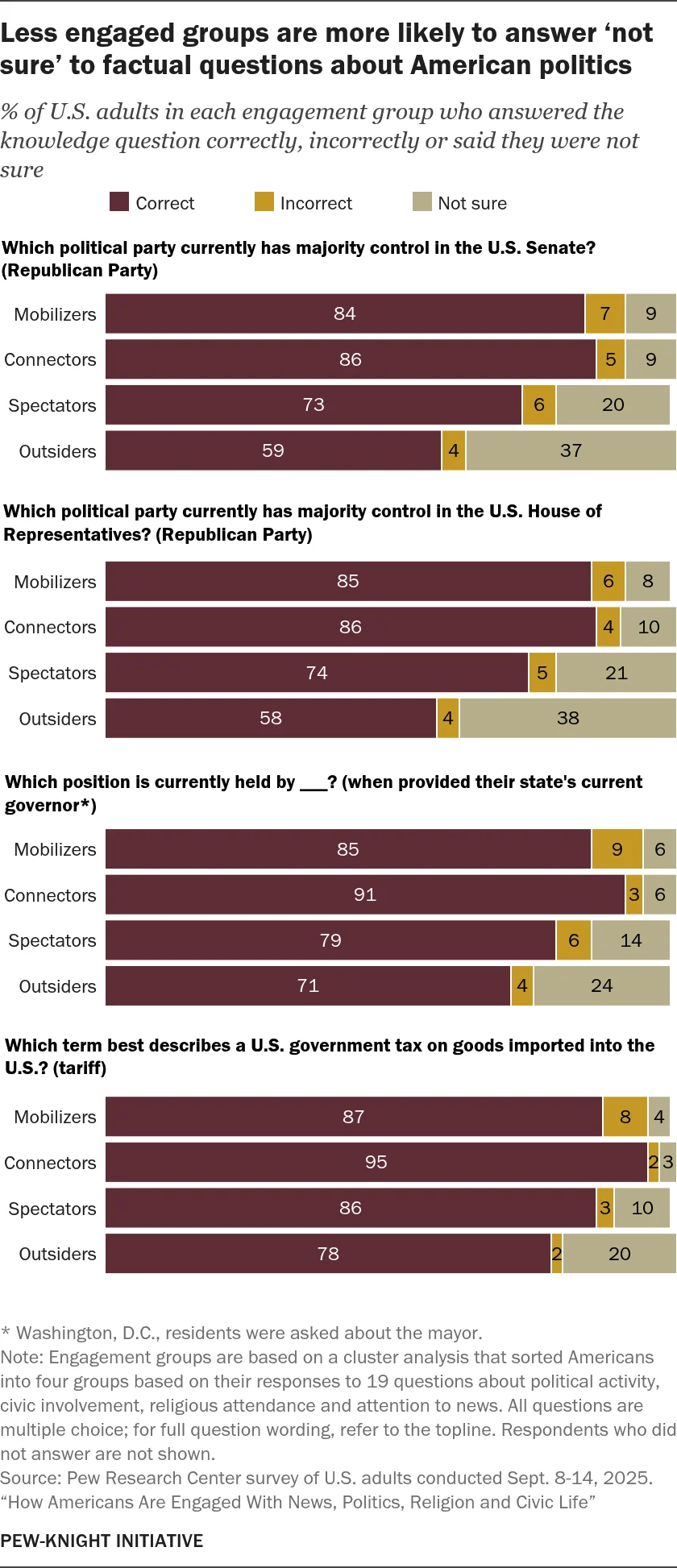
Across the board, most Americans answered these questions correctly. For instance, approximately three-quarters of respondents identified the Republican Party as holding majority control in both the U.S. Senate (73%) and the U.S. House of Representatives (73%). A larger proportion recognized their state’s current governor (80%) and correctly defined a tariff as a tax on imported goods (86%).
However, the study revealed substantial disparities when participants were categorized into the four identified engagement groups: Mobilizers, Connectors, Spectators, and Outsiders.

- Mobilizers and Connectors, representing the most engaged segments of the population, demonstrated the highest rates of correct answers. For example, 84% of Mobilizers and 86% of Connectors correctly identified the party controlling the U.S. Senate.
- Spectators, a group that follows news closely but participates less directly, showed a notable decrease in correct answers, with 73% correctly identifying the Senate’s majority party.
- The Outsiders, comprising the least engaged individuals, exhibited the lowest levels of political knowledge. Only 59% of Outsiders knew which party controlled the U.S. Senate, and 58% identified the party controlling the House. Furthermore, only 71% recognized their state’s governor, and 78% understood the definition of a tariff.
The most striking difference emerged in the "not sure" responses. While incorrect answers remained relatively low across all groups (never exceeding 10% for any question), the tendency to express uncertainty varied dramatically. Half of Outsiders (50%) reported being unsure about at least one of the four knowledge questions. This contrasts sharply with Mobilizers (15%) and Connectors (16%), who were far less likely to express uncertainty. Spectators fell in the middle, with 32% indicating they were unsure on at least one question.
Consequently, only 41% of Outsiders could correctly answer all four political knowledge questions, compared to substantial majorities among Connectors (72%) and Mobilizers (68%).
Defining the Engagement Groups
The Pew-Knight Initiative’s study categorizes Americans into four distinct engagement groups based on their participation across political, civic, religious, and news consumption activities. These groups offer a nuanced understanding of how different segments of the population interact with public life:
-
Mobilizers: This smallest yet most active group excels across all domains. They are deeply involved in political activities, civic engagement, religious participation, and are avid news consumers. They represent the epitome of a highly engaged citizenry.
-
Connectors: While also highly engaged, this larger group exhibits a different pattern. They are actively involved in civic and community life, including joining groups and making donations, but are significantly less focused on direct political participation compared to Mobilizers. Their engagement is broad but leans more towards community and social involvement than overt political action.

-
Spectators: This group is characterized by a high level of news consumption. They closely follow current events and political developments but are less likely to actively participate in political or civic actions such as voting, volunteering, or attending rallies. They are informed observers rather than active participants.
-
Outsiders: This group represents the least engaged segment of the population. They report minimal participation across most activities, including political action, civic involvement, and even news consumption. They are the most likely to feel disconnected from public life.
Factors Influencing Political Knowledge

Beyond direct engagement, the study identified other demographic factors that correlate with political knowledge.
-
Education: A clear pattern emerged showing that individuals with college degrees are more likely to answer all four factual questions correctly, regardless of their engagement group. For example, among Spectators, 67% with a college degree answered all questions correctly, compared to only 46% of Spectators with a high school diploma or less. This suggests that educational attainment plays a significant role in shaping political understanding.
-
Age: Older adults consistently demonstrated higher levels of political knowledge across all engagement groups. Mobilizers aged 50 and older, for instance, had an 83% success rate in answering all four questions correctly, while Mobilizers under 30 scored only 49%. This age-related knowledge gap suggests that accumulated life experience and potentially prolonged exposure to civic and political discourse contribute to greater understanding.

-
Gender: The study also observed a gender gap, particularly in the "not sure" responses. Women were generally more likely than men to indicate uncertainty when faced with political knowledge questions. This aligns with previous research suggesting men are more prone to guessing rather than admitting ignorance. However, this gap narrowed significantly among the most engaged groups. For Mobilizers, the "not sure" rates for men and women were nearly identical (13% vs. 15%). In contrast, among Outsiders, 59% of women expressed uncertainty compared to 38% of men, highlighting how engagement can potentially mitigate gender-based disparities in expressing knowledge.
Implications and Broader Context
The findings of the Pew-Knight Initiative study carry significant implications for understanding civic health and political discourse in the United States. The strong link between engagement and political knowledge suggests that efforts to foster greater civic participation could, in turn, lead to a more informed electorate. A population that possesses a solid understanding of political fundamentals is better equipped to engage in reasoned debate, make informed decisions at the ballot box, and hold elected officials accountable.

The research also highlights the importance of considering diverse pathways to engagement. While "Mobilizers" represent the most active segment, the "Connectors" demonstrate that substantial civic involvement can exist with less emphasis on direct political action. Understanding these different engagement profiles is crucial for designing effective civic education and outreach programs.
The study’s timing, encompassing the lead-up to the 2024 presidential election, provides a relevant snapshot of the American public’s engagement and knowledge during a critical political period. While political activity patterns may shift throughout the electoral cycle, the fundamental relationship between engagement and knowledge is likely to persist.
The Pew-Knight Initiative’s work underscores a critical challenge for American democracy: fostering a more informed and engaged citizenry. By identifying the characteristics of different engagement groups and the factors that influence political knowledge, this research provides valuable insights for policymakers, educators, and organizations working to strengthen civic life. The data suggests that encouraging broader participation in public life may be a key strategy for cultivating a more politically knowledgeable and, by extension, a more resilient democracy.