Driving meaningful change towards a more inclusive and equitable society, within organizations and communities alike, has long been a complex endeavor. Despite significant investments in diversity, equity, and inclusion (DEI) initiatives, many efforts often yield inconsistent results, characterized by incremental progress or even reversals to default behaviors. This persistent challenge has spurred the development of innovative methodologies, among them the Inclusion Nudges approach, which leverages insights from behavioral and social sciences to fundamentally redesign systems, processes, and cultures to make inclusion an inherent norm.
The core premise of Inclusion Nudges addresses a fundamental disconnect: the gap between conscious intentions and unconscious actions. Individuals and organizations often articulate strong commitments to fairness, equality, and diversity, yet their daily behaviors and decisions frequently diverge from these stated values. This discrepancy, rooted in the intricate workings of the human mind, perpetuates systemic exclusion and inequity. Inclusion Nudges offer a strategic pathway to bridge this gap, steering unconscious thought processes and behaviors towards inclusive outcomes without relying solely on rational persuasion or willpower.
The Intention-Action Gap: A Deep-Seated Challenge
For decades, organizations worldwide have grappled with the elusive nature of sustainable DEI progress. While awareness campaigns, anti-discrimination training, and policy mandates are commonplace, their effectiveness in fostering lasting behavioral change has been mixed. Many change agents report a frustrating cycle of moving "three steps forward and one step back," observing a reversion to established patterns despite initial enthusiasm. This experience was particularly salient for the founders of Inclusion Nudges, Lisa Kepinski and Tinna C. Nielsen, during their tenure as internal change-makers within multinational corporations. Confronted with the limited efficacy of conventional approaches across their extensive global networks, they recognized the urgent need for a new solution.
Their quest led them to a multidisciplinary exploration, synthesizing findings from behavioral economics, nudging theory, psychology, anthropology, linguistics, neuroscience, and complex system and microeconomic theory. This integrated perspective revealed that human decision-making is far less rational than commonly assumed, heavily influenced by unconscious cognitive processes. This insight became the cornerstone of the Inclusion Nudges methodology, marking a crucial shift in how inclusion initiatives could achieve impactful, sustained results.
Unveiling the "Absurd Reality" of Unconscious Bias
To illustrate the profound impact of unconscious biases, consider a hypothetical, yet starkly reflective, scenario: a group of senior leaders deliberating over a pool of highly qualified candidates for a key management position. During their discussion, one leader asserts, "The best qualified candidate is undoubtedly the tallest. Tall leaders excel at executing strategy, possess greater presence, and demonstrate superior resilience in challenging times." While consciously, no rational leader would explicitly endorse height as a primary qualification, this scenario highlights an "absurd reality" that frequently plays out through unconscious mechanisms.
Extensive global research consistently demonstrates that physical height disproportionately influences perceptions of leadership capability and career advancement. Data indicates that a significant majority—approximately 60%—of top leaders are 185 cm (6 ft 1 in) or taller, despite this height demographic representing only 14% of the general population. This "height-leadership effect" extends to higher status opportunities, more promotions, and increased incomes for taller individuals. This pattern is not mitigated by local cultural contexts, underscoring its universal, unconscious nature.
The mechanism behind this phenomenon lies in the automatic, instinctive associations our unconscious mind makes. Traits like "tall" become linked with perceived leadership qualities such as "strong," "presence," "powerful," and "capable." Once these unconscious beliefs are activated, the rational mind often seeks evidence to confirm them, inadvertently blinding individuals to the genuine merits of other candidates. This cognitive bias leads to flawed judgments and decisions, often without conscious awareness.
The Dual Systems of the Human Mind
Central to understanding and addressing this intention-action gap is the recognition of two interdependent modes of thinking: the automatic system and the reflective system. Pioneering work in cognitive psychology and behavioral economics, notably by Daniel Kahneman, illuminates these two systems.
- The Automatic System (System 1): This system is characterized by being unconscious, fast, instinctive, effortless, associative, and uncontrolled. It operates like an autopilot, dominating 90-99% of our daily thoughts, choices, and behaviors. It relies on mental shortcuts, such as associations and biases, to quickly process information, make sense of the world, and guide actions, thereby conserving cognitive energy.
- The Reflective System (System 2): In contrast, this system is conscious, slow, effortful, rational, logical, self-aware, rule-following, and controlled. It engages when complex evaluations, deliberate reasoning, or conscious decision-making are required.
While the automatic system is crucial for efficient functioning and survival, its reliance on shortcuts can lead to errors in judgment, particularly when quick associations—like "tall" equating to "strong leader"—override objective facts. In ambiguous, complex, or time-pressured situations, our dependence on these mental shortcuts increases, often at the expense of objectivity and inclusivity. This means that even when individuals consciously know that height is irrelevant to leadership, their unconscious mind might still favor taller candidates.
This inherent cognitive architecture explains why knowledge and willpower alone are insufficient to overcome deeply ingrained biases. The gap between intention and action persists because the unconscious mind, not the conscious one, drives the majority of our decisions. Therefore, designing for inclusion, rather than merely advocating for it, becomes an imperative.

The Emergence of Inclusion Nudges: A Behavioral Science Solution
Inclusion Nudges are a direct response to this understanding of human cognition. Rooted in behavioral economics and nudge theory, which posits that people often do not act in their own or society’s best interest, this approach focuses on subtly altering the "choice architecture" – the environment and processes in which decisions are made. A "nudge" is a non-intrusive intervention that steers individuals towards predictable, desirable behaviors without removing their freedom of choice.
Applied to DEI, Inclusion Nudges combat discrimination, mitigate bias, challenge stereotypes, and foster a sense of belonging by increasing the experience of inclusion, amplifying diverse voices, and encouraging allyship. This approach is particularly critical in an era of increasing cognitive overload, driven by heightened complexity, the echo chambers of social media, and increasingly stressful lives. These factors intensify our reliance on mental shortcuts, paradoxically leading to greater homogeneity and exclusion when collective diversity is most needed. By targeting the unconscious mind with inclusive behavioral design, Inclusion Nudges aim to close the intention-action gap and make inclusive behavior the default.
Three Pillars of Inclusion Nudges: Designing for Change
The Inclusion Nudges change approach manifests through three distinct, yet often interconnected, types of designed interventions:
-
Feel the Need Nudges: Making the Invisible Visible
- Purpose: To motivate the unconscious mind by making hidden issues palpable and creating an emotional impetus for change. Rather than telling people they are biased, these designs show the implications of bias.
- Mechanism: These nudges use data visualization, experiential exercises, or compelling narratives to reveal systemic patterns of exclusion or inequity. For instance, an organization might present data illustrating the absence of gender equality in senior leadership networks by visually calling out the names of numerous men versus a sparse representation of women. This stark visual contrast can evoke a "felt need" for change, overcoming resistance and fostering buy-in for initiatives like sponsorship programs. The impact stems from bypassing rational arguments and directly engaging the unconscious system to register the discrepancy and desire for a more inclusive status quo.
-
Process Design Nudges: Automating Inclusion
- Purpose: To embed inclusive behaviors directly into daily processes, making them automatic and effortless. These designs reduce the negative influence of bias and ensure diverse perspectives are included by default, often without explicitly mentioning "inclusion" or "diversity."
- Mechanism: This involves redesigning collaboration frameworks, decision-making processes, IT systems, or physical environments. A common challenge in groups is the suppression of diverse voices due to conformity pressures or power dynamics. A "Share with a Peer" nudge, where individuals first discuss ideas in pairs before group sharing, can ensure psychological safety, prevent premature conformity, and capture a broader spectrum of perspectives. Other examples include structured interview guides that focus on objective criteria, anonymous feedback mechanisms, or default settings in digital platforms that promote equitable access. These designs empower individuals to act inclusively without conscious effort, transforming culture by making inclusive actions the norm.
-
Frame Perceptions Nudges: Reshaping Understanding
- Purpose: To alter individual and collective perceptions, judgments, and actions by strategically framing issues, communications, or environments. This addresses situations where entrenched perceptions, stereotypes, or narratives hinder inclusion, even when intentions are good.
- Mechanism: These nudges leverage linguistic choices, visual presentation, or contextual alterations to influence how people perceive data, individuals, or situations. For example, to highlight underrepresentation, a "Reverse the Numbers" nudge might reframe statistics. Instead of stating "20% of leaders are women," it could present "80% of leaders are men, leaving many qualified women unseen." This simple rephrasing shifts the focus, making the "hidden people" and the consequences of their exclusion visible, thereby altering perceptions of diversity from a burden to a valuable asset. Other framing techniques include priming specific positive associations, appealing to shared identities, or changing the anchor point of a thought process to shift attention and foster more inclusive evaluations.
Broader Impact and a Global Movement
The application of Inclusion Nudges extends beyond internal organizational change. Its principles are scalable to communities, public policy, and societal structures, offering a powerful methodology for addressing systemic inequities. This approach transforms the role of change agents, making their efforts more impactful and sustainable by engaging "the people it’s about" in co-creating solutions that stick. By integrating behavioral insights into the design of systems, cultures, technologies, policies, and environments, Inclusion Nudges foster inclusive behaviors, interactions, and decision-making at every level.
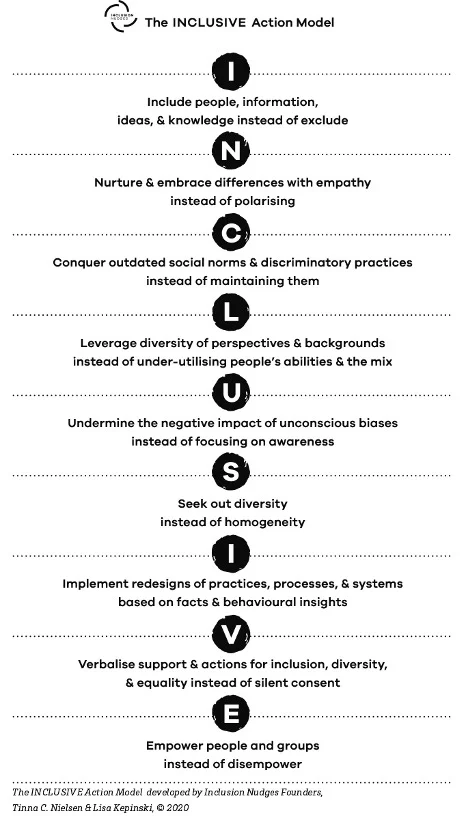
The urgency for such a fundamental shift in how we approach inclusive change has never been greater. Being inclusive in action is challenging, precisely because of the unconscious biases at play. The Inclusion Nudges global initiative, spearheaded by Kepinski and Nielsen, is dedicated to empowering individuals worldwide to apply these designs, aiming to make inclusion the norm everywhere, for everyone. This mission is supported by the "Inclusion Nudges INCLUSIVE Action Model," detailed in their Guidebook and Action Guides, which synthesizes decades of experience in leading change across diverse contexts.
Crucially, the Inclusion Nudges initiative distinguishes itself through its foundational principles of sharing, reciprocity, and open source. Frustrated by the prevalent tendency within the social change sector to discuss "what" works without revealing "how," the founders committed to openly sharing detailed, step-by-step descriptions of effective change designs.
- Sharing: This principle fosters a collaborative ecosystem where change-makers contribute their designs, which are then documented, analyzed for their behavioral insights, and disseminated through guidebooks, articles, and direct support. This collective intelligence accelerates progress and scales impact.
- Reciprocity: Encouraging a two-way exchange, this principle emphasizes that receiving examples and contributing one’s own experiences are equally vital to sustain the movement. It creates a network of mutual support and learning.
- Open Source: Operating under a Creative Commons License, the initiative ensures that knowledge and practical "how-to" designs are freely accessible to all. This democratization of effective tools removes financial and proprietary barriers, enabling a broader spectrum of individuals and organizations—regardless of resources—to implement inclusive behavioral designs.
The Inclusion Nudges movement represents a paradigm shift from conventional, often reactive, DEI efforts to a proactive, scientifically informed approach that redesigns the very fabric of our interactions and decisions. By joining forces and embracing these principles, individuals, teams, and entire societies can move beyond good intentions to create genuinely inclusive environments where diversity thrives and belonging is universally experienced. The collective impact of making inclusion an integrated, effortless part of daily life promises a more equitable and prosperous future for all.