Young adults in the United States are navigating a complex economic landscape, characterized by escalating costs and a competitive job market that are significantly impacting their ability to cover essential expenses. This challenging environment is casting a long shadow over the traditional aspiration of homeownership, pushing it further out of reach for a growing segment of the population. New research from the Pew Research Center underscores this sentiment, revealing that an overwhelming majority of individuals under 40 perceive homeownership as a considerably more difficult endeavor today compared to their parents’ generation.
This comprehensive analysis, drawing on extensive data from the Pew Research Center’s American Trends Panel and government housing and income statistics, paints a stark picture of the widening affordability gap. The findings indicate that while home prices have surged nationwide, the growth in household incomes for young adults has not kept pace, fundamentally altering the price-to-income ratio and rendering the dream of owning a home a distant prospect for many.
The Widening Chasm: Home Prices Outpace Incomes
A cornerstone of home affordability is the relationship between housing prices and household income. The Pew Research Center’s analysis, which tracks this metric over several decades, reveals a significant shift. In 1975, the national median home price was approximately $154,100, while the median household income for those under 40 stood at $62,900, resulting in a price-to-income ratio of 2.5. This meant that, on average, a young adult household could afford a home with about two and a half years of their median income.
This ratio remained relatively stable for several decades, hovering around 2.5 to 3.0 through the late 20th and early 21st centuries. However, the period leading up to and following the 2008 financial crisis saw a slight increase, reaching a peak of 3.6 in 2006 during the housing bubble. Following the crisis, the ratio dipped, offering a brief respite.
The post-2019 era, however, has witnessed a dramatic and concerning trend. Between 2019 and 2024, the national median home price experienced a substantial increase, reaching approximately $350,000. In stark contrast, the median household income for those under 40, while also growing, lagged significantly behind. By 2024, this median income had risen to roughly $100,900, resulting in a price-to-income ratio of 3.5. This marks a significant deterioration in affordability compared to 2019, when the ratio was 2.9. This signifies that young adult households now need approximately three and a half years of their median income to afford a median-priced home, a substantial increase from just five years prior.

The implications of this growing disparity are profound. It suggests that the financial barriers to entry for first-time homebuyers have become substantially higher. This not only delays or prevents homeownership but can also force young adults to allocate a larger portion of their income to rent, further hindering their ability to save for down payments and other home-buying expenses.
Beyond the Price Tag: The Cumulative Impact of Monthly Costs
While the initial purchase price is a major hurdle, the ongoing costs of homeownership also play a critical role in affordability. The Pew Research Center’s analysis incorporates various components of monthly homeownership expenses, including principal and interest payments, property taxes, homeowner’s insurance, and mortgage insurance.
Since 2019, several of these cost factors have seen significant upward pressure. Notably, mortgage interest rates have climbed substantially. According to data from Freddie Mac, the average 30-year fixed mortgage rate rose from 3.9% in 2019 to approximately 6.7% in 2024. This increase alone can dramatically inflate monthly mortgage payments, making homeownership less accessible.
The cumulative effect of these rising monthly costs has led to a significant decrease in the percentage of renter households under 40 who can afford to own a home. In 2019, an estimated 56% of these households possessed sufficient income to cover the monthly expenses associated with homeownership. By 2024, this figure had plummeted to just 37%. This stark decline highlights the growing burden of monthly housing costs, even for those who might manage to overcome the initial down payment obstacle.
The Down Payment Dilemma: A Bridge Too Far for Many
Even before considering monthly payments, prospective homebuyers must contend with the substantial challenge of accumulating a down payment. A 2024 Federal Reserve survey revealed that a significant majority of renters under the age of 40—70%—cited their inability to afford a down payment as the primary reason for renting rather than owning. This figure is particularly telling, as it suggests that the down payment hurdle is perceived as even more significant than the ongoing monthly mortgage obligations.
The escalating home prices have directly translated into larger down payment requirements. While the specific percentages vary based on loan types and individual circumstances, a larger home price inherently necessitates a larger sum of money for a down payment, typically ranging from 3% to 20% of the purchase price. This means that the absolute dollar amount required for a down payment has increased considerably in recent years, making it an increasingly formidable barrier for young adults striving to enter the housing market.

Shifting Perceptions: Homeownership as an Investment
The challenges in affordability are clearly influencing how young adults view homeownership. The Pew Research Center’s survey data reveals a near-unanimous consensus among adults that buying a home is more difficult for young people today than it was for their parents’ generation, with 89% of those under 40 expressing this view.
While most Americans still consider homeownership a sound investment, there are subtle but important differences in the intensity of this belief between age groups. Overall, 67% of adults believe buying a home is a good investment. However, adults under 40 are less likely than their older counterparts to describe it as a very good investment. Specifically, only 24% of adults aged 18-39 hold this strong conviction, compared to 30% of all adults and 38% of those aged 60 and older. This suggests that while the aspirational value of homeownership persists, the perceived return on investment may be tempered by the visible and tangible difficulties in achieving it.
A Localized Crisis: Metro Areas Face Diverse Affordability Challenges
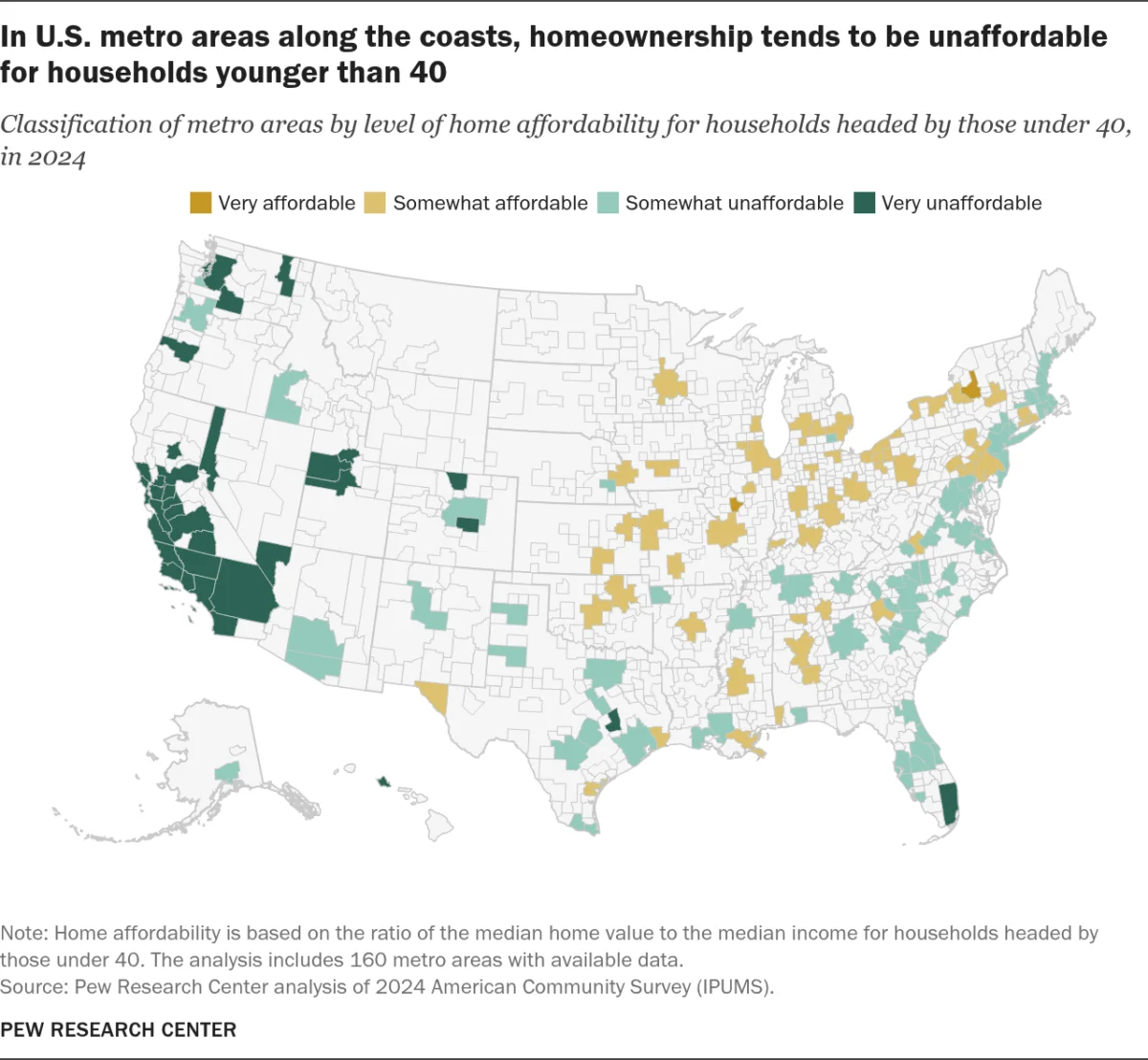
The issue of home affordability is not monolithic; it varies significantly across different metropolitan areas within the United States. The Pew Research Center’s analysis delves into these regional disparities, examining data for 160 metropolitan areas. The findings consistently show that home prices have outpaced young adult incomes in the vast majority of these locations.
Between 2019 and 2024, median home values increased faster than the median income of young adult households in 142 out of the 160 analyzed metropolitan areas. This widespread trend indicates that the affordability crisis is not confined to a few high-cost urban centers but is a pervasive issue across the country.
To categorize the severity of these local challenges, metro areas were classified based on their home price-to-income ratios:
- Very Affordable: Price-to-income ratio of 2.0 or less
- Somewhat Affordable: Price-to-income ratio between 2.1 and 3.0
- Somewhat Unaffordable: Price-to-income ratio between 3.1 and 4.0
- Very Unaffordable: Price-to-income ratio of 4.1 or higher
In 2019, a more balanced landscape existed, with 59% of metro areas falling into the "affordable" categories (very or somewhat affordable) and 41% categorized as "unaffordable" (somewhat or very unaffordable). However, by 2024, this balance had dramatically shifted. Only 39% of metro areas remained in the affordable categories, while a significant 61% were classified as unaffordable for young adult households. This reversal underscores the worsening affordability conditions across a broad spectrum of U.S. cities.

Coastal Metros and Beyond: The Geographic Divide
The data reveals a pronounced geographic divide in home affordability. Metro areas located along the U.S. coasts, particularly in California and Hawaii, consistently exhibit the highest levels of unaffordability. In 2024, all metro areas in California, Hawaii, Nevada, and Utah with available data were classified as very unaffordable for households headed by those under 40.
The list of the 10 least affordable metro areas in 2024 is dominated by California cities, with Santa Maria-Santa Barbara topping the list with a price-to-income ratio of 9.6. Other highly unaffordable California metros include San Luis Obispo-Paso Robles (9.2), Chico (8.9), Salinas (8.0), Los Angeles-Long Beach-Anaheim (7.5), Merced (7.4), Oxnard-Thousand Oaks-Ventura (7.1), San Diego-Chula Vista-Carlsbad (7.0), and Santa Rosa-Petaluma (6.5). Urban Honolulu, Hawaii, also features prominently on this list with a ratio of 8.7.
In stark contrast, the most affordable metro areas are predominantly found in the Midwest and Northeast. The 10 most affordable metros in 2024 were located in New York, Illinois, Missouri, Ohio, and Pennsylvania. Springfield, Illinois, led this group with the lowest price-to-income ratio of 2.3, followed by Utica-Rome, New York (2.4), and a cluster of Ohio and Pennsylvania cities including Canton-Massillon, Cleveland, Pittsburgh, and Youngstown-Warren, all demonstrating ratios below 3.0.
This geographical disparity has significant implications for internal migration patterns and economic opportunity. Young adults in more affordable regions may find it easier to achieve homeownership, potentially creating a talent drain from less affordable areas and exacerbating regional economic inequalities.
Methodology and Data Sources
The Pew Research Center’s analysis for this report relies on a robust methodology, combining survey data with extensive government statistics. The public opinion data comes from a survey of 10,091 U.S. adults conducted from May 4-17, 2026, as part of the Pew Research Center’s American Trends Panel.
For the analysis of home prices and incomes, the study utilized data from the U.S. Census Bureau’s American Community Survey (ACS) and the Current Population Survey (CPS) Annual Social and Economic Supplement (ASEC). Specifically, the Owner-Occupied Real Estate OFHEO Purchases Only Price Index was used to measure changes in median home prices. Household incomes were adjusted for size and scaled to reflect a three-person household, drawing from IPUMS CPS microdata files. Inflation adjustments were made using the Consumer Price Index for All Urban Consumers (CPI-U) less shelter.

The analysis of monthly homeownership costs draws upon research from Harvard’s Joint Center for Housing Studies. The metro-level analysis of home values and young adult incomes is also based on ACS data, with exclusions for homeowners living in mobile homes, boats, tents, or vans. Microdata files from IPUMS USA were used for this component.
The research acknowledges the impact of the COVID-19 pandemic on data collection in 2020 and 2021, noting that the Census Bureau employed entropy balance weights to adjust the ASEC data for this period. The detailed survey questions, topline responses, and methodology for this analysis are publicly available through links provided by the Pew Research Center.
Conclusion: A Persistent Challenge Requiring Multifaceted Solutions
The findings from the Pew Research Center paint a clear and compelling picture: the dream of homeownership, a cornerstone of the American Dream for generations, is becoming increasingly unattainable for young adults in the United States. The confluence of rapidly escalating home prices, stagnant wage growth for younger demographics, and rising mortgage interest rates has created a perfect storm of unaffordability. This situation is not merely an economic inconvenience; it has profound implications for wealth accumulation, generational equity, and the overall stability of communities.
The data underscores the localized nature of this crisis, with significant variations in affordability across different metropolitan areas. While some regions offer pockets of relative affordability, many others, particularly coastal areas, present formidable, almost insurmountable, barriers for aspiring homeowners.
Addressing this complex challenge will require a multifaceted approach involving policymakers, industry stakeholders, and communities. Potential solutions could include initiatives to increase housing supply, particularly affordable housing options, measures to stabilize or reduce mortgage interest rates, reforms to down payment assistance programs, and policies aimed at boosting wage growth for younger workers. Without concerted and comprehensive action, the widening affordability gap threatens to further entrench economic inequality and dim the prospects of homeownership for an entire generation.