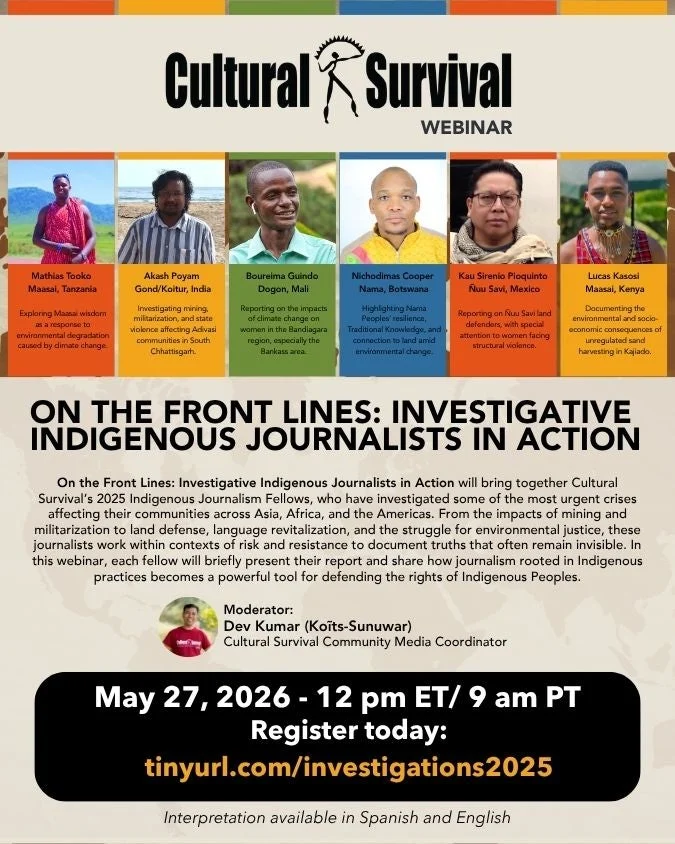
The Fellowship for Indigenous Journalists, an initiative dedicated to amplifying Indigenous voices and strengthening journalistic practices within Indigenous communities, has announced an upcoming webinar scheduled for Wednesday, May 27, 2026. The virtual event, which will commence at 1:48 PM Eastern Time, aims to provide valuable insights and resources for journalists working to cover Indigenous issues with accuracy, sensitivity, and impact. While specific topics were not detailed in the initial announcement, the timing and the organization hosting the event strongly suggest a focus on enhancing reporting on Indigenous rights, cultural preservation, self-determination, and the challenges faced by Indigenous Peoples globally.
Background and Context
The Fellowship for Indigenous Journalists operates under the broader umbrella of Cultural Survival, a renowned non-governmental organization established in 1972. Cultural Survival’s enduring mission is to advocate for Indigenous Peoples’ rights and support their self-determination, cultures, and political resilience. Their vision extends to a future where Indigenous Peoples’ inherent rights and dynamic cultures are respected and honored, deeply interwoven into their lands, languages, spiritual traditions, and artistic expressions, all rooted in self-governance. This webinar, therefore, is a natural extension of Cultural Survival’s long-standing commitment to empowering Indigenous communities and ensuring their narratives are accurately and effectively communicated to a wider audience.
The landscape of Indigenous journalism is one of both immense potential and significant challenges. Indigenous journalists often operate in under-resourced environments, facing pressures to cover complex issues with limited access to training, technology, and established journalistic networks. Furthermore, the legacy of colonial narratives and pervasive stereotypes can create barriers to accurate and nuanced reporting. Initiatives like the Fellowship for Indigenous Journalists are crucial in addressing these gaps, fostering a new generation of storytellers who can bring authentic perspectives to light.
Anticipated Focus and Content
Given the stated mission and vision of Cultural Survival, the upcoming webinar is likely to delve into critical areas relevant to Indigenous journalists. Potential themes could include:
- Ethical Reporting on Indigenous Issues: This might cover best practices for engaging with Indigenous communities, obtaining informed consent, respecting cultural protocols, and avoiding harmful stereotypes. The webinar could also address the historical context of media representation of Indigenous Peoples and strategies for decolonizing journalistic narratives.
- Covering Indigenous Rights and Activism: With Indigenous Peoples worldwide actively defending their lands, resources, and cultural heritage, journalists play a vital role in documenting these struggles and advocating for justice. The webinar could provide insights into reporting on land rights, environmental justice, human rights abuses, and the legal frameworks surrounding Indigenous sovereignty.
- The Role of Indigenous Languages in Journalism: The revitalization and preservation of Indigenous languages are central to cultural survival. This could be a key topic, exploring how Indigenous journalists can incorporate their languages into their work, promote linguistic diversity, and reach audiences in their native tongues.
- Technological Tools and Digital Storytelling: In an increasingly digital world, equipping journalists with the latest tools for multimedia storytelling, data journalism, and secure communication is essential. The webinar might offer practical advice on leveraging technology to enhance reporting and reach broader audiences.
- Building Networks and Professional Development: Connecting Indigenous journalists with mentors, peers, and established media organizations can foster professional growth and collaboration. The webinar could serve as a platform for networking and sharing experiences.
The Importance of Indigenous Journalism
The work of Indigenous journalists is paramount in challenging dominant narratives and providing essential counter-perspectives. For decades, mainstream media coverage of Indigenous Peoples has often been characterized by a lack of depth, perpetuation of stereotypes, and an absence of Indigenous voices. This has contributed to widespread misunderstanding and misinformation about the diverse realities, rights, and contributions of Indigenous communities.
Data from various reports highlight the persistent underrepresentation of Indigenous perspectives in media. For instance, studies on media representation have consistently shown that Indigenous individuals are often portrayed in stereotypical or marginalized roles, if they are represented at all. This lack of accurate and nuanced coverage can have significant real-world consequences, influencing public opinion, policy decisions, and the overall well-being of Indigenous communities.

Indigenous journalists, by their very existence and work, are actively reshaping this landscape. They bring lived experiences, cultural understanding, and linguistic fluency that are indispensable for accurate and impactful storytelling. Their reporting can shed light on issues that are often overlooked or misrepresented by external media, such as the impacts of resource extraction, the challenges of implementing self-governance, and the resilience of Indigenous traditions in the face of globalization.
Cultural Survival’s Role and Impact
Cultural Survival has a long and distinguished history of supporting Indigenous Peoples. Since its inception in 1972, the organization has been at the forefront of advocating for Indigenous rights, providing grants to grassroots Indigenous organizations, supporting Indigenous media and cultural initiatives, and engaging in policy advocacy at national and international levels. The Fellowship for Indigenous Journalists is a testament to their evolving strategies to empower Indigenous communities through communication and storytelling.
The organization’s "Our Mission" statement succinctly captures its enduring purpose: "Cultural Survival advocates for Indigenous Peoples’ rights and supports Indigenous communities’ self-determination, cultures and political resilience, since 1972." Their "Our Vision" further articulates their aspirational goals: "Cultural Survival envisions a future that respects and honors Indigenous Peoples’ inherent rights and dynamic cultures, deeply and richly interwoven in lands, languages, spiritual traditions, and artistic expression, rooted in self-determination and self-governance." The webinar aligns perfectly with these core tenets, providing a practical avenue for advancing these objectives.
Broader Implications and Future Outlook
The success of such webinars can have a ripple effect, empowering individual journalists and strengthening the broader ecosystem of Indigenous media. As Indigenous journalists become more equipped with skills, knowledge, and networks, their ability to produce high-quality, impactful journalism increases. This, in turn, can lead to:
- Increased Public Awareness and Understanding: More accurate and compelling reporting can foster greater empathy and understanding of Indigenous issues among the general public, potentially leading to more informed civic engagement and policy support.
- Empowerment of Indigenous Communities: By giving Indigenous communities a platform to share their own stories and perspectives, these initiatives contribute to their self-determination and cultural revitalization.
- Accountability and Justice: Investigative journalism by Indigenous reporters can hold governments, corporations, and other powerful entities accountable for their actions, particularly concerning land rights, environmental impacts, and human rights.
- Preservation of Cultural Heritage: Journalism that highlights Indigenous languages, traditions, and worldviews plays a crucial role in documenting and preserving this invaluable cultural heritage for future generations.
The announcement of this webinar by the Fellowship for Indigenous Journalists underscores a growing recognition of the critical role Indigenous media plays in global discourse. As the world grapples with complex issues ranging from climate change and resource management to social justice and human rights, the authentic voices and informed perspectives of Indigenous journalists are more vital than ever. The commitment of organizations like Cultural Survival to nurturing these voices promises a future where Indigenous narratives are not only heard but also understood and respected on their own terms.
The call to "Stay Informed" through signing up for updates from Cultural Survival highlights the organization’s dedication to continuous engagement and support for its network. This webinar is likely just one of many initiatives aimed at building capacity and fostering solidarity within the Indigenous journalism community. The date, May 27, 2026, is set, and the journalistic community, particularly those focused on Indigenous issues, will be eagerly anticipating the specific details of this valuable learning opportunity. The provided image, identified as "Fellowship Journalist Webinar," and the YouTube link (though not directly accessible or specified as the webinar content itself) suggest a multimedia component or a reference point for related discussions, further indicating a comprehensive approach to the event.