The bedrock principle of birthright citizenship in the United States, enshrined in the 14th Amendment, is facing an unprecedented legal challenge that could redefine American nationality. The Supreme Court is poised to consider a case that questions whether an executive order can curtail the long-standing interpretation of the amendment, which grants U.S. citizenship automatically to virtually all individuals born on American soil. This pivotal legal battle centers on the authority of the President to unilaterally alter a constitutional guarantee that has shaped the nation’s demographic and social fabric for over a century.
The Constitutional Foundation and Its Interpretation
The 14th Amendment to the U.S. Constitution, ratified in 1868 in the aftermath of the Civil War, states unequivocally: "[a]ll persons born or naturalized in the United States, and subject to the jurisdiction thereof, are citizens of the United States and of the State wherein they reside." This broad and inclusive language was intended to ensure full citizenship rights for newly freed slaves. However, its interpretation has evolved over time, particularly concerning the children of non-citizens.
For decades, the prevailing legal understanding, solidified by the Supreme Court’s landmark decision in United States v. Wong Kim Ark (1898), has affirmed that individuals born in the U.S. are citizens, irrespective of their parents’ immigration status. The exceptions have traditionally been narrowly defined, primarily including children of foreign diplomats, members of occupying foreign military forces, and, historically, certain Native American tribes. Congress later extended birthright citizenship to Native Americans through statute in 1924. This established jurisprudence has created a predictable and stable framework for citizenship for generations of Americans.
The Challenge to Birthright Citizenship
The current legal challenge emerges from a potential executive action proposed by former President Donald Trump, aiming to restrict birthright citizenship to children born in the U.S. to parents who are either U.S. citizens or legal permanent residents. This proposed policy, if enacted and upheld by the courts, would represent a significant departure from established legal precedent. The Supreme Court’s willingness to hear a case on this matter signals the gravity of the issue and the potential for a reevaluation of constitutional interpretation.
The debate over birthright citizenship has intensified in recent years, fueled by differing perspectives on immigration, national sovereignty, and the interpretation of constitutional law. Proponents of restricting birthright citizenship often argue that it incentivizes illegal immigration and that birth on U.S. soil should not automatically confer citizenship if the parents have not followed legal immigration pathways. Conversely, advocates for maintaining the current system emphasize the constitutional mandate, the historical understanding of the 14th Amendment, and the potential for creating a stateless or marginalized population within the country.
A Global Perspective on Birthright Citizenship
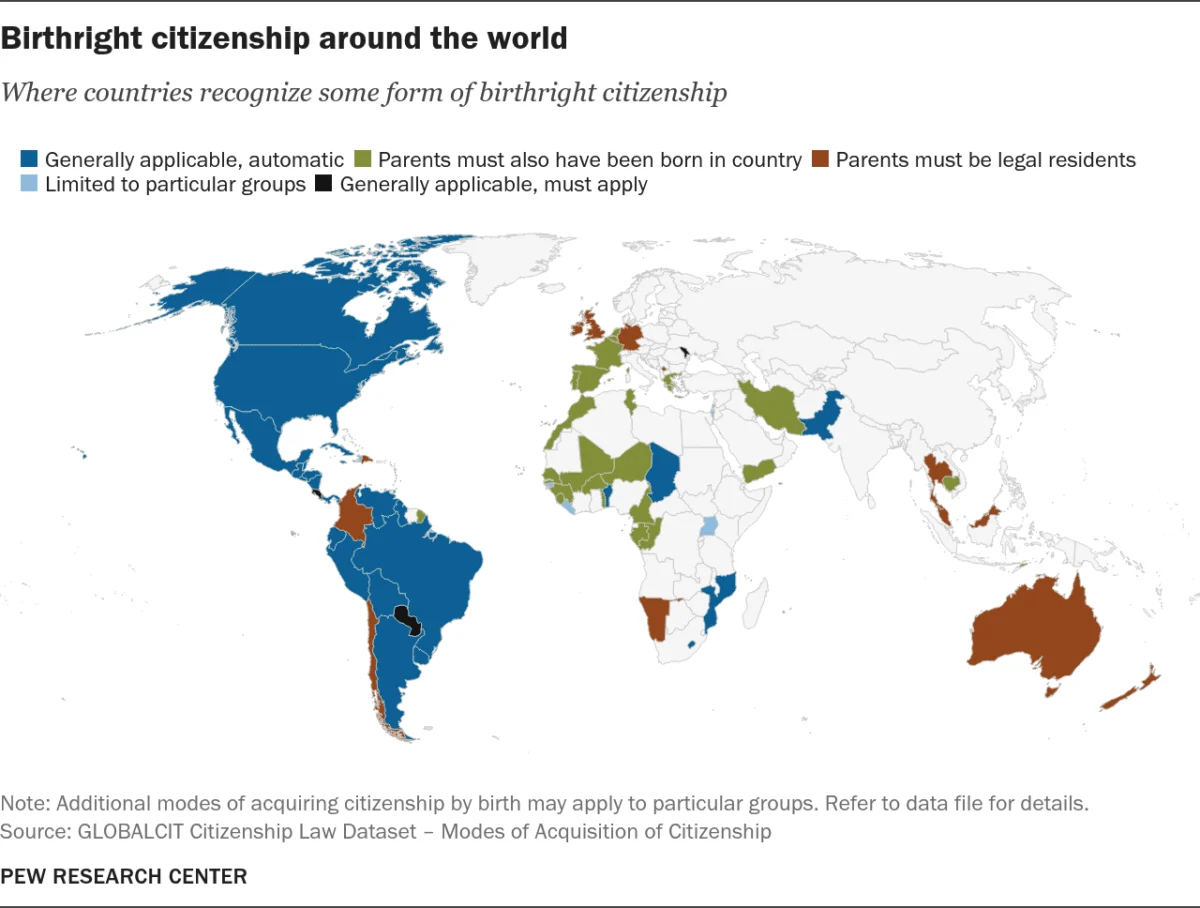
The Pew Research Center, in an analysis that provides crucial international context, has examined birthright citizenship laws across the globe. This research highlights that the U.S. model, where citizenship is largely determined by place of birth (jus soli) regardless of parental status, is not universally replicated.
According to the Pew analysis, which draws on data from the Global Citizenship Observatory (GCO), a research project at the European University Institute’s Robert Schuman Centre for Advanced Studies, 156 out of 191 countries primarily grant citizenship based on descent (jus sanguinis), meaning a child’s citizenship is determined by that of their parents.
However, a significant number of countries do incorporate elements of birthright citizenship. In 59 countries, at least some individuals can become citizens simply by being born there. Of these, 52 countries grant citizenship automatically. The remaining countries require parents to apply for their children’s citizenship, with varying degrees of administrative discretion.
The U.S.-style, broadly applicable birthright citizenship is notably less common than other forms. The Pew analysis identifies 33 countries, including the U.S., where birthright citizenship is automatic and generally applicable without regard to the parents’ legal status. This places the United States in a distinct category alongside many nations in the Western Hemisphere, which tend to have more expansive birthright citizenship laws.

Furthermore, the research details more limited variations of birthright citizenship found in approximately 50 other countries. These often include restrictions based on parental residency status, gender, or membership in particular ethnic, racial, or religious groups. For instance, 17 of the 59 countries with birthright citizenship do not extend it automatically to children of non-citizen parents unless those parents are legally residing in the country. Six countries limit birthright citizenship to specific demographic groups.
Another category identified is "second-generation" birthright citizenship, where a child born in the country must also have one or both parents who were born there, even if those parents are not citizens. Twenty-six countries fall into this category, with nearly half of them imposing further restrictions based on parental residency, gender, or group affiliation.
Historical Context and Precedents
The legal framework surrounding birthright citizenship in the U.S. has been shaped by key historical moments and judicial interpretations. The 14th Amendment itself was a radical departure from previous citizenship norms, which were largely based on descent and property ownership. Its ratification was a direct response to the need to secure the rights of formerly enslaved people.
The Wong Kim Ark decision in 1898 is the cornerstone of modern birthright citizenship jurisprudence. In this case, the Supreme Court affirmed that a child born in the United States to Chinese parents who were legal residents, though not citizens, was a U.S. citizen by birth. The Court’s reasoning was rooted in its interpretation of the 14th Amendment’s Citizenship Clause, emphasizing that "all persons born or naturalized in the United States" includes individuals born on U.S. soil, subject to its jurisdiction, regardless of their parents’ nationality or legal status. The Court famously stated that the principle of birthright citizenship was a long-standing common law tradition inherited from England and deeply embedded in American legal history.
This interpretation has largely held sway, though debates and legal challenges have periodically surfaced. During periods of increased immigration or heightened national security concerns, proposals to limit birthright citizenship have emerged, but none have successfully overturned the established precedent.
The Implications of a Potential Shift
A Supreme Court ruling that allows an executive order to redefine birthright citizenship would have profound and far-reaching consequences.
Legal Ramifications:
- Constitutional Interpretation: Such a ruling could signal a shift in how the Supreme Court approaches the interpretation of constitutional amendments, particularly those related to fundamental rights. It might empower the executive branch to alter established constitutional guarantees through executive action, a move that could be seen as a significant expansion of presidential power.
- Citizenship Status: Millions of individuals currently considered U.S. citizens by birth could face uncertainty regarding their status. This could lead to complex legal battles over citizenship claims, documentation, and rights.
- The "Undocumented" Population: A curtailment of birthright citizenship would likely expand the population of individuals born in the U.S. but without citizenship, potentially creating a large, permanent underclass with limited rights and opportunities.
Social and Economic Impacts:
- Family Separation: Families could be divided by citizenship status, with children born in the U.S. holding different rights and legal standing than their parents. This could create immense social disruption and strain family structures.
- Economic Contributions: Individuals without citizenship status often face significant barriers to employment, education, and economic advancement, potentially impacting their ability to contribute to the economy and society.
- Social Cohesion: A divided citizenry based on birthright could erode social cohesion and exacerbate existing societal tensions. The integration of immigrants and their descendants has been a key component of American social development, and altering this process could have unforeseen consequences.
International Relations:
- Global Norms: A move away from broad birthright citizenship in the U.S. could influence other countries’ approaches to citizenship law and potentially weaken the international norm of birthright citizenship.
- Human Rights: International human rights organizations and advocates might raise concerns about the potential creation of stateless populations or individuals denied fundamental rights based on their parents’ status.
Official Responses and Public Sentiment
The debate surrounding birthright citizenship is highly polarized. While former President Trump and his supporters have advocated for its restriction, citing national security and immigration control, a broad coalition of legal scholars, civil rights organizations, and many politicians have defended the current interpretation of the 14th Amendment.
The Biden administration, while not directly involved in the specific case at the Supreme Court’s current stage, has generally upheld the existing legal framework. However, the political landscape is fluid, and any definitive Supreme Court ruling would undoubtedly trigger significant political reactions and policy responses.
Public opinion on birthright citizenship is also divided. Polling data often shows a partisan split, with Republicans generally more supportive of restricting birthright citizenship and Democrats more inclined to preserve it. This division reflects the broader ideological and political disagreements surrounding immigration policy in the United States.
The Road Ahead
As the Supreme Court prepares to hear arguments in this critical case, the nation watches with anticipation. The outcome will not only hinge on legal interpretation but also on the broader societal implications of citizenship and belonging in the United States. The decision will reverberate through legal, social, and political spheres, potentially reshaping the very definition of what it means to be an American. The historical weight of the 14th Amendment, the precedent set by Wong Kim Ark, and the global context of citizenship laws all converge in this pivotal moment, making the Supreme Court’s deliberation on birthright citizenship one of the most significant legal and social junctures in recent American history.