
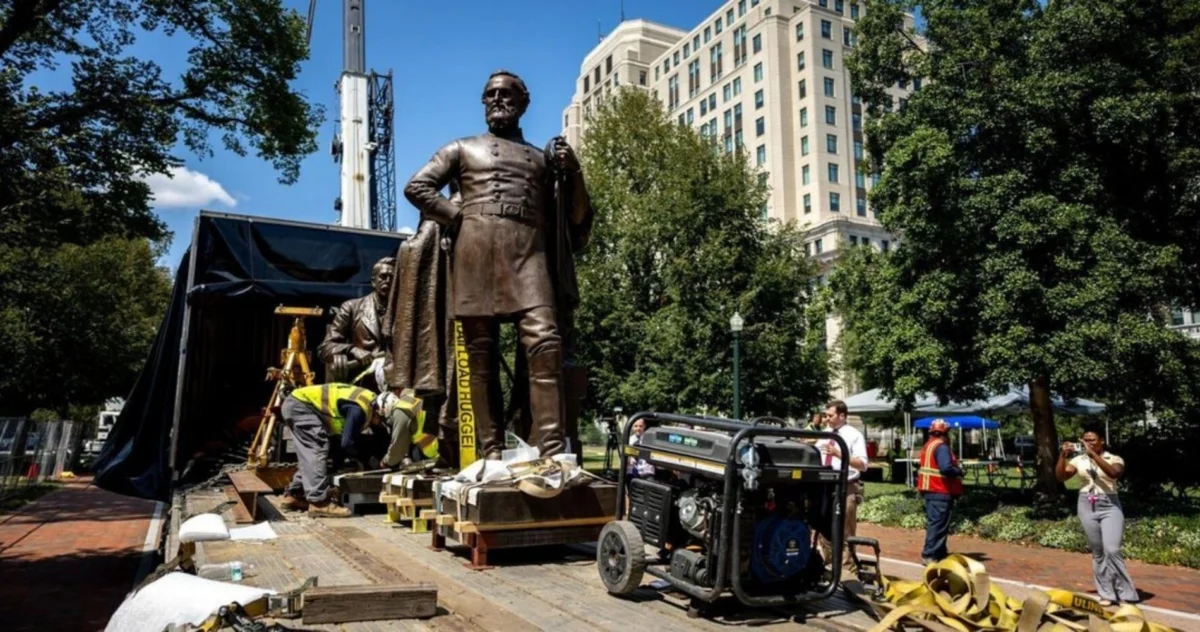
On Friday, the Commonwealth of Virginia completed the removal of three remaining Confederate monuments from Capitol Square, a landmark civic campus and public park surrounding the state Capitol in Richmond. This action, mandated by legislation passed earlier this year, signifies a definitive shift in the state’s approach to public iconography. As a result, the Commonwealth no longer maintains or publicly displays any monuments dedicated to the Confederate States of America on state-owned property, closing a chapter of historical contention that has defined the Virginia landscape for over a century.
The removal of these statues—including a prominent likeness of Stonewall Jackson—follows a concerted, multi-year effort by state and local officials to address the legacy of racial injustice and the role of public monuments in shaping historical memory. For decades, the presence of these figures at the seat of Virginia’s government served as a focal point for debates regarding the state’s role in the Civil War and the subsequent efforts to uphold white supremacy during the Jim Crow era.
The Historical Genesis of Confederate Iconography
To understand the significance of Friday’s events, one must examine the timeline of when these monuments were erected. Contrary to the popular belief that they were immediate post-war memorials, the vast majority of Confederate statues in Virginia and across the South were commissioned and installed in two distinct waves: the turn of the 20th century and the mid-1950s to 1960s.
The initial wave, occurring between 1890 and 1920, coincided with the era of Jim Crow laws, which systematically disenfranchised African Americans and codified segregation. Historians and organizations such as the Equal Justice Initiative (EJI) have documented that these monuments were intentionally placed to reassert a racial hierarchy. By romanticizing the Confederate cause—often reframing the defense of slavery as a noble pursuit of "states’ rights"—proponents of these statues sought to reshape the narrative of the Civil War to serve a post-reconstruction political agenda.
The second surge of monument installation occurred during the Civil Rights Movement. As federal courts and legislatures moved toward integration, segregationist groups utilized Confederate imagery to signal resistance to federal authority. By framing the Confederacy as a symbol of cultural heritage, these organizations effectively weaponized public space to oppose the advancement of racial equality, a practice that sustained the influence of these symbols well into the 21st century.
A Chronology of Removal and Reckoning
The removal of statues from Capitol Square is the culmination of a decade of intense public pressure and legislative action. The following timeline highlights the key inflection points in this transformation:
- July 2020: In a decisive move at the state level, House Speaker Eileen Filler-Corn ordered the removal of a life-sized statue of Robert E. Lee and seven other Confederate busts from the Virginia Capitol building. This move established a precedent for the state’s executive and legislative branches to curate public spaces more inclusively.
- August 2020: Richmond, the former capital of the Confederacy, began the systematic removal of city-owned monuments along the historic Monument Avenue. This was prompted by weeks of civil unrest and protests in the wake of the murder of George Floyd, which accelerated public demands to address symbols of racial terror.
- July 2021: The City of Charlottesville removed two high-profile statues of Robert E. Lee and Thomas "Stonewall" Jackson. These statues had been the epicenter of the 2017 "Unite the Right" rally, where a peaceful counterprotester was killed, thrusting the debate over Confederate iconography into the national spotlight.
- December 2022: Richmond officially removed its final city-owned Confederate statue, the A.P. Hill monument. At the time, then-Mayor Levar Stoney characterized the effort as "a hundred years of difficult work," noting that Richmond had held the largest concentration of such monuments in the United States.
- Early 2026: Governor Abigail Spanberger signed landmark legislation that, among other provisions, removed tax-exempt benefits previously enjoyed by groups that supported the maintenance of Confederate memorials. This legislation set the stage for the final removal of the Capitol Square statues.
The Legislative and Economic Shift
The recent removal is not merely a symbolic gesture; it is supported by a comprehensive legislative framework. Governor Spanberger’s recent signature on a bill to overhaul the state’s tax code effectively ended the long-standing carve-outs that had financially supported groups like the United Daughters of the Confederacy since the 1950s.
These groups were instrumental in the mid-century push to install Confederate monuments, often in direct response to the Supreme Court’s Brown v. Board of Education decision. By stripping these organizations of their historical tax advantages, the Commonwealth has essentially signaled a departure from state-sponsored validation of pro-Confederate narratives.
Broader Implications and National Contrast
The decision to remove these monuments stands in sharp contrast to current national trends. While Virginia moves toward a more critical examination of its past, other regions of the country have seen efforts to preserve or reinstall Confederate monuments. Furthermore, the federal government has faced criticism for historical policies that named military bases after Confederate leaders, as well as more recent efforts by some national political actors to push for the protection or restoration of Confederate statues on public lands.
Sociologists note that the removal of these monuments fundamentally alters the "civic landscape." For many, the monuments represented a state-sanctioned endorsement of white supremacy, making public spaces feel exclusionary to the Black community. By removing them, the state is attempting to reconcile its public image with its modern demographic reality, moving from a culture of romanticized revisionism toward a more rigorous, fact-based historical narrative.
"Virginia has a story to tell that extends far beyond the Confederacy," Speaker Filler-Corn remarked during the initial stages of this process. The sentiment remains central to the state’s ongoing efforts. The challenge moving forward for the Commonwealth will be how it chooses to utilize the now-vacant spaces. Proposals range from installing memorials dedicated to civil rights leaders to creating educational installations that provide historical context regarding the Civil War and the subsequent era of segregation.
Conclusion: Turning the Page
The removal of the final three statues from Capitol Square concludes a cycle of policy reform that has been decades in the making. As Virginia moves forward, the absence of these statues serves as a silent testament to a state that is actively choosing to prioritize a more inclusive definition of its history.
The legacy of the Confederacy in Virginia was never static; it was a contested narrative maintained by intentional civic choices. The recent actions taken by the state government suggest that the Commonwealth has, at least in its physical presence, decided to "turn the page," as former Mayor Stoney suggested. While the debate over the history of the South will undoubtedly continue in academic and public forums, the removal of these monuments ensures that the state’s most prominent civic campus will no longer serve as a stage for the glorification of a cause built upon the preservation of slavery.
As historians look back at this era, the removal of these statues will likely be viewed as a pivotal moment in the American effort to address the structural and cultural remnants of racial inequality. Whether this shift will influence broader national discourse remains to be seen, but for Virginia, the physical transformation of Capitol Square is complete.




