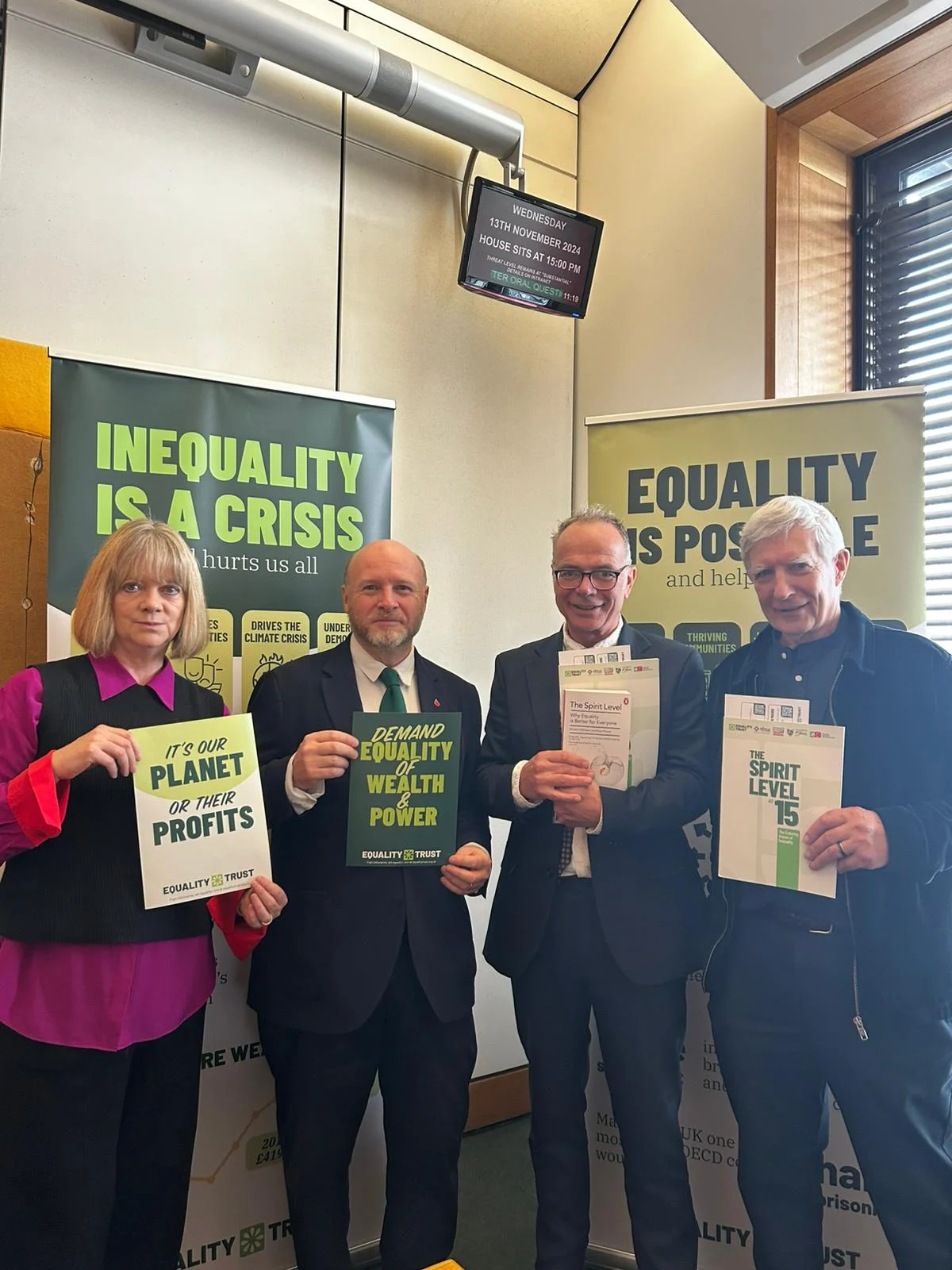
The Equality Trust has issued a formal response to the government’s 2025 budget, expressing profound concern that the fiscal measures outlined by the Chancellor will entrench existing disparities and continue to destabilize the social fabric of the United Kingdom. In a detailed critique released shortly after the budget announcement on November 26, 2025, the advocacy group argued that the government’s financial roadmap prioritizes the interests of the ultra-wealthy and major corporations over the urgent needs of the general public. The organization warned that by failing to implement progressive wealth taxes, the administration is allowing an "inequality of wealth" to transform into a permanent "inequality of power," further eroding public trust in democratic institutions.
Priya Sahni-Nicholas, Co-Executive Director of the Equality Trust, characterized the budget as a victory for the country’s most affluent sectors. She noted that the sources of the UK’s ongoing economic crises—specifically the super-rich, oil and gas conglomerates, major banks, and energy firms—would find the budget favorable. According to Sahni-Nicholas, the Chancellor intentionally chose to shield these entities from public demands for greater fiscal responsibility, opting instead to place the burden of national recovery on middle- and lower-income households. The Trust emphasized that while options were available to tax wealth, income derived from assets, and environmental polluters, the government instead chose to implement billions in tax hikes that affect the broader population.
The Socio-Economic Context of the 2025 Budget
The 2025 budget arrived at a critical juncture for the British economy. Following years of stagnant wage growth, high inflation, and a deteriorating public infrastructure, the Treasury was under significant pressure to find new revenue streams to fund the National Health Service (NHS), education, and social care. Leading up to the announcement, various economic think tanks and advocacy groups had proposed a series of "wealth taxes" aimed at the top 1% of earners, whose fortunes have seen significant growth even during periods of national economic downturn.
According to data from the Office for National Statistics (ONS) and independent researchers, the gap between the wealthiest households and the rest of the population has widened consistently over the last decade. The wealthiest 10% of households in the UK currently hold approximately 43% of the nation’s total wealth, while the bottom 50% hold less than 5%. This concentration of resources has led to calls for a fundamental restructuring of the tax system—a move that the Equality Trust argues was conspicuously absent from the Chancellor’s latest proposals.
Chronology of Fiscal Developments Leading to the Reaction
The trajectory toward the 2025 budget was marked by several key economic milestones and policy debates that set the stage for the Equality Trust’s critical stance:
- Early 2025: Rising Pressure for Reform: Throughout the first quarter of the year, social justice organizations and various academic bodies presented evidence to the Treasury suggesting that a modest 1% to 2% tax on assets exceeding £10 million could generate billions in annual revenue without impacting the vast majority of citizens.
- Summer 2025: Corporate Profit Reports: Mid-year financial reports from major energy companies and banks showed record-breaking profits, driven in part by high interest rates and global energy price volatility. This intensified the public debate regarding "windfall taxes" and corporate accountability.
- October 2025: The Pre-Budget Report: Speculation grew that the government might reform Capital Gains Tax (CGT) or Inheritance Tax (IHT) to align them more closely with income tax rates. However, leaks from Whitehall suggested a "cautious" approach aimed at maintaining "market stability."
- November 26, 2025: The Budget Announcement: The Chancellor delivered the budget in the House of Commons, confirming significant increases in indirect taxation and the freezing of income tax thresholds (fiscal drag), while leaving the primary mechanisms of wealth accumulation largely untouched.
- Post-Announcement (Current): The Equality Trust and other civil society groups issued immediate rebuttals, highlighting the discrepancy between the tax burden placed on labor versus the tax burden placed on capital.
Supporting Data on UK Wealth Inequality
The Equality Trust’s concerns are rooted in a growing body of statistical evidence regarding the UK’s economic health. Research indicates that the UK remains one of the most unequal countries in the developed world. The Gini coefficient, a standard measure of income inequality where 0 represents perfect equality and 100 represents perfect inequality, has remained stubbornly high in the UK compared to its European neighbors.
Furthermore, the "cost of living crisis" that began in 2022 has had a disproportionate impact on the lowest deciles of the population. While inflation has stabilized compared to its 2023 peaks, the price of essential goods—food, rent, and energy—remains significantly higher than pre-pandemic levels. The Equality Trust points out that while the average worker’s real wages have barely moved in fifteen years, the total wealth of UK billionaires has increased by over 1,000% since 1990.
The budget’s reliance on "fiscal drag"—the process where inflation pushes taxpayers into higher tax brackets because thresholds are not adjusted—is estimated to pull millions of low-to-middle earners into higher tax liabilities. The Equality Trust argues that this is a "stealth tax" that lacks the transparency of a direct wealth tax and unfairly targets those who rely on a monthly salary rather than dividends or capital appreciation.
Reactions from Related Parties and Stakeholders
The Equality Trust’s reaction reflects a broader sentiment shared by various sectors of civil society, though the budget received a warmer welcome from business interest groups.
- The Confederation of British Industry (CBI): While expressing some concern over certain regulatory costs, the CBI generally praised the budget for providing "certainty" and "stability" for investors, arguing that avoiding major wealth taxes prevents capital flight.
- The Institute for Fiscal Studies (IFS): The IFS provided a more neutral but sobering analysis, noting that the budget would likely result in the highest tax-to-GDP ratio in the post-war era, yet much of this revenue would be consumed by debt interest and the rising costs of an aging population, rather than transformative public investment.
- Opposition Parties: Leaders of the opposition echoed the Equality Trust’s sentiments, accusing the government of "protecting their friends in the City" while asking "working people to pay the bill for economic mismanagement."
- Environmental Groups: Organizations such as Greenpeace criticized the lack of significant new taxes on fossil fuel extractors, arguing that the budget missed a "once-in-a-generation opportunity" to fund the green transition through polluter-pays mechanisms.
Analysis of Implications: The "Inequality of Power"
A central theme in the Equality Trust’s critique is the concept of the "inequality of power." This refers to the idea that extreme concentrations of wealth do not merely result in different standards of living but allow a small elite to exert disproportionate influence over the political process, media narratives, and economic policy.
When the government chooses to protect the assets of the super-rich while increasing the tax burden on the general public, it risks creating a "participation gap." Economic historians have long argued that high levels of inequality lead to social instability and a decline in civic engagement. If the public perceives the "system" as being rigged in favor of a wealthy few, the legitimacy of democratic institutions is called into question.
The Equality Trust warns that this budget will likely exacerbate the sense of "pay more and get less." As public services—such as the NHS, police, and local councils—continue to face funding shortfalls despite higher taxes on the average citizen, the social contract is weakened. The Trust argues that this environment is ripe for political polarization and the rise of populist movements that capitalize on genuine economic grievances.
Broader Impact and Long-term Economic Outlook
The decision to forego wealth taxes in favor of broad-based tax hikes may have several long-term consequences for the UK economy. Economists who favor wealth redistribution argue that high inequality acts as a drag on economic growth. When wealth is concentrated at the top, it is often held in passive assets or moved offshore. Conversely, when income is distributed more equitably, it tends to be spent in the local economy, driving demand and supporting small businesses.
The 2025 budget’s focus on protecting "wealth creators"—a term often used by the Treasury—is viewed by critics as a continuation of "trickle-down" economics, a theory that has faced increasing scrutiny from global institutions like the International Monetary Fund (IMF) and the OECD. These organizations have recently suggested that reducing inequality is not just a moral imperative but a prerequisite for sustainable, long-term economic stability.
As the UK moves into 2026, the repercussions of this budget will become clearer. If the Equality Trust’s predictions hold true, the UK may see a continued decline in social mobility, where a person’s life chances are determined more by their inherited wealth than by their talent or hard work. The organization’s call for a system that taxes "wealth and income from wealth" remains a central pillar of their advocacy, as they seek to shift the national conversation toward a more equitable distribution of the country’s resources.
Conclusion and Future Outlook
The Equality Trust has signaled that it will continue to monitor the impact of the 2025 budget on the UK’s Gini coefficient and other measures of social well-being. By providing a platform for the "public’s demands," the Trust aims to keep the issue of wealth taxation at the forefront of the political agenda.
The organization’s concluding remarks serve as a warning to policymakers: a society where "billionaires rake in obscene profits" while the general population struggles to maintain its standard of living is a society at risk. The 2025 budget, in the eyes of the Equality Trust, was a missed opportunity to reset the UK’s economic course. Instead of building a "more equal society," the government has opted for a path that may lead to further fragmentation and a continued loss of faith in the nation’s economic and political systems.