The landscape of British social policy underwent a significant evaluation on January 13, 2026, as Priya Sahni-Nicholas, Co-Executive Director of The Equality Trust, addressed a Public Policy Exchange forum to scrutinize the government’s recently unveiled Child Poverty Strategy. Titled "Tackling Child Poverty: Improving Welfare, Security and Future Prospects," the strategy represents the first comprehensive, UK-wide effort to address juvenile deprivation since the pre-2010 era. While the analysis presented by Sahni-Nicholas acknowledged a "welcome shift" in the governmental understanding of the causes of poverty, it simultaneously highlighted a critical disconnect between poverty reduction efforts and the broader issue of systemic wealth inequality.
The briefing provided at the event emphasized that while the new strategy successfully targets the immediate symptoms of financial hardship through redistributive income measures, it fails to confront the underlying economic structures that allow poverty to persist. This critique comes at a pivotal moment for the United Kingdom, where child poverty rates have diverged sharply from other advanced European economies over the past decade and a half.
A Statistical Overview of the UK Poverty Crisis
To understand the urgency behind the 2026 strategy, one must examine the statistical trajectory of the United Kingdom since 2010. While many comparable economies saw a decline in child poverty during the mid-2010s and early 2020s, the UK experienced a consistent upward trend. By the start of 2025, official figures indicated that 4.5 million children—approximately one in three—were living in poverty.
The depth of this crisis is further illustrated by food security metrics. Nearly 20% of UK children currently reside in households that cannot consistently secure adequate nutrition. This level of deprivation has been framed by the current administration as a systemic failure inherited from nearly fifteen years of policy choices that prioritized fiscal consolidation over social safety nets. The Child Poverty Strategy aims to reverse this trend, stating an explicit goal to end child poverty in the long term while achieving measurable reductions within the current parliamentary term.
Chronology of UK Child Poverty Policy (1997–2026)
The evolution of the UK’s approach to child poverty can be divided into three distinct phases. Between 1997 and 2010, the previous Labour government implemented a series of tax credits, benefit increases, and expanded public services that successfully lifted approximately 600,000 children out of poverty. This era demonstrated that direct income redistribution is a potent tool for rapid poverty reduction.
The second phase, spanning from 2010 to 2024, was characterized by "austerity" measures. Policies such as the benefit cap and the controversial two-child limit were introduced, which critics argue were primary drivers of the current crisis. During this period, child poverty transitioned from being a marginal issue to a mainstream economic reality for millions of working families.
The third and current phase began in December 2025 with the release of the new Child Poverty Strategy. This document explicitly frames poverty as a moral and economic failure rather than a result of individual character flaws. By January 2026, the discussion had moved toward implementation and critique, with the Public Policy Exchange event serving as a primary venue for expert analysis.

Key Policy Interventions: The "Wins" of the 2026 Strategy
The Equality Trust’s analysis identified several areas where the government’s new approach represents a significant improvement over previous decades. The most impactful of these is the abolition of the two-child limit. Estimates suggest that this single policy change will lift roughly 450,000 children out of relative poverty, addressing a mechanism that disproportionately penalized larger families and minority communities.
Furthermore, the strategy broadens the scope of "who gets to reimagine" policy. By integrating the voices of organizations like Changing Realities—parents with direct experience of the benefits system—the government has moved toward a model of "dignity-based" policy making. This approach acknowledges the "mental load" and stigma associated with poverty, treating claimants as stakeholders rather than passive recipients.
Other notable interventions include:
- Expansion of Universal Services: The introduction of breakfast clubs, free school meals expansion, and caps on school uniform costs targets the "poverty premium"—the higher costs faced by low-income families for essentials.
- Focus on In-Work Poverty: The strategy recognizes that employment is no longer a guaranteed escape from poverty. Measures to increase the National Living Wage and reduce childcare barriers address the reality of low pay and insecure work.
- Spatial and Intersectional Lens: Acknowledging that poverty is not evenly distributed, the strategy emphasizes place-based approaches that account for regional disparities and the compounding effects of disability and ethnicity.
The Wealth Gap: The Omitted Variable in Poverty Reduction
Despite the strengths of the income-focused measures, Sahni-Nicholas argued that the strategy contains a glaring omission: the role of accumulated wealth. In the entirety of the government’s diagnosis and proposed metrics, the word "wealth" is conspicuously absent.
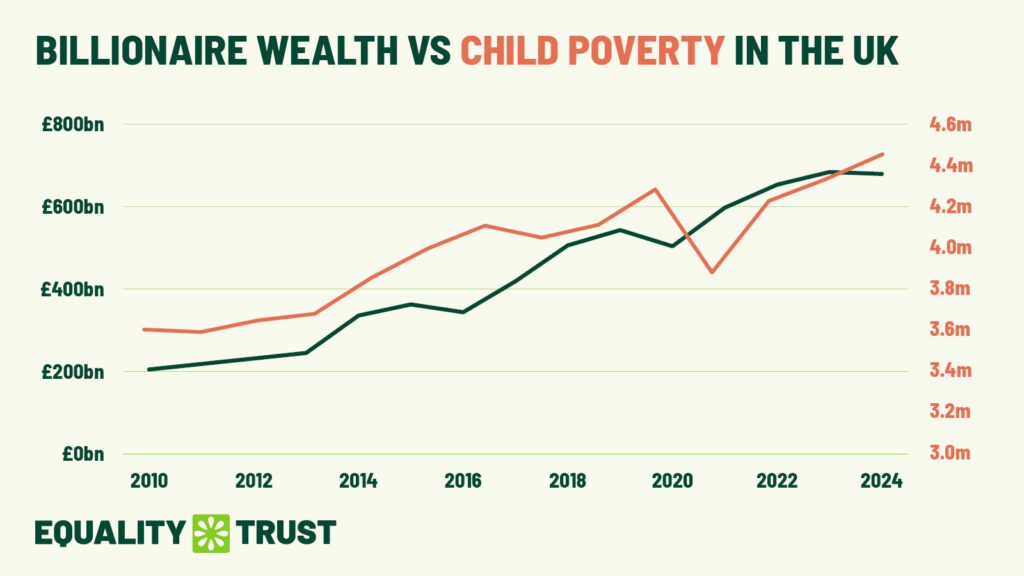
The Equality Trust contends that poverty is not merely an income problem but the lower-tier expression of an economy where assets are increasingly concentrated at the top. Families with identical incomes can experience vastly different standards of living based on their access to assets, such as homeownership, savings, or inherited wealth. Without addressing wealth, the government is essentially treating the symptoms of inequality while leaving the engine of inequality intact.
This critique draws on the economic theories of Thomas Piketty, specifically the concept that the return on capital (r) often outpaces economic growth (g). When wealth grows faster than wages, the structural gap between asset owners and wage earners widens. In the UK context, the majority of government revenue is derived from income tax—levied on wages and work—while returns on assets are often taxed at significantly lower rates. This fiscal structure creates a situation where public investment in services is constrained by wage growth, while the wealthiest segments of society continue to accumulate assets at a rate that the broader economy cannot match.
Power Dynamics and the Economic Model
A central pillar of the Equality Trust’s framework is that inequality is a product of power imbalances. The current strategy discusses "opportunity" and "life chances" but remains silent on how corporate power, housing market volatility, and political influence at the top shape the conditions that produce poverty.
History provides a precedent for a more radical approach. Following the Second World War, the UK achieved a sustained reduction in inequality not through targeted anti-poverty programs alone, but through systemic shifts in power. This included the expansion of trade union rights, the massive build-out of social housing, the creation of a comprehensive National Health Service, and the implementation of highly progressive taxation. These measures did not just reduce hardship; they reshaped the economic model to ensure that gains were distributed more equitably across the population.

Implications and Future Recommendations
The 2026 Child Poverty Strategy is viewed by analysts as a "necessary corrective"—a floor rather than a ceiling. For the strategy to achieve its long-term goal of ending child poverty, several structural shifts will be required in future iterations.
First, wealth must be integrated into the child poverty agenda. This includes addressing housing wealth, debt, and the role of intergenerational transfers. Second, success should be measured not just by lifting families above a specific poverty line, but by narrowing the gap between the top and bottom deciles of the population.
Furthermore, fiscal reform is essential. Sustained progress in reducing poverty requires a transparent discussion on who pays for social investment. This would likely involve aligning the taxation of wealth and capital gains with the taxation of work. Finally, the government must establish binding targets and accountability mechanisms to ensure that the ambition of the strategy is not diluted by future political shifts.
Analysis of the Strategy’s Long-term Viability
While the current administration has been praised for reinstating child poverty as a core national priority, the long-term viability of the strategy remains tethered to its ability to survive economic fluctuations. By focusing primarily on income redistribution through the benefits system, the strategy remains vulnerable to future "austerity" cycles.

A more resilient approach would involve "pre-distribution"—changing the way the market itself works so that families have more power and higher wages before government intervention is even required. This would involve strengthening labor market protections and decoupling essential needs, such as housing and energy, from volatile market forces.
In conclusion, the January 2026 briefing by The Equality Trust serves as a reminder that while the new Child Poverty Strategy marks a significant and welcome departure from the policies of the last decade, it stops short of a transformative break with the status quo. To truly "end" child poverty, the UK must eventually move beyond the margins of the current economic system and confront the deep-seated structures of wealth and power that continue to produce inequality at scale.