A comprehensive new study by the Pew Research Center reveals a complex and often contradictory moral landscape in the United States, with a significant majority of Americans expressing permissive views on a wide range of behaviors, while stark divisions emerge along political, religious, and generational lines on other issues. The research, conducted through two extensive surveys in the spring of 2025, delves into the moral judgments of U.S. adults concerning fifteen distinct actions, highlighting areas of broad consensus and deep societal fissures.
The analysis, which surveyed 3,605 U.S. adults from March 24 to 30, 2025, and an additional 8,937 U.S. adults from May 5 to 11, 2025, as part of the Pew Research Center’s American Trends Panel, indicates that while certain behaviors are almost universally deemed acceptable or non-issues, others ignite passionate debate and sharply divergent opinions.
Widespread Acceptance of Common Behaviors
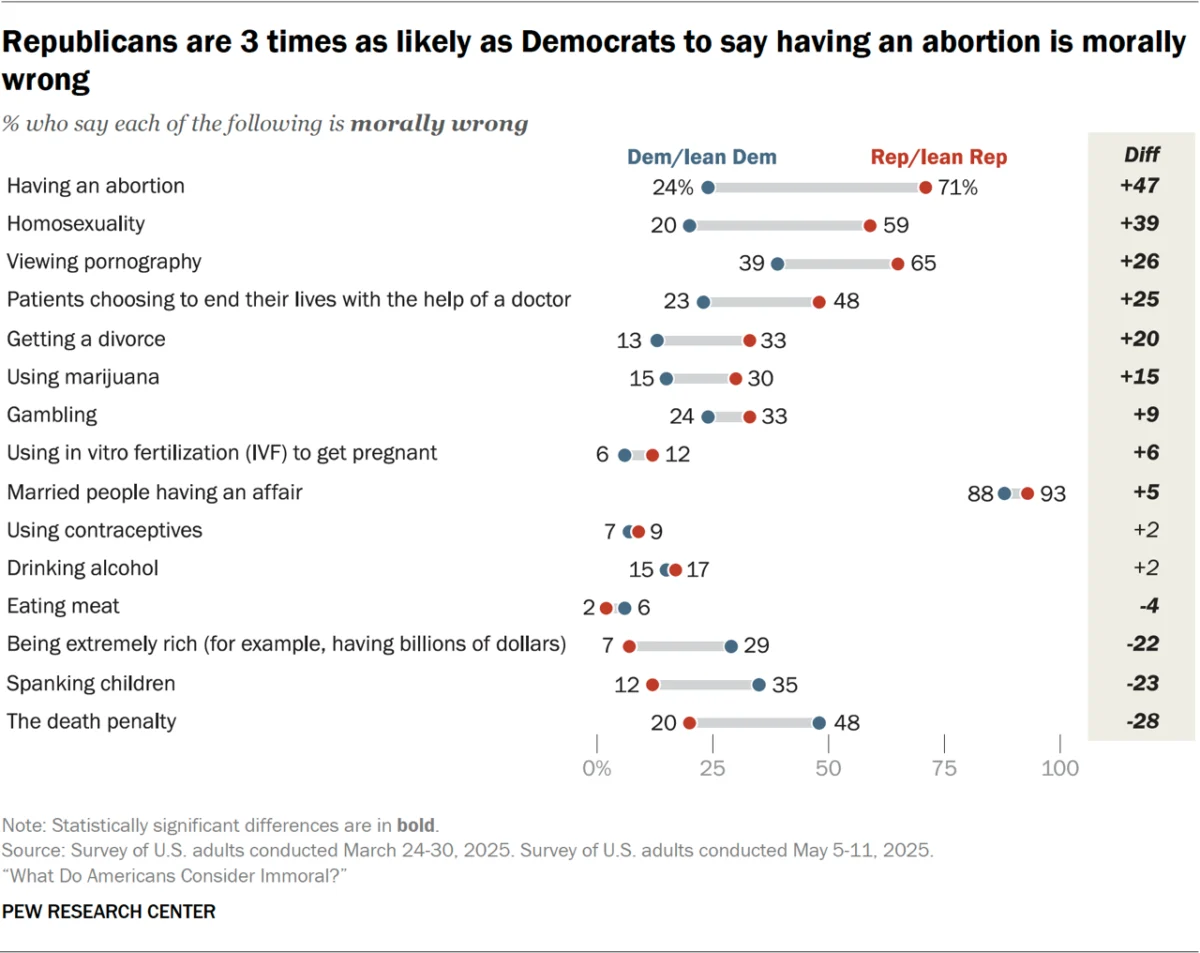
At one end of the spectrum, the study found near-unanimous acceptance for everyday actions. A remarkable 96% of U.S. adults consider eating meat either morally acceptable or not a moral issue. Similarly, 91% hold permissive views on the use of contraceptives to prevent pregnancy. These findings suggest a broad societal consensus on practices that are deeply integrated into daily life and widely accepted within various cultural and religious frameworks.
The research deliberately excluded behaviors that elicit near-universal condemnation, such as murder or theft, and those that are uncontroversial, like asking for directions. This focus on debated issues underscores the nuances of contemporary American morality.

Extramarital Affairs: A Clear Moral Boundary
In contrast to the broad permissiveness observed on many issues, the study identified one behavior that a clear majority of Americans find morally reprehensible: extramarital affairs. An overwhelming nine-in-ten U.S. adults stated that married people having an affair is morally wrong. This finding stands as a strong indicator of enduring traditional values concerning marital fidelity within American society. For comparative global perspectives, a separate Pew Research Center international report revealed that while extramarital affairs are also widely condemned in many other countries, the intensity of this moral judgment can vary.
Deep Divisions Emerge on Abortion and Pornography
The moral landscape becomes considerably more fractured when examining issues like pornography and abortion. The American public is nearly evenly split on these contentious topics, reflecting deep-seated ideological and personal beliefs.
Regarding the viewing of pornography, 52% of U.S. adults deem it morally wrong. However, a substantial portion, 32%, view it as not a moral issue, and 15% consider it morally acceptable. This distribution highlights a significant segment of the population that either abstains from making moral judgments on this matter or finds it acceptable.
Similarly, the morality of abortion presents a deeply divided public. While 47% of Americans believe having an abortion is morally wrong, a near-equivalent half of the population holds differing views. Thirty-one percent consider abortion not a moral issue, and 21% believe it is morally acceptable. This near 50/50 split underscores the ongoing societal debate and the profound personal convictions surrounding reproductive rights.
Political Partisanship as a Defining Factor
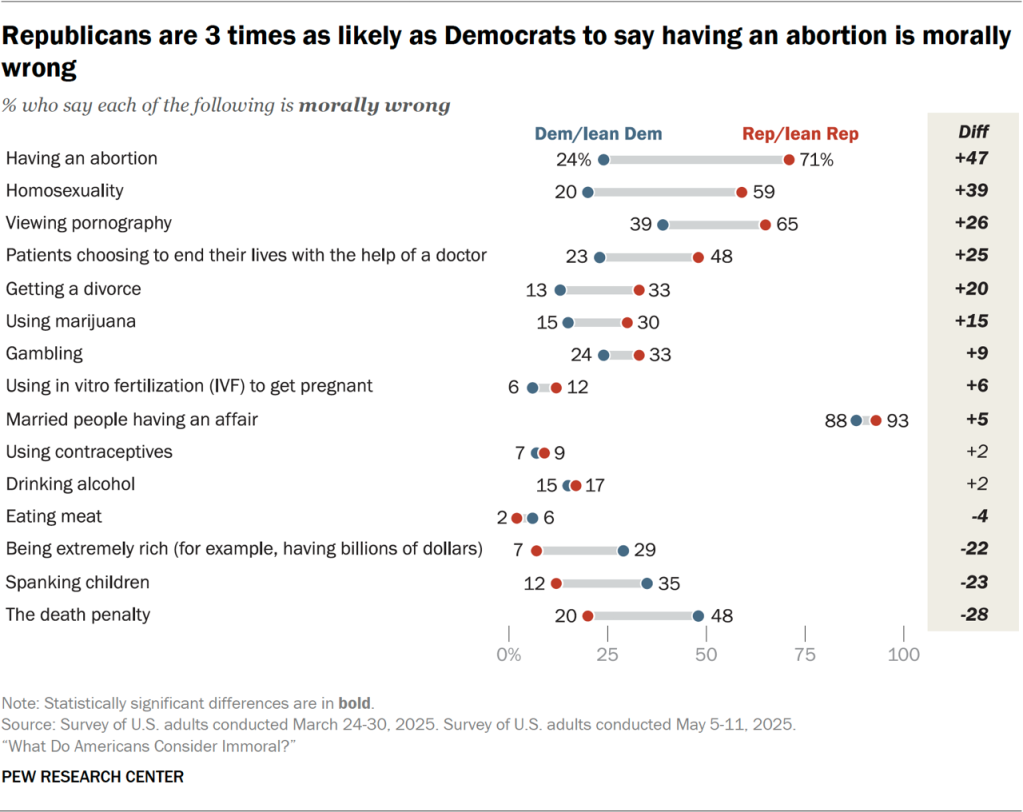
The Pew Research Center’s findings reveal that political affiliation is a significant predictor of moral views, particularly on issues like abortion. A stark partisan divide is evident, with Republicans and Republican-leaning independents being substantially more likely than Democrats and Democratic-leaning individuals to condemn abortion on moral grounds. Specifically, 71% of Republicans view abortion as morally wrong, in contrast to only 24% of Democrats. This aligns with existing research on partisan differences regarding abortion legality, indicating that moral judgments are deeply intertwined with political ideology.
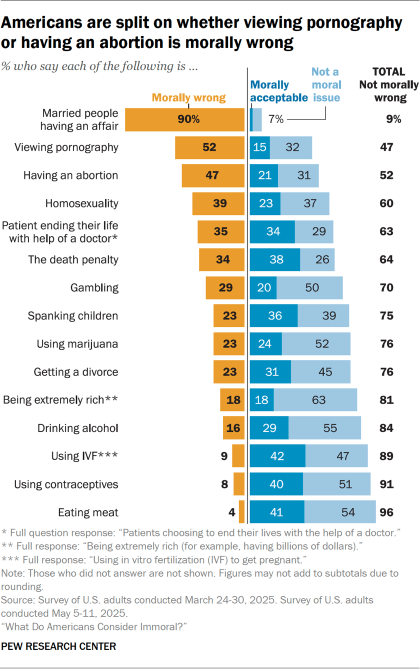
The partisan divide extends beyond abortion. Republicans are more inclined than Democrats to view several other behaviors related to sex and family life as morally wrong, including:
- Homosexuality: A significant majority of Republicans (69%) consider homosexuality morally wrong, compared to 30% of Democrats.
- Having an abortion: As noted, 71% of Republicans versus 24% of Democrats.
- Viewing pornography: 68% of Republicans vs. 35% of Democrats.
- Getting a divorce: 40% of Republicans vs. 18% of Democrats.
- Premarital sex: 34% of Republicans vs. 15% of Democrats.
- Having an extramarital affair: 97% of Republicans vs. 89% of Democrats (though both parties show very high disapproval).
Conversely, Democrats are more likely than Republicans to view certain other behaviors as morally wrong:
- Being extremely rich: 48% of Democrats vs. 25% of Republicans.
- Spanking children: 37% of Democrats vs. 29% of Republicans.
- Using the death penalty: 36% of Democrats vs. 26% of Republicans.
- Having an abortion: 47% of Democrats (as mentioned above, this is the overall figure, but it is lower than Republicans) vs. 71% of Republicans.
- Viewing pornography: 35% of Democrats vs. 68% of Republicans.
These partisan divergences suggest that political identity plays a crucial role in shaping moral frameworks, influencing how individuals perceive the ethical implications of various actions.
Religious Affiliations and Moral Stances
Religious identity also emerges as a powerful determinant of moral viewpoints. White evangelical Protestants, in particular, tend to hold more traditionally conservative moral positions across several issues compared to other religious groups.
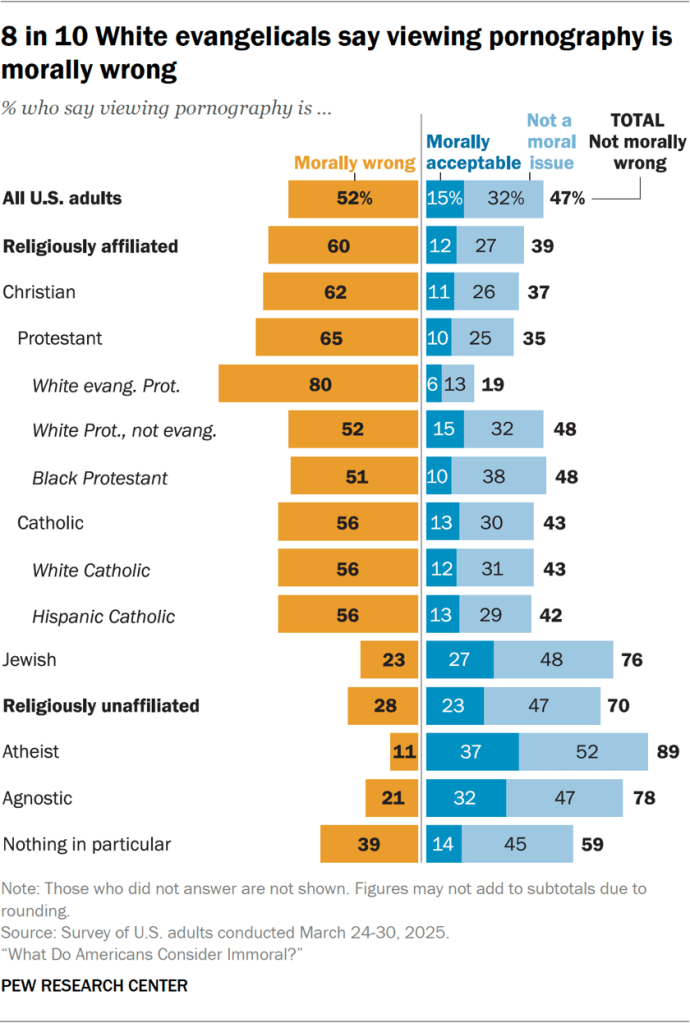
For instance, 80% of White evangelicals view the viewing of pornography as morally wrong, a significantly higher proportion than other Protestant denominations (approximately 50%) or Catholics (56%). Jewish adults (23%) and the religiously unaffiliated (28%) are far less likely to consider pornography morally wrong, with about half of these groups viewing it as not a moral issue.
The divide is equally pronounced concerning homosexuality. A substantial 72% of White evangelicals deem homosexuality morally wrong, a sentiment shared by only 34% of Catholics and 13% of the religiously unaffiliated.
Furthermore, White evangelicals are more likely than members of most other religious groups to consider abortion and physician-assisted suicide morally wrong. Conversely, they are the least likely among studied religious groups to view the death penalty as immoral, with only 20% expressing this opinion. In stark contrast, 48% of atheists, 46% of Black Protestants, and 42% of Jews consider the death penalty immoral.
Generational Divides in Moral Outlooks
Generational differences also significantly shape moral perspectives in the United States. However, the direction of these differences is not uniform across all issues, indicating a complex interplay of societal shifts and individual experiences.
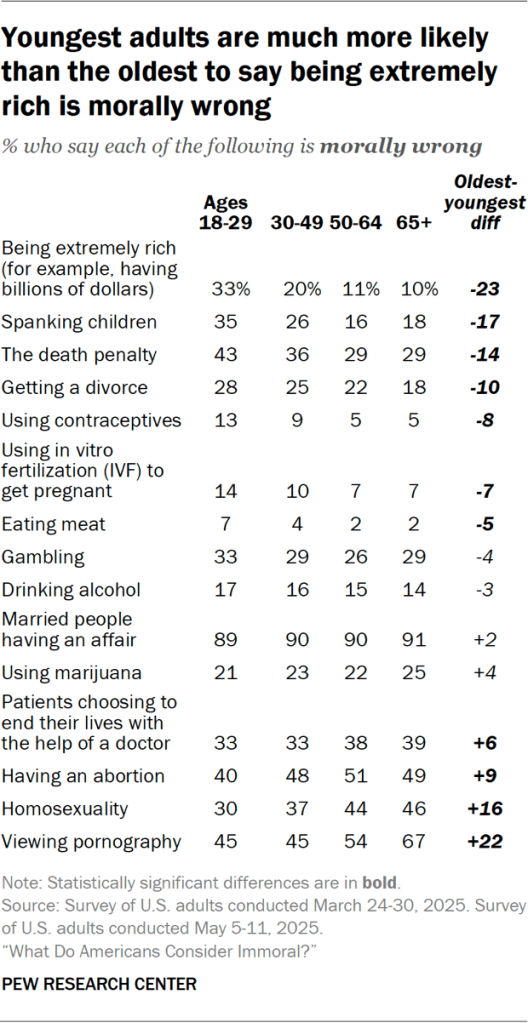
Younger adults, aged 18 to 29, are notably more inclined than older generations to view certain behaviors as morally wrong. This includes being "extremely rich" (33% of young adults vs. 10% of those 65 and older) and spanking children (35% of young adults). These attitudes suggest a potential shift in moral priorities among younger demographics, perhaps influenced by contemporary discussions on economic inequality and child-rearing practices.
Conversely, younger adults are less likely than older generations to consider homosexuality morally wrong, with 30% of those aged 18 to 29 holding this view, compared to higher percentages among older age groups. This trend indicates a growing acceptance of LGBTQ+ rights and identities among younger Americans.
These generational divides persist even within partisan groups, highlighting how age can modulate or reinforce existing political beliefs. For example, within the Republican party, young adults are more likely than older Republicans to believe that being extremely rich is morally wrong, though the gap is less pronounced than among Democrats.
Gender Differences in Moral Judgments
While substantial overlap exists in the moral views of men and women, the study identified a few areas where gender plays a noticeable role. Men are somewhat more likely than women to consider getting a divorce (28% vs. 19%), having an abortion (51% vs. 44%), and homosexuality (43% vs. 37%) as morally wrong. These differences might reflect varying societal expectations and traditional gender roles that continue to influence moral attitudes.
In contrast, women are more likely than men to find the viewing of pornography morally wrong (58% vs. 47%). This finding could be linked to differing societal perceptions of sexual expression and its impact, with women perhaps being more attuned to potential negative consequences.
Public Perception of National Morality
Adding another layer to the moral discourse, the Pew Research Center also explored Americans’ perceptions of the overall morality of their fellow citizens. A slight majority of Americans (53%) believe that the morality and ethics of their fellow Americans are somewhat or very bad, while 47% hold a more positive view. This sentiment is more pronounced among Republicans (54% rate American morality as good) compared to Democrats (40% share this view).
This finding contrasts with perceptions in many other countries surveyed by Pew Research Center in 2025, where a greater proportion of citizens tend to view their compatriots as morally and ethically good. This suggests a potentially more critical self-assessment of national character within the United States.
Implications and Broader Context
The findings from these Pew Research Center surveys provide a granular snapshot of the moral fabric of contemporary America. The broad permissiveness on issues like diet and contraception suggests a society that has largely secularized or adapted traditional norms to modern lifestyles. However, the deep divisions on issues like abortion and sexuality underscore the persistent influence of political and religious ideologies, creating fault lines that shape public discourse and policy debates.
The study’s methodology, involving large, nationally representative samples from the American Trends Panel, lends significant weight to its conclusions. The inclusion of detailed questions on fifteen distinct behaviors allows for a nuanced understanding of how moral judgments are formed and how they vary across different demographic groups.
The research also draws connections to broader societal trends, such as the ongoing debate about economic inequality, as reflected in attitudes toward wealth, and evolving views on gender and sexuality. The persistent generational differences suggest that these moral landscapes will continue to shift in the coming years.
As the United States navigates complex social and political challenges, understanding these deeply held moral beliefs and the cleavages that define them is crucial for fostering informed public dialogue and addressing societal divisions. The Pew Research Center’s continued commitment to exploring these fundamental questions of morality offers invaluable insights into the evolving values of the American public.