
The rapid expansion of the digital infrastructure supporting the modern economy has reached a critical juncture, as a new Pew Research Center survey reveals a significant hardening of public sentiment toward data centers. Across the United States, citizens are increasingly expressing skepticism regarding the environmental and economic footprint of these massive facilities. This shift in public perception comes at a time when the surge in artificial intelligence and cloud computing demand has necessitated a massive scale-up in physical server capacity, leading to a collision between tech-driven industrial development and local community concerns.
Data collected between July 20 and August 9, 2026, among 10,548 U.S. adults indicates that negative views regarding data centers have surged across virtually every demographic and political category since the beginning of the year. While the facilities are essential for the operation of modern digital services, the public is increasingly viewing them as detrimental to the environment, local energy costs, and the overall quality of life in surrounding regions.
A Rapid Shift in Public Sentiment
The data paints a stark picture of declining support. As of August 2026, 54% of Americans characterize data centers as "mostly bad" for the environment, a notable increase from the 39% who held that view in January. Similarly, concerns regarding home energy costs have climbed, with 50% of the population now labeling data centers as having a negative impact on their household expenses, up from 38% earlier in the year.

The perception of "quality of life" has seen one of the most dramatic shifts. Nearly half of the public (49%) now believes data centers negatively affect the quality of life in their local area, nearly double the 30% figure recorded at the start of 2026. This data suggests that as more communities grapple with the physical presence of these facilities—which often require vast amounts of land, water for cooling, and proximity to high-voltage power lines—the initial promise of economic development is being overshadowed by concerns over noise, traffic, and resource strain.
The Chronology of Growing Opposition
The year 2026 has been marked by a series of legislative and social escalations regarding data center placement. The timeline of this tension highlights a growing divide between federal policy and local reality.
- January 2026: Public awareness begins to rise as the national discourse shifts toward the energy demands of generative AI. At this stage, while some skepticism exists, many Americans remain undecided or unfamiliar with the technical nature of data centers.
- March 2026: Initial reports emerge regarding the concentration of new data center construction in rural corridors, leading to the first organized community protests against zoning permits.
- August 2026: The friction reaches a boiling point. In a move that signaled shifting political tides, Texas Governor Greg Abbott issued a statewide moratorium on new data center development. Similar actions by state and local officials in Pennsylvania and Illinois reflect a growing willingness among policymakers to prioritize local grid stability over rapid industry expansion.
- September 2026: Current polling confirms that this friction has permeated the electorate. The "not in my backyard" (NIMBY) sentiment is no longer limited to isolated incidents but has become a pervasive national trend.
The Economic Paradox: Jobs and Tax Revenue
While the environmental and lifestyle concerns are clearly defined, the perception of data centers as economic engines remains complicated and mixed. Data suggests that citizens are less certain about the economic value these facilities provide. Between 21% and 24% of Americans perceive them as "mostly good" for local tax revenue and job creation, but these figures are closely shadowed by nearly identical percentages who view them as "mostly bad."
The increase in negative sentiment toward these economic factors—rising by roughly 9 percentage points since January—indicates that the public is increasingly questioning whether the promised tax windfalls and employment opportunities are worth the associated infrastructural costs. Many residents have begun to argue that the jobs created are often specialized, temporary construction roles rather than long-term, high-paying positions for the local workforce.

Partisan Divergence and Political Realignment
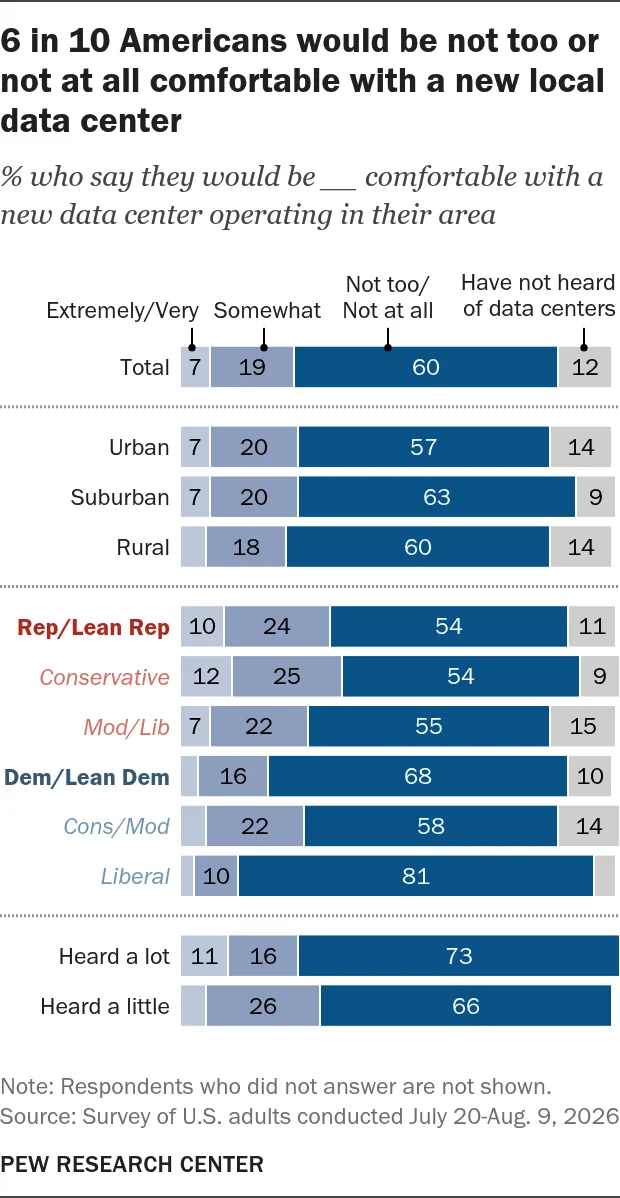
The survey reveals that while skepticism has increased across the board, the intensity of opposition varies along partisan lines. Democrats and those who lean toward the Democratic Party consistently report more negative views than their Republican counterparts. Specifically, 68% of Democrats indicate they would be uncomfortable with a new data center in their area, compared to 54% of Republicans.
However, this does not mean Republicans are uniformly supportive. The data shows a significant increase in negative sentiment among the GOP as well; for instance, the share of Republicans who believe data centers harm local quality of life has risen from 24% in January to 42% in August.
This political realignment is particularly interesting given the contrasting stances at the highest levels of government. President Donald Trump has remained a staunch advocate for data center development, framing it as a national security and economic imperative in the race for technological dominance. Conversely, several state-level leaders from both parties have been forced to pivot. The actions of Governors like Josh Shapiro (D-PA) and JB Pritzker (D-IL) to implement stricter oversight and pause tax incentives demonstrate that even pro-business administrations are feeling the pressure to respond to the anxieties of their constituents.
Demographic Patterns and the Rural Divide
A critical finding in the research is the impact on rural communities. As land prices in urban centers soar, developers have increasingly targeted rural areas for massive data center projects. This trend is reflected in the polling: rural Americans, who were previously more neutral, have become significantly more critical. Since January, the share of rural residents who view data centers as "mostly bad" for the environment has risen from 32% to 50%.
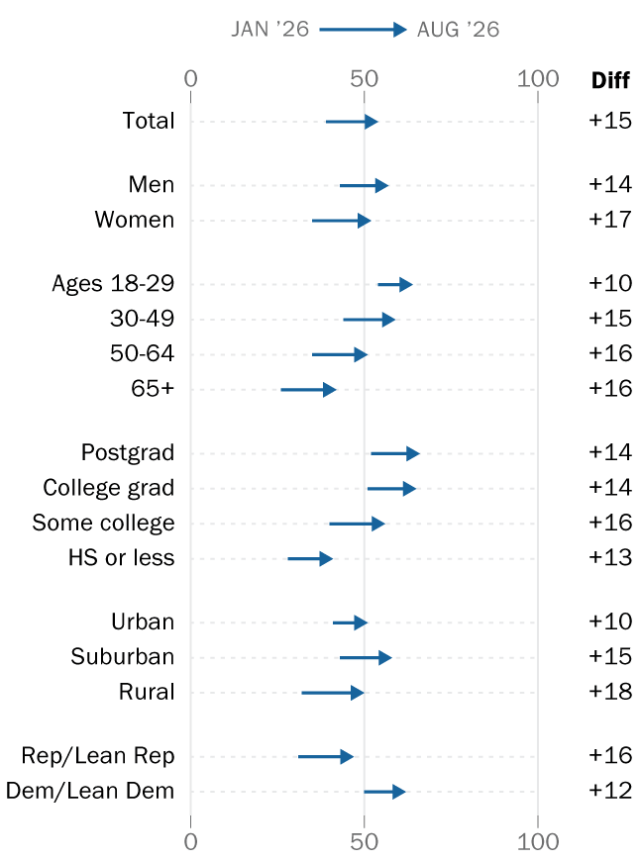
Educational attainment also plays a role in how these issues are perceived. Those with higher levels of education, particularly postgraduates, are among the most likely to view data centers negatively. This may suggest that as the conversation around AI and energy consumption becomes more mainstream, higher-educated segments of the population are more attuned to the potential long-term risks associated with energy-intensive digital infrastructure.
The Problem of Awareness
Despite the growing opposition, there remains a significant portion of the population that is either unaware of or unfamiliar with the industry. While awareness has grown—with 88% of Americans having heard at least a little about data centers, up from 75% in January—a substantial segment of the population still reports feeling "not sure" about the impacts of these facilities.
This lack of comprehensive knowledge often results in a vacuum where concerns about local impact dominate the conversation. For proponents of the data center industry, the challenge lies in communicating the necessity of these facilities for the functioning of the modern internet, while simultaneously addressing the legitimate anxieties of residents regarding energy usage, land use, and environmental sustainability.
Implications for the Future of Infrastructure
The implications of this research are profound for the tech sector and for national energy policy. As the U.S. continues to transition toward a digital-first economy, the conflict over physical infrastructure is likely to intensify. If a majority of Americans (60%) express discomfort with the presence of a data center in their neighborhood, local governments will find it increasingly difficult to approve new construction projects.

This "social license to operate" is becoming a bottleneck for firms looking to expand. The trend suggests that developers can no longer rely solely on favorable tax policies or top-down government mandates. Instead, the industry will likely be forced to adopt more transparent practices, such as investing in renewable energy to power their facilities, water-neutral cooling technologies, and tangible, community-focused development programs.
Ultimately, the shifting views of the American public represent a crucial feedback loop. The rapid development of AI and data-dependent technologies has moved faster than the public’s comfort level, leading to a period of recalibration. Whether the industry can bridge this gap through better engagement and more sustainable practices, or whether it will continue to face localized, grassroots opposition, will be one of the defining challenges of the late 2020s. As the data shows, the days of quiet, uncontested expansion are over; the public is watching, and for now, they are not convinced that the trade-offs are in their favor.




