
India has achieved monumental strides in public health over the past two decades, particularly in expanding routine immunization coverage across its vast and diverse population. Through sustained national campaigns, targeted interventions, and massive logistical efforts, the country has significantly curtailed the prevalence of vaccine-preventable diseases. Yet, as national coverage indicators continue to trend upward, the remaining frontier of public health delivery has shifted to a more complex challenge: reaching the elusive population of zero-dose children—infants and toddlers who have not received even their first dose of the basic diphtheria, tetanus, and pertussis (DTP1) vaccine.
Addressing this final mile requires moving beyond generalized public health messaging and top-down directives. Because the barriers keeping children unimmunized vary wildly across different households, neighborhoods, and socioeconomic strata, contemporary health strategies demand localized, highly adaptable frameworks. In the densely populated urban pockets of India’s most populous states, Bihar and Uttar Pradesh, health practitioners and policymakers have increasingly turned to an innovative methodology known as the "Learning by Doing" approach. By fusing human-centered design with continuous, real-time evaluation, this initiative empowers urban communities to actively participate in the problem-solving process, transforming passive recipients of healthcare into co-creators of sustainable solutions.
The Magnitude of the Zero-Dose Challenge in Northern India
To understand the urgency of grassroots interventions in Bihar and Uttar Pradesh, one must examine the broader epidemiological landscape of India. Historically, India accounted for a significant share of the global burden of zero-dose children. While nationwide initiatives such as Mission Indradhanush—launched by the Ministry of Health and Family Welfare in December 2014—have successfully inoculated millions of children in previously neglected rural and urban areas, pockets of vulnerability persist.
Urban areas present a uniquely complex set of challenges compared to rural counterparts. Rapid urbanization, transient migrant populations, seasonal labor movements, and densely packed informal settlements or slums create an environment where traditional tracking mechanisms often fail. Frontline health workers—such as Accredited Social Health Activists (ASHAs) and Auxiliary Nurse Midwives (ANMs)—frequently face administrative hurdles, resistance from specific community segments, misinformation, or sheer logistical fatigue when trying to map every newborn in rapidly expanding peri-urban zones.
In states like Bihar and Uttar Pradesh, where absolute population figures are massive, even a small percentage of unimmunized children translates into tens of thousands of vulnerable young lives exposed to preventable, life-threatening diseases. Consequently, public health experts realized that standardizing immunization drives was insufficient. Solutions had to be tailored to the micro-realities of individual urban wards, taking into account local power dynamics, daily wage labor schedules, and localized fears or hesitations regarding vaccine safety.
The Three-Phase Framework: Define, Design, and Deliver
The deployment of the "Learning by Doing" approach in Bihar and Uttar Pradesh represents a departure from rigid programmatic implementation. Rather than executing a pre-packaged blueprint, the initiative was structured around a dynamic, iterative framework known as the 3D model: Define, Design, and Deliver.
Phase 1: Define
The initial phase focused on rigorous, empathetic discovery. Instead of relying solely on quantitative health management information systems, project implementers engaged directly on the ground. Through qualitative research, anthropological mapping, and deep community engagement, teams sought to uncover the underlying reasons why specific caregivers failed to vaccinate their children.
The findings revealed that barriers were rarely monolithic. While some families lacked basic awareness about immunization schedules or session sites, many others faced systemic obstacles. Daily wage earners reported that immunization sessions conflicted with their working hours, resulting in lost wages if they queued at government clinics. Other caregivers harbored latent anxieties fueled by misinformation regarding vaccine side effects, while transient migrant families were frequently missed because they lacked local registration or were simply invisible to the municipal health infrastructure.
Phase 2: Design
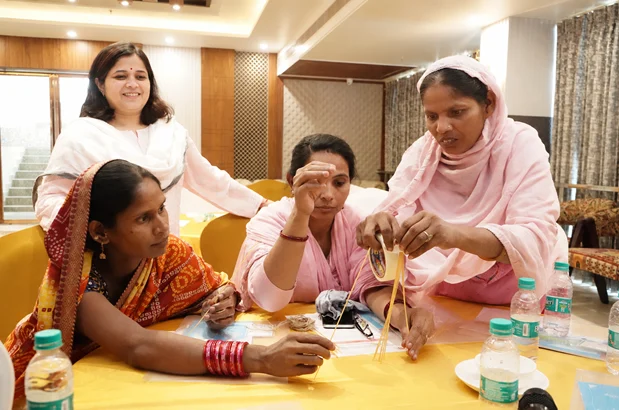
Armed with a granular understanding of local bottlenecks, the initiative moved into the co-creation phase. This is where human-centered design truly set the project apart. Rather than public health officials dictating strategy from district headquarters, potential solutions were mapped out alongside the actual stakeholders: caregivers of zero-dose children, local frontline health workers, community elders, and municipal government representatives.
By bringing these diverse groups into collaborative workshops, the initiative fostered local ownership. Solutions were not imported; they were built from within. For instance, immunization schedules were synchronized with community feedback to minimize economic disruption for working parents. Communication channels were redesigned to leverage trusted local voices—such as respected community leaders and self-help group members—rather than relying exclusively on distant institutional notices. Furthermore, tracking mechanisms for migrant families were simplified to ensure that mobility did not equate to medical exclusion.
Phase 3: Deliver
The final phase tested these co-created interventions in real-world conditions within selected urban blocks of Bihar and Uttar Pradesh. However, delivery was not treated as the end of the process. Instead, implementation was paired with continuous learning and feedback loops. As interventions rolled out, teams closely monitored their efficacy, adjusting strategies on the fly based on daily operational insights. If a specific outreach timing failed to attract fathers or working mothers, the schedule was immediately modified. If a particular pocket of resistance persisted, local influencers were deployed to address specific myths.
This agility ensured that the program evolved concurrently with the changing dynamics of the urban neighborhoods it served.
Chronology of Urban Immunization Reform
The evolution of targeted urban immunization strategies in northern India did not occur overnight. It represents a steady maturation of public health policy spanning over a decade:
- December 2014: The Government of India launches Mission Indradhanush, aiming to immunize all children under two years of age and pregnant women against vaccine-preventable diseases, placing special emphasis on districts with low immunization coverage.
- 2017–2019: Subsequent phases of Intensified Mission Indradhanush (IMI) place a sharper focus on urban settlements, brick kilns, construction sites, and remote migrant clusters where routine delivery systems traditionally underperformed.
- 2021–2022: Public health agencies, recognizing the persistence of localized zero-dose pockets exacerbated by pandemic-related disruptions, pilot human-centered design methodologies in select urban districts of Bihar and Uttar Pradesh.
- 2023–2024: The integration of the "Learning by Doing" framework formally takes root. Localized co-creation workshops bridge the communication gap between municipal health authorities and marginalized urban communities.
- Present: Insights and operational models from Bihar and Uttar Pradesh are documented and shared across broader platforms, offering scalable blueprints for national and international public health strategies targeting the final milestone of universal immunization.
Perspectives from the Ground: Stakeholder Insights
While quantitative metrics ultimately measure the success of immunization campaigns, qualitative feedback from frontline participants highlights the human dimension of the 3D framework.
District health officials in Uttar Pradesh noted that involving caregivers in the design phase fundamentally altered community reception. "When people feel listened to, rather than lectured at, their entire disposition toward public health initiatives changes," remarked a district immunization officer who participated in the rollout. "In the past, our messaging focused heavily on the dangers of diseases. While true, that approach did not address the father who worried he would lose a day’s wages by taking his child to the clinic. By reshaping the delivery timing to accommodate evening and weekend windows, we removed a tangible economic barrier."
Frontline workers, who often bear the brunt of community skepticism, expressed renewed enthusiasm for their roles. An ASHA worker in urban Bihar shared that collaborative problem-solving relieved much of the isolation she previously felt in her daily duties. "Before, I was just expected to hit targets with limited tools," she explained. "Working with local committees to design solutions meant that community members started helping me identify missed children, rather than closing their doors when I arrived."
Public health analysts observing the Bihar and Uttar Pradesh initiatives emphasize that human-centered design acts as a bridge between state infrastructure and community trust. In densely populated urban settings where formal institutions can sometimes feel distant or bureaucratic, empowering local stakeholders creates a vital buffer of accountability and mutual respect.
Broader Implications and Future Outlook
The lessons learned from applying the "Learning by Doing" approach in Bihar and Uttar Pradesh extend far beyond routine immunization. They offer a replicable template for how complex social and public health challenges can be managed in rapidly urbanizing environments across the developing world.
As global health organizations continue to push toward the targets outlined in the Immunization Agenda 2030 (IA2030)—which prioritizes reducing the number of zero-dose children by 50%—the experiences in northern India underscore several critical takeaways:
- Granularity is Essential: National and state-level data provides necessary strategic direction, but true operational success requires ward-level and household-level granularity.
- Co-Creation Builds Resilience: Solutions designed with communities are inherently more resilient and sustainable than those imposed on them.
- Agility Trumps Rigidity: Public health programs must institutionalize continuous learning mechanisms, allowing frontline teams to pivot and adapt strategies in real time based on empirical feedback.
By proving that urban communities can be actively mobilized to solve their own public health deficits, Bihar and Uttar Pradesh have provided a valuable roadmap. Reaching the final zero-dose child is no longer merely a logistical challenge of cold-chain maintenance and supply distribution; it is an exercise in human connection, localized empathy, and collaborative problem-solving that holds the key to safeguarding the health of future generations.




