The Pew-Knight Initiative, a joint endeavor by The Pew Charitable Trusts and the John S. and James L. Knight Foundation, is dedicated to fostering a deeper understanding of how Americans consume civic information, shape their beliefs and identities, and participate in their communities. As a nonpartisan, non-advocacy fact tank, Pew Research Center, in collaboration with the Knight Foundation’s commitment to informed and engaged communities, has released a comprehensive report analyzing the landscape of religious radio programming across the United States. This research delves into the characteristics of AM and FM stations broadcasting faith-based content, the nature of their programming, and the motivations and experiences of their listeners, particularly concerning their exposure to political and social issues.
Background and Context of the Study
The Pew-Knight Initiative’s ongoing research agenda focuses on news habits and media consumption, recognizing the critical role various media outlets play in shaping public discourse and individual understanding. Religious radio stations represent a significant, yet often under-examined, segment of the American media ecosystem. These stations are accessible in virtually every corner of the United States, broadcasting a diverse range of content from music and sermons to talk shows and audio dramas. Understanding these platforms is crucial for a holistic view of how Americans access information and engage with topics that extend beyond purely spiritual matters.
This specific report stems from a broader initiative by Pew Research Center to illuminate the complexities of religious media. The research aims to answer fundamental questions about the prevalence of religious radio, its programming diversity, and the extent to which it intersects with political and social commentary. The methodology employed in this study is designed to provide a multi-faceted perspective, drawing on several key data sources to capture a comprehensive picture. These sources include an analysis of station programming, listener surveys, and in-depth interviews, allowing for a robust examination of both the supply and demand sides of religious radio content. The findings are intended to inform the public, media professionals, and policymakers about this influential sector of broadcast media.
The Reach and Appeal of Religious Radio Programming
A significant portion of the American adult population engages with religious audio content. According to the Pew Research Center’s findings, approximately 45% of U.S. adults report ever listening to religious audio programming, whether through traditional radio or online platforms. This engagement encompasses a variety of formats, including music, sermons, talk shows, and even audio dramas.
The primary drivers for tuning into this content are overwhelmingly spiritual and personal. A majority of listeners indicate that they are drawn to religious programming because it offers spiritual uplift, a sense of relaxation, or guidance for navigating the complexities of daily life. These motivations underscore the role of religious radio as a source of comfort, inspiration, and moral compass for its audience.
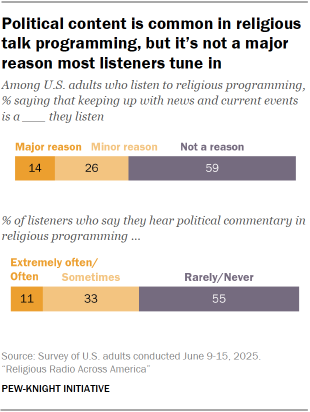
However, the notion that religious radio is solely focused on spiritual matters is increasingly challenged by the data. While fewer listeners cite keeping up with news and current events as a primary reason for tuning in, the reality of political and social discourse on these stations is more nuanced. Approximately four-in-ten listeners report encountering commentary on political and social issues at least sometimes. This suggests that the lines between spiritual guidance and engagement with contemporary societal concerns are often blurred within this media landscape.

An examination of a month’s worth of religious radio broadcasts from July 2025 further illuminates this point. The analysis revealed a notable variation in the extent to which stations address political and social issues. Some stations dedicate multiple hours each day to programming focused on these topics, while others maintain a more limited engagement, primarily through brief news updates or passing mentions. This divergence highlights the diverse approaches taken by religious broadcasters in their content curation and their perceived role in addressing broader societal issues.
Listeners’ Exposure to Political Content on Religious Radio
The extent to which listeners encounter political and social commentary on religious radio varies considerably, often depending on the type of programming they choose to access. A substantial segment of religious programming listeners, approximately one-third (35%), report rarely hearing discussions about news and politics. An additional 21% state that they never encounter such content. This indicates that for a significant portion of the audience, religious radio remains a sanctuary from the often-contentious realm of political debate.
This pattern is strongly linked to the specific programming choices made by listeners. For instance, individuals who tune into religious talk shows are far more likely to be exposed to political and social commentary. Among this group, about six-in-ten (56%) report hearing political or social commentary at least sometimes. This contrasts with listeners of other forms of religious programming, such as music or sermons, where political discussions are less prevalent.
Furthermore, listeners of religious talk shows are also more inclined to use these programs as a source for news and current events. A similar share, 59%, of talk show listeners indicate that keeping up with news and current events is at least a minor reason for their engagement. In contrast, among all listeners of religious programming (not exclusively talk shows), only 40% cite keeping up with news and current events as a reason for listening. For those who listen to religious programming other than talk shows, this figure drops to a mere 28%. This data underscores the distinct function that religious talk radio serves in bridging spiritual content with civic engagement for a specific segment of the audience.
The visual representation of this data, presented in a bar chart, clearly illustrates that while political content is common in religious talk programming, it is not the primary driver for most listeners tuning in. This nuance is critical for understanding the multifaceted nature of religious radio’s appeal.
Listener Sentiment Towards Political Content
The reception of political and social commentary within religious programming is not uniformly positive. Among those who report encountering such content, their feelings range from appreciation to strong dislike. The Pew Research Center’s findings indicate a complex emotional landscape surrounding this intersection of faith and politics on the airwaves.
A significant portion of listeners who are exposed to political and social commentary express a neutral sentiment, neither particularly liking nor disliking it. However, a notable minority holds stronger opinions. Approximately 38% of listeners who encounter political content say they like it, with 10% stating they like it "a lot." Conversely, 25% report disliking it, with 9% expressing strong disapproval.
Political affiliation appears to be a significant factor in these sentiments. Republicans are more likely than Democrats to express a positive view of political content within religious programming, with 10% of Republicans saying they like it a lot, compared to only 3% of Democrats. Conversely, Democrats are more likely to express a strong negative reaction, with 20% of Democrats disliking the political commentary a lot, compared to 9% of Republicans. This divergence in sentiment suggests that political leanings heavily influence how individuals perceive the appropriateness and value of political discussions within a religious context.
It is important to note that the question regarding listener sentiment towards political content was posed only to those respondents who indicated they encountered such commentary with some regularity (extremely often, often, sometimes, or rarely). Those who reported never hearing political or social commentary were not asked about their preferences, as the question was predicated on their experience of exposure. This methodological consideration ensures that the sentiment data accurately reflects the views of those who are directly engaging with the content in question.
Broader Implications and Future Research
The findings from the Pew-Knight Initiative’s study on religious radio offer valuable insights into the evolving media consumption habits of Americans and the complex relationship between faith, information, and civic engagement. The research highlights that religious radio is not a monolithic entity but rather a diverse landscape with varying levels of engagement with political and social issues.
The fact that a significant portion of listeners actively seek spiritual uplift and guidance suggests that the primary role of many religious radio stations remains rooted in faith-based content. However, the presence of political and social commentary, particularly on talk radio formats, indicates a growing tendency for religious media to engage with contemporary issues. This raises important questions about the potential for these platforms to influence public opinion, mobilize communities, and shape political discourse.
For policymakers and civic organizations, understanding these trends is crucial. It sheds light on alternative channels through which citizens receive information and form their perspectives on critical societal matters. The differential reception of political content by partisan groups also suggests the potential for religious radio to either reinforce existing political divisions or, conversely, to serve as a bridge for dialogue and understanding, depending on the nature of the programming.
The Pew-Knight Initiative’s commitment to supporting research on civic information consumption is vital in an era of rapid media transformation. Future research could further explore the specific types of political and social issues discussed on religious radio, the ideological leanings of commentators, and the impact of this programming on listener attitudes and behaviors. Additionally, examining the online presence of religious radio stations and their engagement with digital audiences would provide a more complete picture of their influence in the contemporary media environment.
As the media landscape continues to diversify, the role of religious radio in shaping public discourse and fostering civic engagement will undoubtedly remain a subject of significant interest and study. The Pew-Knight Initiative’s ongoing work provides a critical foundation for understanding these complex dynamics and their implications for American society.