
The world’s demand for electricity continues to climb, reaching unprecedented levels in 2025. However, the sources powering this energy consumption are undergoing a significant transformation. A comprehensive analysis by the Pew Research Center, drawing on data from the independent energy think tank Ember, reveals a dramatic surge in renewable energy sources like wind and solar power, particularly in key regions. While fossil fuels still account for the majority of global electricity generation, their dominance is steadily eroding as cleaner alternatives gain substantial traction.
The Evolving Energy Landscape: A Deep Dive into Global Trends
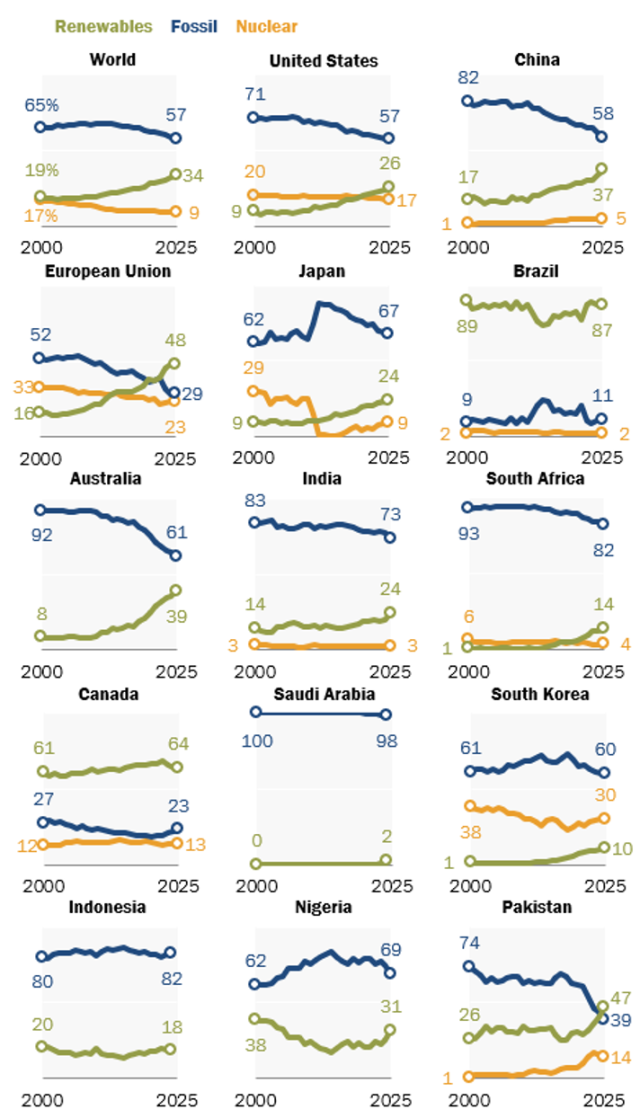
The Pew Research Center’s in-depth examination of long-term global energy production trends, based on Ember’s meticulously compiled data, paints a clear picture of a world in transition. In 2025, 57% of all electricity generated worldwide was still derived from the burning of fossil fuels, a notable decrease from 65% in 2000. This shift, while incremental on a global scale, signifies a fundamental change in how nations are powering their economies and societies.
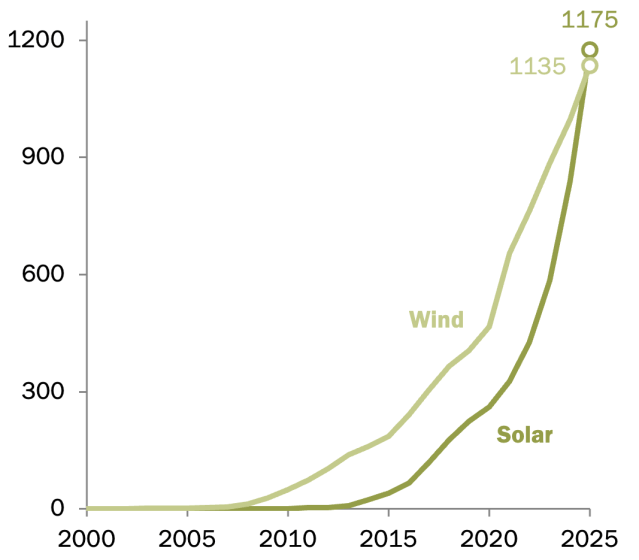
The data highlights a striking acceleration in the adoption of wind and solar power. Collectively, these two renewable sources accounted for a substantial 17% of global electricity generation in 2025, a remarkable leap from less than 5% a decade prior in 2015. This exponential growth underscores the increasing viability and attractiveness of renewable technologies.
Fossil Fuels’ Declining Share, Renewables’ Ascending Trajectory
A closer look at the data reveals the diminishing role of coal. In 2025, coal accounted for one-third of all global electricity production, a significant drop from its peak of 41% in 2013. This decline is a direct consequence of both environmental policy shifts and the increasing cost-competitiveness of renewable alternatives.
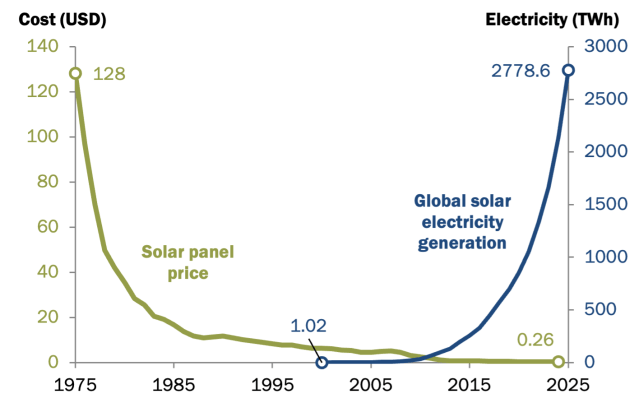
Conversely, the expansion of wind and solar power has been nothing short of transformative. In 2025, solar power alone contributed 9% to the world’s electricity mix, a dramatic increase from just 3% in 2020 and a mere 0.01% at the turn of the millennium. This surge is largely attributed to the plummeting costs of solar panel technology. Over the past 50 years, the average price of a single solar panel has fallen by over 99%, from approximately $128 in 1975 to a mere $0.26 in 2024, according to data from Our World in Data. This drastic price reduction has made solar power accessible and economically viable for a wider range of applications and regions.
Renewables Overtake Coal: A Historic Milestone
A significant milestone was reached in 2025 when renewable sources, encompassing wind, solar, bioenergy, hydropower, geothermal, tidal, and wave power, collectively generated a slightly larger share of global electricity than coal for the first time. Renewables accounted for 34% of global electricity production, surpassing coal’s 33% share. This event marks a symbolic and practical turning point in the global energy transition, indicating that cleaner energy sources are no longer a niche market but a dominant force in electricity generation.
Nuclear Power’s Diminishing Footprint
In contrast to the growth of renewables, nuclear energy’s contribution to global electricity generation has declined. Falling from 17% of global generation in 2000 to just 9% in 2025, nuclear power’s trajectory reflects a complex interplay of safety concerns, waste disposal challenges, and the burgeoning cost-effectiveness of renewables. While some nations continue to rely on nuclear power, its overall global share has contracted significantly.
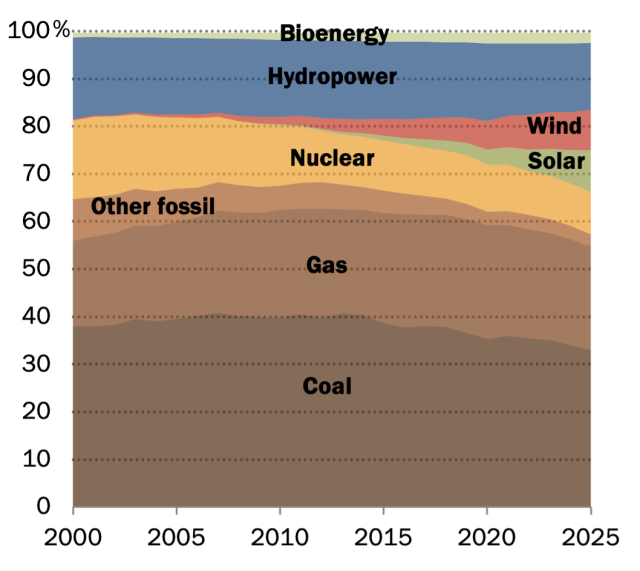
It is crucial to note that while the share of certain energy sources may have decreased, their absolute output has often increased due to the overall rise in global electricity demand. Hydropower, for instance, is producing a far greater volume of electricity in 2025 than in 2000, even though its percentage of the total energy mix has seen a slight decline. This highlights the sheer scale of growth in energy consumption, necessitating a multifaceted approach to meeting demand with cleaner sources.
Regional Dynamics: Europe Leads the Renewable Charge
The transition to renewable energy is not uniform across the globe. The European Union stands out as a leader, with renewables accounting for nearly half (48%) of its electricity generation in 2025. This contrasts sharply with the global average and showcases the EU’s commitment to ambitious climate goals. In the EU, renewables have surpassed fossil fuels (29%) and nuclear power (23%) as the primary electricity source.
The trend is also evident in countries like Brazil and Canada, where renewables have long been dominant, largely due to extensive hydropower infrastructure. In 2025, these sources provided 87% of Brazil’s electricity and 64% of Canada’s, with wind and solar contributing significantly to this share.
China and the U.S.: Accelerating Renewable Adoption
Major economies like China and the United States are also making significant strides in adopting renewable energy. Both nations have demonstrably reduced their reliance on fossil fuels over the past 25 years. By 2025, renewable sources accounted for 37% of China’s electricity and 26% of the U.S. electricity.
China, in particular, has emerged as a global powerhouse in renewable energy production. The nation leads the world in both solar and wind energy generation. In 2025, China’s combined solar and wind electricity output surpassed that of the 38 member nations of the Organisation for Economic Co-operation and Development (OECD) combined. This remarkable achievement is bolstered by China’s aggressive expansion in clean energy technologies, with annual solar electricity growth exceeding 25% since 2020. In 2025 alone, China added 336 terawatt-hours of solar electricity, a figure greater than the total electricity production of the United Kingdom in the same year. Similarly, China’s wind energy generation has seen consistent growth, adding over 100 terawatt-hours annually since 2020.
The United States, meanwhile, remains a leader in nuclear and natural gas electricity generation. However, its commitment to renewables is also growing, reflecting a broader global trend.
Shifts in Fossil Fuel Dominance: Gas Replaces Coal in Key Regions
The transformation of the energy landscape is also evident in the changing role of different fossil fuels. In Africa and North America, natural gas has largely supplanted coal as the primary source of electricity. This shift is particularly pronounced in Africa, where investments in fracking infrastructure have coincided with a dramatic increase in gas-based electricity generation, rising from 92 terawatt-hours in 2000 to 419 terawatt-hours in 2025. Conversely, coal generation in Africa saw only a marginal increase over the same period.
In North America, natural gas now accounts for 37% of electricity generation in 2025, a substantial rise from 15% in 2000. This is mirrored by a significant decline in coal’s share, which dropped from 47% in 2000 to 15% in 2025. The Middle East also exhibits a similar trend, with natural gas comprising nearly three-quarters (73%) of its electricity in 2025, up from 50% at the turn of the century.
Contrasting Trends: Asia’s Rising Coal Consumption
While many regions are moving away from coal, certain areas, particularly Southeast Asia, are witnessing an increase in its use. The Association of Southeast Asian Nations (ASEAN) countries have more than doubled their reliance on coal for electricity between 2000 and 2025, with coal’s share rising from 20% to 45%. This divergence highlights the complex and varied pathways of energy transitions across different geographical and economic contexts.
Asia’s Explosive Growth in Electricity Demand
The overall growth in global electricity production has been substantial, more than doubling between 2000 and 2025. This surge is largely fueled by the rapid economic development and increasing energy demands across Asia. The continent’s electricity generation experienced an impressive 298% increase during this period, with China and India leading the charge. China’s electricity generation saw a staggering 680% increase from 2000 to 2025, while India’s grew by 264%.
Asia’s burgeoning energy needs accounted for a significant majority – 76% – of the world’s total electricity demand growth between 2000 and 2025. China alone was responsible for over half (56%) of this global increase. This rapid expansion in Asia underscores the continent’s critical role in shaping future global energy trends and the imperative for sustainable development strategies within the region.
Japan, while part of Asia, presents a contrasting trend, with its electricity generation experiencing a slight decline since 2000. This reduction is largely attributed to the aftermath of the Fukushima Daiichi nuclear accident in 2011, which led to the shutdown of most of its nuclear power plants and necessitated a recalibration of its energy sources, including a greater reliance on renewables alongside a gradual return to nuclear power.
Implications and Future Outlook
The data clearly indicates a fundamental shift in the global energy paradigm. The dramatic growth of renewables, driven by technological advancements and cost reductions, is reshaping the electricity sector. While fossil fuels remain dominant, their declining share suggests a long-term trend towards cleaner energy sources. However, the continued reliance on coal in some regions and the uneven pace of renewable energy adoption worldwide present ongoing challenges for climate mitigation efforts.
The success of countries like China in rapidly scaling up renewable energy production and clean-tech manufacturing offers a model for other nations seeking to transition to a low-carbon economy. As global electricity demand continues to rise, the choices made by nations in the coming years regarding their energy mix will be critical in determining the planet’s environmental trajectory. The Pew Research Center’s analysis provides vital data for policymakers, industry leaders, and the public to understand these evolving dynamics and navigate the complex path toward a sustainable energy future.