The effectiveness of diversity, equity, belonging, and inclusion (DEBI) initiatives within organizations is profoundly impacted by the precise framing and definition of these foundational terms, according to recent insights from experts in organizational change. A lack of common understanding, coupled with deeply ingrained psychological biases, can transform well-intentioned efforts into sources of division, resistance, and ultimately, failure, rather than fostering a truly inclusive environment. This challenge, often overlooked in the rush to implement programs, underscores the critical need for a deliberate and inclusive approach to language in DEBI strategies.
The Unseen Barriers: Psychological Responses to DEBI Terminology
For decades, organizations have grappled with the complex landscape of fostering diverse and equitable workplaces. However, the language used to articulate these goals frequently triggers unforeseen psychological reactions that can undermine progress. When terms like "diversity," "equity," and "inclusion" are introduced, individual responses can range from disengagement, perceived irrelevance, to outright defensiveness. Studies in social psychology and cognitive science illuminate why these reactions are so prevalent.
One common pattern observed by DEBI practitioners is the "us vs. them" mentality. Employees, particularly those from majority groups, may dismiss diversity as "not my issue," perceiving it as solely applicable to minority groups. Conversely, individuals from minority backgrounds might feel burdened, viewing the responsibility to "fix" diversity issues as unfairly placed upon them. Other reactions include a sense of detachment ("not my day job") or a narrow interpretation of terms, such as "diversity talent" being exclusively equated with women or minorities, or "equity" being misconstrued as preferential treatment leading to exclusion of majority groups. These interpretations often stem from past experiences where DEBI initiatives were poorly implemented, focusing on quotas or "fixing" specific groups rather than systemic change.
These perceptions are not merely anecdotal; they are rooted in well-documented psychological phenomena. The concept of "priming," for instance, demonstrates how words and images can unconsciously influence thoughts and behaviors. Research has shown that exposure to words associated with stereotypes can subtly alter behavior—for example, individuals exposed to words related to the elderly might subsequently walk slower. Similarly, attempts to counter stereotypes, such as stating "girls are as good as boys at math," can inadvertently reinforce the very stereotype they aim to dispel by drawing attention to it. This highlights the delicate balance required in linguistic choices within DEBI discourse.
The Fear of Loss and Tribal Instincts
Beyond cognitive priming, language also triggers powerful emotional responses. Neuroscientific studies confirm that emotions are significant drivers of unconscious thinking, decision-making, and behavior. In the context of DEBI, the perception of a "zero-sum game"—where one group’s gain is seen as another’s loss—can activate "loss-aversion bias." This bias makes individuals inherently resistant to change, leading them to defend the status quo and resist initiatives perceived as diminishing their power or privilege. For instance, discussions around equitable promotion practices can be met with resistance from those who fear losing their traditional advantages.
Furthermore, human beings possess an innate "tribal mentality," a fundamental fear of the "unknown" and a tendency to favor "in-group" members over "out-group" members. When DEBI language inadvertently casts certain groups as "others" or signals a shift in established social hierarchies, it can trigger an unconscious, anxious reaction. This tribal instinct can lead to unintentional exclusion of diverse perspectives and information, as individuals are more likely to trust and assimilate input from those they perceive as similar to themselves. The result is a reinforcing cycle of exclusion, even when conscious intentions are inclusive.
Another powerful, yet often unspoken, emotional barrier is shame. Discussions around historical injustices or systemic inequalities can evoke feelings of shame in individuals who may feel implicitly blamed for past discrimination or overwhelmed by their own privilege, without knowing how to contribute positively to change. This emotional discomfort can manifest as unconscious micro-aggressions or disengagement, further hindering constructive dialogue and collaborative action. These deep-seated emotional and cognitive responses underscore why a superficial approach to DEBI terminology is destined to fail.
A History of Evolving Terminology and Missed Opportunities
The journey of organizational DEBI has seen an evolution of terms, each reflecting a growing understanding of the multifaceted nature of inclusion. Initially, the focus was largely on "diversity," often interpreted as demographic representation. This evolved to "diversity and inclusion," recognizing that representation alone was insufficient without active efforts to make diverse individuals feel valued and heard. The addition of "equity" acknowledged the need to address systemic barriers and historical disadvantages to ensure fair access and opportunity. Most recently, "belonging" has been integrated, emphasizing the psychological safety and authenticity individuals need to thrive.
Despite this linguistic evolution, a pervasive challenge has been the lack of formally articulated and commonly understood definitions within organizations. This vacuum often leaves individuals to interpret DEBI terms based on their own lived experiences, biases, and limited exposure, leading to a fragmented understanding. For some, "diversity" might still exclusively mean gender or race; for others, "inclusion" might be limited to social events rather than integrated systemic practices. "Equity" might be narrowly seen as affirmative action targets, rather than a commitment to dismantling discriminatory systems. This divergence in understanding creates an "absurd reality" where alignment in action is virtually impossible, causing initiatives to stall or even backfire.
Historically, many DEBI strategies have inadvertently reinforced these issues. Focusing on targets for "minorities and women" without engaging all people, or creating programs "to fix the women" in pursuit of gender equality, perpetuates the idea that DEBI is about specific groups rather than a universal organizational imperative. This approach often leads to assimilation rather than true inclusion, failing to leverage the full spectrum of human potential and diverse perspectives.
The Inclusion Nudges Approach: Redefining for Action
Recognizing these challenges, experts behind the "Inclusion Nudges" global initiative advocate for a fundamental shift in how DEBI terms are defined and integrated into organizational culture. Their approach emphasizes that clear, action-oriented definitions serve as "guiding stars," aligning collective understanding and behavior towards desired outcomes.
The Inclusion Nudges framework provides distinct definitions designed to foster a comprehensive and actionable understanding:
- Diversity: The Mix of All of Us. This definition broadens the scope beyond specific demographic characteristics to encompass all people, their backgrounds, multiple identities, unique experiences, perspectives, knowledge, and abilities. It explicitly rejects the notion that diversity refers only to "the minority," instead embracing the full spectrum of human difference.
- Equity: The Fairness Frame for the Mix. Equity is defined as ensuring all individuals have equal access to opportunities and fair treatment, actively working to eliminate discriminatory practices, systems, laws, policies, social norms, and cultural traditions. It emphasizes balancing power, correcting historical inequalities, and addressing behavioral patterns that perpetuate disparity. The core intent is fairness for all.
- Belonging: I Feel Valued as a Part of the Mix. This concept centers on the individual’s experience: feeling welcomed, safe, seen, heard, and able to be their full, authentic self without having to "cover" or downplay personal traits. Belonging is presented as the natural outcome when diversity, equity, and inclusion are successfully implemented through equitable and inclusive practices, norms, cultures, and systems.
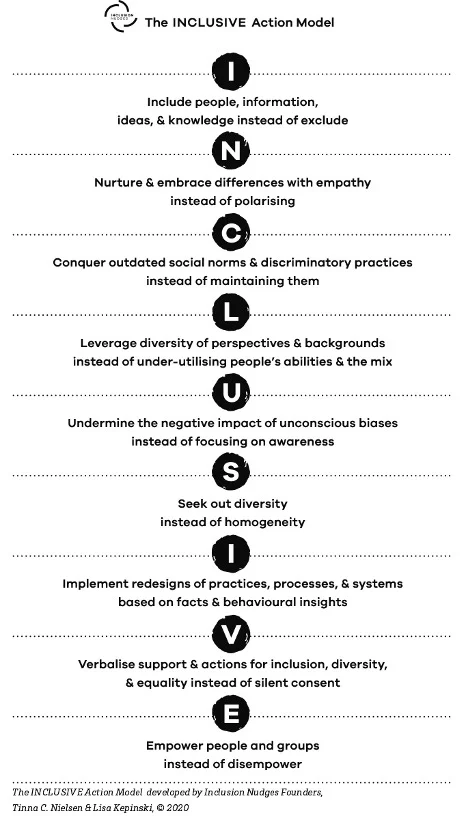
- Inclusion: Welcoming and Applying the Mix. Inclusion is about fostering the structures, systems, processes, culture, behavior, and mindset that embrace and respect all people and their diversity. Crucially, it involves actively seeking out and utilizing diverse knowledge, perspectives, information, and ideas. It mandates challenging excluding norms, confronting stereotypes, fostering openness, and encouraging individuals to speak up, ensuring all people can participate and contribute fully.
From Words to Action: Engaging All Stakeholders
While articulating clear definitions is a crucial first step, the Inclusion Nudges approach stresses that rational understanding alone is insufficient to drive inclusive behavior. Behavior is largely driven by unconscious processes (System 1 thinking), not solely by conscious reasoning (System 2). Therefore, definitions must be translated into tangible, relatable actions.
A key recommendation is to involve all people—not just DEBI specialists or HR—in the process of defining what diversity, equity, belonging, and inclusion mean to them within their specific context. This approach shifts the focus from abstract words to concrete, observable actions. By engaging employees in identifying behaviors they perceive as inclusive, inviting, respectful, and empathetic, organizations achieve several critical objectives:
- Contextual Relevance: Definitions are tailored to the organization’s unique culture and operational realities.
- Ownership and Engagement: Involving employees in the definition process fosters a sense of ownership, making them active participants in the change initiative rather than passive recipients.
- Actionable Insights: The output is a rich collection of real-life examples and personal stories of inclusive behavior, which are far more impactful than abstract concepts.
Once these examples of inclusive behavior are gathered, the next step is to make them highly visible and accessible. Rather than burying them in complex documents or spreadsheets, the Inclusion Nudges method advocates for displaying these stories and examples in prominent physical and digital spaces: factory walls, office common areas, meeting rooms, internal communication channels, and even public-facing platforms. This constant visual and narrative reinforcement illustrates how inclusion plays out in daily interactions, making it tangible and relatable without overusing the DEBI buzzwords themselves. Communication should focus on one example at a time, highlighting that these actions are being taken by peers and colleagues, creating a social norm effect. When data supports that a majority is already engaging in certain inclusive behaviors, communicating this fact ("8 out of 10 of your colleagues are doing X") can powerfully influence others.
Achieving Inclusion Without Overusing the "I-Word"
Ultimately, the goal is to embed inclusive practices so deeply into the organizational fabric that they become "how work gets done here" or "how people experience being in the group." This means consciously shifting the perception away from the words themselves and towards the desired outcomes. Instead of saying "we need more inclusion," one might say, "we need the thinking from everyone for new solutions" or "we need our systems designed to enable our most objective decision-making." This subtle linguistic shift frames DEBI as integral to business performance, innovation, agility, and overall success, rather than a separate, siloed initiative.
Over time, through consistent application of action-oriented definitions and the strategic use of "nudges" (subtle interventions that guide behavior), a shared understanding of DEBI will naturally take root. While formal definitions may still be necessary for strategies, KPIs, and external communications, the internal focus should remain on the practical, everyday behaviors that embody these principles. This approach avoids creating "buzzwords" that can lose meaning and instead cultivates a culture where inclusive actions are the norm.
The challenge of translating abstract definitions into concrete, widespread behavior across thousands of individuals simultaneously is a common hurdle for change leaders. The Inclusion Nudges change approach offers a systematic methodology, documented in their guidebooks and blog posts, to address this complex problem. By focusing on how definitions become reality through deliberate design of actions, behaviors, systems, and cultures, organizations can move beyond mere rhetoric to foster genuine inclusion.
By adopting an inclusive, action-oriented framing of DEBI, organizations can overcome the hidden tripwires of misunderstanding, resistance, and emotional barriers. This fundamental shift in approach is not just about language; it is about creating environments where every individual feels valued, heard, and empowered to contribute their fullest, ultimately driving innovation, enhancing performance, and building more equitable societies. The journey towards making inclusion the norm, everywhere and for everyone, begins with how we define it.