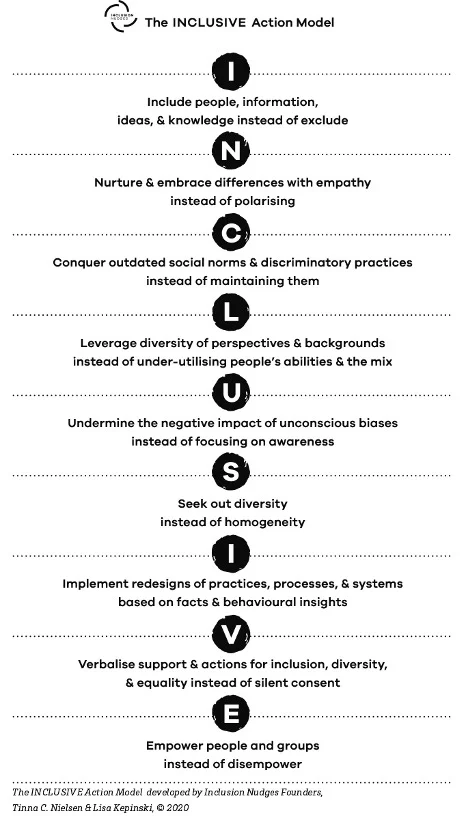
The persistent quest for truly inclusive environments within organizations, communities, and wider society often encounters a significant hurdle: the gap between stated intentions and actual behaviors. Despite widespread recognition of the benefits of diversity, equity, and inclusion (DEI), and substantial investments in traditional training and awareness programs, many change makers experience a frustrating cycle of progress followed by regression. This phenomenon—where initiatives move "three steps forward and then one step back," or even stagnate—highlights a fundamental challenge in human decision-making and underscores the urgent need for more effective, evidence-based solutions. A new approach, known as Inclusion Nudges, seeks to bridge this gap by leveraging insights from behavioral and social sciences, aiming to make inclusive actions the default, rather than an arduous conscious effort.
For decades, organizations have grappled with issues such as gender parity, anti-discrimination, and equality. Early efforts often focused on legal compliance and raising awareness, evolving into more comprehensive diversity training modules designed to educate individuals about bias and its impact. While these initiatives have undeniably played a role in shifting mindsets and establishing foundational principles, their long-term efficacy in driving sustained behavioral change has frequently been questioned. Internal change agents within multinational corporations, for instance, often report that despite their best efforts and substantial resources, desired outcomes in fostering truly inclusive cultures materialize slower than anticipated or fall short of expectations. This widespread experience signals that knowledge and willpower alone are insufficient to overcome ingrained patterns of exclusion. The global networks of professionals reveal similar struggles, indicating a systemic challenge that transcends organizational boundaries and local cultures.
This realization prompted a shift in thinking, leading to the development of Inclusion Nudges. Drawing upon a rich tapestry of disciplines—including behavioral economics, nudging theory, psychology, anthropology, linguistics, neuroscience, and complex system and microeconomic theory—this innovative methodology provides a crucial difference in impact. It posits that to achieve genuine inclusion, we must move beyond merely informing the conscious mind and instead design environments and processes that subtly steer the unconscious mind towards inclusive behaviors.
Unpacking the Unconscious: The Science Behind the Gap
To understand why Inclusion Nudges are a necessity, it’s critical to confront a counterintuitive aspect of human decision-making: our minds are not always rational. Consider a hypothetical, yet illustrative, scenario: a group of senior leaders deliberating over qualified candidates for a top management position. Imagine one leader asserting, "The best-qualified candidate is definitely the tallest. Tall leaders excel at strategy, possess greater presence, and demonstrate more resilience in tough times. They are simply the best leaders." While such an overt statement linking height to leadership prowess would be deemed absurd by any rational, conscious mind, the underlying bias it represents is a pervasive, albeit often invisible, reality.
Research consistently demonstrates that height disproportionately influences leadership selection. Studies from around the world have repeatedly shown that taller individuals are more likely to be perceived as leaders, receive promotions, and earn higher incomes, often irrespective of their actual merit or qualifications. In the United States, for example, a significant majority—around 60%—of top leaders are 185 cm (6 ft 1 in) or taller, a stark contrast to the general population where only about 14% of men reach this height. This "height-leadership effect" is a powerful testament to the influence of unconscious associations.
The explanation lies in the dual-process theory of the human mind, which distinguishes between two interdependent modes of thinking. The automatic system is characterized as unconscious, fast, instinctive, effortless, associative, and uncontrolled. Operating much like an autopilot, it governs the vast majority of our daily behaviors and choices, estimated to account for 90-99% of all thought processes. This system relies heavily on mental shortcuts, such as associations (perceived connections between elements) and biases (errors in processing information), to make rapid judgments and process stimuli. These shortcuts are evolutionarily advantageous, enabling quick reactions without expending significant cognitive energy. However, they can also lead to flawed judgments and decisions, as seen in the "tall equals strong leader" association.
In contrast, the reflective system is conscious, slow, effortful, rational, logical, self-aware, rule-following, and controlled. This is the system we typically believe is guiding our decisions, particularly in professional contexts. While we consciously aspire to fairness, objectivity, and merit-based hiring, our automatic system frequently overrides these intentions. When the unconscious mind activates a belief—such as a tall person being inherently more capable—the rational mind often then seeks evidence to confirm this belief, effectively becoming blind to contradictory facts or the merits of other candidates. This creates a significant "intention-action gap," where our stated values and knowledge diverge from our actual behaviors, often without our conscious awareness.
This cognitive gap is not diminishing; rather, it is exacerbated by the complexities of modern life. Cognitive overload, the proliferation of social media echo chambers, and increasingly busy and stressful lives intensify our reliance on mental shortcuts. This, in turn, can lead to greater homogeneity and exclusion, undermining the collective benefits of diversity. Therefore, merely knowing about biases or having good intentions is insufficient. A proactive, behavioral design approach is crucial to target the unconscious mind directly.
The Power of Nudging and Inclusion Nudges
The concept of nudging, popularized by behavioral economists Richard Thaler and Cass Sunstein, challenges the traditional assumption that individuals consistently make rational choices in their own best interest. Instead, it posits that by subtly altering the "choice architecture"—the context in which decisions are made—people can be predictably guided towards better outcomes. A nudge is a non-intrusive intervention that steers behavior without removing freedom of choice, effectively "pushing" the unconscious mind in a desired direction.
Inclusion Nudges apply this powerful methodology to the realm of DEI. They are designs based on behavioral and social sciences insights, specifically crafted to steer the unconscious mind towards inclusive behaviors by targeting behavioral drivers, judgment and choice processes, and perceptions. The goal is to make inclusion the default, the easy choice, without the need for rational arguments, threats, or conscious effort. This approach directly addresses the implicit norms embedded in cultures and systems, helping to close the intention-action gap. It offers a practical framework to combat discrimination, reduce the influence of bias, alter stereotypes, mitigate prejudice, and foster a stronger sense of belonging by increasing experiences of inclusion, amplifying voices, and encouraging allyship.
Three Pillars of Behavioral Design for Inclusion

The Inclusion Nudges change approach manifests through three distinct, yet often interconnected, types of designed interventions:
1. Show the Hidden Issue and Make People FEEL THE NEED to Engage in Change
Human behavior is driven more by feeling and seeing than by knowing. Simply telling people they are biased or that change is needed rarely leads to sustained action. Instead, Inclusion Nudges employ designs that show the implications of an issue, creating an emotional resonance that motivates the unconscious mind to engage. These "Feel the Need" Inclusion Nudges make invisible patterns visible, compelling individuals to recognize the status quo’s inadequacy and feel an intrinsic desire for change. For example, demonstrating the practical impact of bias without explicitly naming "bias" can be far more effective than a didactic lecture.
One powerful application involves making systemic inequities tangible. Consider a scenario where an organization wants to promote a sponsorship program for women leaders. Instead of simply announcing the program, a "Feel the Need" Nudge might involve presenting data that visually highlights the stark gender imbalance in senior executives’ formal and informal networks. This could be done by anonymously mapping out mentoring relationships or sponsorship connections, perhaps showing a dense web of connections among men and a sparse, isolated few for women. By visually contrasting the extensive networks of men with the limited visibility of women, leaders are not told they are biased, but rather shown the undeniable reality of an unequal system. Witnessing the numerous male names and only a handful of female names in critical informal networks creates a visceral understanding of the problem, fostering a genuine "feel the need" to support initiatives like a women’s sponsorship program. This approach bypasses rational resistance and directly appeals to the unconscious drive for fairness and effectiveness.
2. PROCESS DESIGNS to Make Inclusion the Norm Without Talking About Inclusion and Diversity
While motivating engagement is crucial, often the most profound change comes from designing processes that make inclusive behavior automatic. These "Process Design" Inclusion Nudges embed inclusion into the very fabric of daily operations, making it easy and intuitive. This eliminates the need for constant conscious reflection or explicit discussions about inclusion, ensuring that diverse perspectives are captured and biases are mitigated by default. This can be applied to collaboration frameworks, idea generation sessions, decision-making protocols, IT systems, or even the physical environment.
A common challenge in group dynamics is the self-silencing of individuals, conformity to majority views, and power imbalances that prevent diverse perspectives from surfacing. To counter this, a "Process Design" Nudge might introduce a structured method for sharing ideas. For instance, before a group discussion, individuals could be asked to independently "Share with a Peer" by discussing their initial thoughts or solutions with one other person, then consolidating their perspectives, before sharing with the larger group. This simple intervention serves multiple purposes: it ensures every voice is heard in a safer, one-on-one setting before facing the full group, reducing the pressure to conform; it allows for the capture and correction of communication misunderstandings; and it naturally surfaces a broader range of ideas, thereby accessing the full diversity of thought within the team. By making this a standard part of meeting protocol, the process itself becomes inclusive, fostering psychological safety and enabling individuals to contribute without conscious effort or prompting to "be inclusive."
3. FRAME PERCEPTIONS of Issues in Ways That Alter Understanding and Support Action
The way information is presented, problems are framed, or language is used profoundly influences our unconscious perceptions, judgments, and subsequent actions. "Frame Perceptions" Inclusion Nudges strategically alter these cognitive frames to challenge stereotypes, shift narratives, and change how individuals perceive data, people, and situations. By flipping numbers, priming specific associations, appealing to identity, or changing the anchor of thought processes, these designs can transform a perception of diversity as a burden into one of value, thereby increasing inclusive behavior as the norm.
Consider the challenge of making "hidden people" visible—those whose contributions or needs are often overlooked in standard reporting. A "Frame Perceptions" Nudge might involve "reversing the numbers" to highlight what is not being seen. Instead of presenting statistics on the percentage of a majority group, the data could be reframed to emphasize the smaller, often marginalized group. For example, if a report typically shows that "90% of employees are from the dominant demographic," a framing nudge might present it as "10% of our employees are from underrepresented groups – imagine the talent and perspectives we are missing if we don’t fully include them." Or, if leadership roles are 80% male, the focus could shift to "Only 20% of our leaders are female, despite women making up 50% of our workforce. What are the consequences of this disparity on innovation and decision-making?" This simple act of reversing the numerical focus or changing the anchor of the comparison can dramatically alter how the unconscious mind perceives the issue, prompting a deeper consideration of the hidden consequences of exclusion and the untapped potential of diversity. It moves beyond a mere statistical observation to an emotional and strategic imperative.
The Broader Impact and Imperative
The implementation of Inclusion Nudges represents a fundamental shift in how organizations approach DEI. It moves beyond abstract ideals and compliance mandates to practical, behavioral interventions that yield tangible results. Through collaborative efforts with communities, organizations, and individuals worldwide, the efficacy of this approach has been demonstrated time and again. It empowers change agents by providing concrete, actionable strategies, thereby sustaining their motivation and ensuring changes are co-created with those most affected, leading to more impactful and durable outcomes.
In an increasingly complex and interconnected world, the need for truly inclusive systems, cultures, and behaviors has never been more pressing. The ability to harness diverse perspectives is critical for innovation, problem-solving, and societal resilience. Inclusion Nudges offer a scalable framework for designing policies, technologies, environments, and processes that foster inclusive interactions and decision-making at every level. By making inclusion a natural, integrated part of daily work and life, it ceases to be a burden and instead becomes an effortless default.
A Global Movement for Collective Change
Beyond a mere change approach, Inclusion Nudges have catalyzed a global initiative and a vibrant community dedicated to collective action. Founded on the principles of sharing, reciprocity, and open source, this movement seeks to empower a vast network of change makers. Acknowledging a common frustration within social change circles—where what works is often discussed, but how it works remains elusive—the creators, Lisa and Tinna, committed to sharing detailed, step-by-step descriptions of effective behavioral designs. This commitment is embodied in resources like The Inclusion Nudges Guidebook and Action Guides, which provide comprehensive "how-to" information.
- Sharing: The initiative thrives on collaboration and co-creation. Practitioners are encouraged to share their experiences and designs based on Inclusion Nudges. These contributions are meticulously documented, analyzed for their underlying behavioral insights, and then disseminated through various platforms, accelerating the pace and scale of inclusive change globally.
- Reciprocity: Building a truly inclusive world requires collective effort. The principle of reciprocity encourages the exchange of examples, mutual support, and the sharing of these invaluable resources within networks. This collaborative ecosystem ensures that knowledge flows freely, enabling as many people as possible to contribute to making inclusion the norm.
- Open Source: Driven by the conviction that knowledge for social change should not be hoarded, the Inclusion Nudges concept and approach are shared under a Creative Commons License. This open access ensures that ideas and practical designs are available to everyone, fostering widespread adoption and experimentation.
By embracing these principles, the Inclusion Nudges movement invites individuals and organizations globally to join forces. Together, through practical, scientifically informed behavioral design, the vision of making inclusion the norm—everywhere, for everyone—moves closer to becoming a reality.