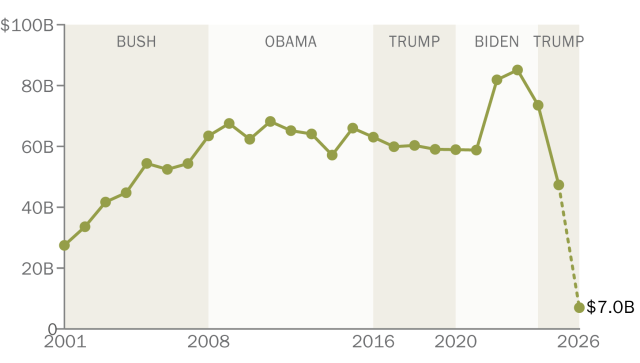
United States assistance to foreign nations has experienced a dramatic decline, reaching its lowest point in more than twenty years during the fiscal year that concluded on September 30, 2025. According to an in-depth analysis by the Pew Research Center of federal data, this downward trend is projected to continue, with current fiscal year disbursements on track to be even lower. Federal agencies disbursed a total of $47.3 billion in foreign aid in fiscal year 2025, a significant reduction of approximately $26 billion from the $73.5 billion allocated in fiscal year 2024. When adjusted for inflation, this figure represents the lowest amount of foreign aid dispensed by the U.S. since fiscal year 2004. The federal fiscal year operates on a cycle from October 1st to September 30th.
The reduction in foreign assistance signifies a notable shift in U.S. global engagement, particularly within the context of the Trump administration’s approach to international relations and development. This decrease comes after a period of increased foreign aid, largely driven by the substantial financial and humanitarian support provided to Ukraine following Russia’s full-scale invasion in February 2022. In fiscal years 2022 and 2023, inflation-adjusted foreign assistance saw significant spikes, peaking at $85.1 billion in fiscal year 2023. However, these figures have since receded sharply.
A Steep Decline: Tracking Foreign Aid Over Time
The data from ForeignAssistance.gov, the U.S. government’s primary portal for aid information, reveals a stark contrast in foreign assistance levels. Between fiscal years 2008 and 2021, annual foreign aid spending, adjusted for inflation, consistently hovered between $57 billion and $68 billion. During this period, foreign assistance typically constituted around 1% of total federal expenditures, underscoring its role as a stable, albeit relatively small, component of the national budget.
The recent surge in aid, particularly to Ukraine, temporarily distorted this trend. In fiscal years 2022 and 2023, aid to Ukraine alone accounted for a substantial portion of the overall increase. By fiscal year 2024, total foreign assistance, while still elevated compared to pre-2022 levels, began to decrease, falling to $73.5 billion. The precipitous drop in fiscal year 2025 to $47.3 billion marks a significant recalibration of U.S. international commitments.

As of July 1, 2026, the most recent data available for the current fiscal year (fiscal year 2026), the U.S. has disbursed just under $7 billion in foreign aid. This figure represents only 0.09% of estimated federal spending for fiscal year 2026, a stark reduction from 0.67% in fiscal year 2025 and significantly lower than the historical average of approximately 1%.
The Trump Administration’s Impact on Aid Infrastructure
The analysis also points to a broader trend of dismantling U.S. foreign aid infrastructure under the Trump administration. Reports indicate a significant reduction and refocusing of international aid programs, which may contribute to the sustained decline in disbursements. This strategic shift has led to a contraction in the agencies and mechanisms responsible for delivering aid, potentially impacting the efficiency and reach of future assistance efforts.
Shifting Recipient Landscape: Ukraine, Israel, and Jordan
Ukraine has consistently been the largest recipient of U.S. foreign aid for the past four consecutive years. In fiscal year 2025, Ukraine received approximately $6.7 billion, a decrease of 34.1% from fiscal year 2024, amounting to $3.5 billion less. Of this aid, roughly 69% was economic assistance, with military and security aid comprising 18.7%. However, the trajectory for fiscal year 2026 shows a dramatic reduction, with Ukraine having received only $214.4 million as of July 1, 2026, predominantly in economic or humanitarian aid.
Following Ukraine, Israel and Jordan were the next largest recipients in fiscal year 2025. Israel received $3.3 billion, a significant decrease of 51.4% from the previous year. Jordan received $1.7 billion, marking a more modest decline of 5.2%. The composition of aid to these nations also highlights differing priorities. Aid to Israel in fiscal year 2025 was overwhelmingly military and security assistance. In contrast, aid to Jordan was more diversified, with substantial allocations to economic programs, military and security initiatives, and education and social services.
As of July 1, 2026, Jordan has emerged as the leading individual recipient for the current fiscal year, with $965.7 million in recorded assistance. The West Bank and Gaza ($325.3 million) and Ethiopia ($286.7 million) follow as significant recipients of U.S. aid in fiscal year 2026.
Global, Regional, and Individual Country Allocations
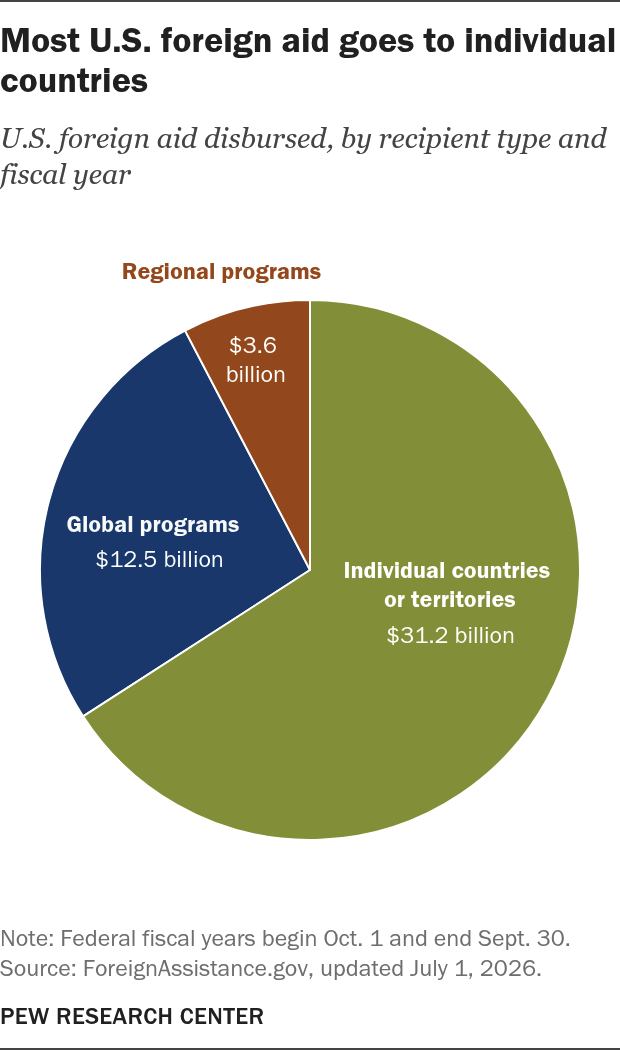
While direct aid to individual countries remains a significant component, the distribution of U.S. foreign assistance also encompasses broader initiatives. In fiscal year 2025, global programs accounted for 26.5% of all foreign aid, totaling $12.5 billion. These programs address issues that transcend national borders, such as global health initiatives, climate change mitigation, and international development efforts. Regional programs received 7.7% ($3.6 billion), supporting initiatives within specific geographic areas. The largest share, 65.9% ($31.2 billion), was directed to individual countries and territories.
Reallocation of Aid: A Shift in Priorities
The nature of foreign aid spending has also seen a notable shift. Historically, military and security programs often constituted the largest portion of U.S. foreign assistance, encompassing training for military and police forces, counter-terrorism operations, and conflict resolution. In fiscal year 2024, these endeavors accounted for over a quarter of all foreign assistance.
However, fiscal year 2025 witnessed a substantial reduction in military and security aid, which fell by nearly $11 billion, from $18.2 billion to $7.3 billion. Consequently, this category represented only 15.5% of total aid, the smallest share recorded since fiscal year 2001, the earliest year for which data is available on ForeignAssistance.gov.
Conversely, public health initiatives became the largest category of foreign aid spending in fiscal year 2025, representing 23.1% of the total. This includes funding for critical areas such as combating infectious diseases like HIV/AIDS and malaria, maternal and child health programs, and improvements in water and sanitation infrastructure. While still substantial, health programs saw a decrease from $15.2 billion in fiscal year 2024 to $10.9 billion in fiscal year 2025.
Economic development aid also played a larger role, accounting for 17.3% of foreign assistance in fiscal year 2025, an increase from 13.3% in the previous year, despite an absolute decrease of nearly $1.4 billion. The remaining funds in fiscal year 2025 were allocated to a diverse range of programs, including education, environmental protection, disaster relief, and democracy promotion.
Methodology and Scope of Data
The Pew Research Center’s analysis is based on disbursements, meaning the actual outflow of funds, rather than appropriated or obligated funds, which are subject to change. The primary data source is ForeignAssistance.gov. It is important to note that this data does not encompass all forms of U.S. international engagement, such as Foreign Military Sales, which allow for the transfer of defense articles and services to other nations. These sales, often substantial in value, operate under a separate framework and are not reflected in the foreign assistance figures presented.
The "peace and security" category in the data encompasses a broad range of activities, including military and police training, counter-terrorism efforts, counternarcotics operations, and programs related to conflict prevention and resolution. The significant reduction in this category for fiscal year 2025, alongside the increase in the share of health and economic development aid, suggests a potential shift in the strategic focus of U.S. foreign policy.
Broader Implications and Future Outlook
The substantial decrease in U.S. foreign aid carries significant implications for global development, humanitarian efforts, and international relations. Reduced funding can impact the stability and progress of recipient countries, potentially exacerbating humanitarian crises and hindering efforts to address global challenges such as poverty, disease, and climate change. Furthermore, a diminished role in foreign assistance could alter the U.S.’s standing and influence on the global stage, creating opportunities for other nations to expand their own international aid programs.
The trend suggests a re-evaluation of America’s role in global affairs, with a potentially greater emphasis on domestic priorities or a more selective approach to international engagement. The long-term consequences of this sustained reduction in foreign aid will likely unfold over the coming years, impacting geopolitical dynamics and the effectiveness of international cooperation on critical global issues. The data indicates a period of significant transition in how the United States allocates its resources and engages with the world.