The landscape of local news consumption in the United States has undergone a profound transformation in recent decades, as Americans increasingly shift away from traditional print and television mediums towards digital platforms. This ongoing evolution, tracked by the Pew-Knight Initiative, reveals a significant decline in attention to local news, shifts in how people access it, and evolving perceptions of its financial health and importance. The Pew Research Center, a nonpartisan fact tank, and the John S. and James L. Knight Foundation, a social investor focused on informed and engaged communities, have collaborated on extensive research to illuminate these trends, providing critical data from 2016 to the present.
The core findings of this research paint a clear picture: fewer Americans are closely following local news, while the sources they rely on are diversifying, with a notable surge in digital and community-based channels. This shift has significant implications for civic engagement, community cohesion, and the sustainability of local journalism itself.
The Erosion of Attention to Local News
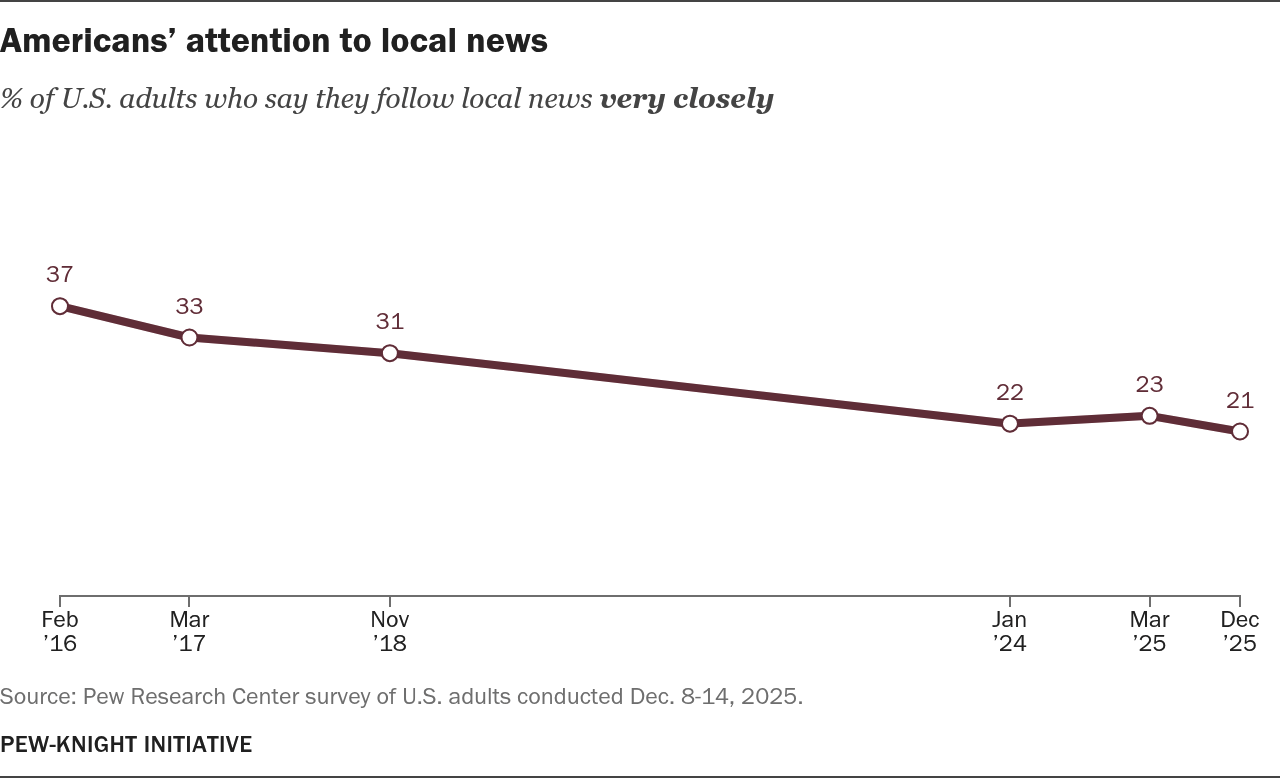
A striking trend identified by the Pew-Knight Initiative is the steady decline in Americans’ attentiveness to local news. In 2016, a robust 37% of U.S. adults reported following local news "very closely." By 2025, this figure had fallen to just 21%. This mirrors a broader societal trend of decreased engagement with news in general, as documented in other Pew Research Center analyses. The downward trajectory suggests a growing detachment from local affairs, potentially fueled by the overwhelming volume of information available through digital channels and a perceived lack of relevance or accessibility of traditional local news formats.

The data illustrates a consistent pattern:
- 2016: 37% followed local news very closely.
- 2017: 33%
- 2018: 31%
- 2024: 22%
- 2025: 23% (with a specific survey in December 2025 showing 21%)
This decline is not isolated to local news but reflects a broader disengagement with news consumption, indicating a potential challenge for informing citizens about crucial community issues.
Shifting Sources: The Rise of Digital and Community Channels
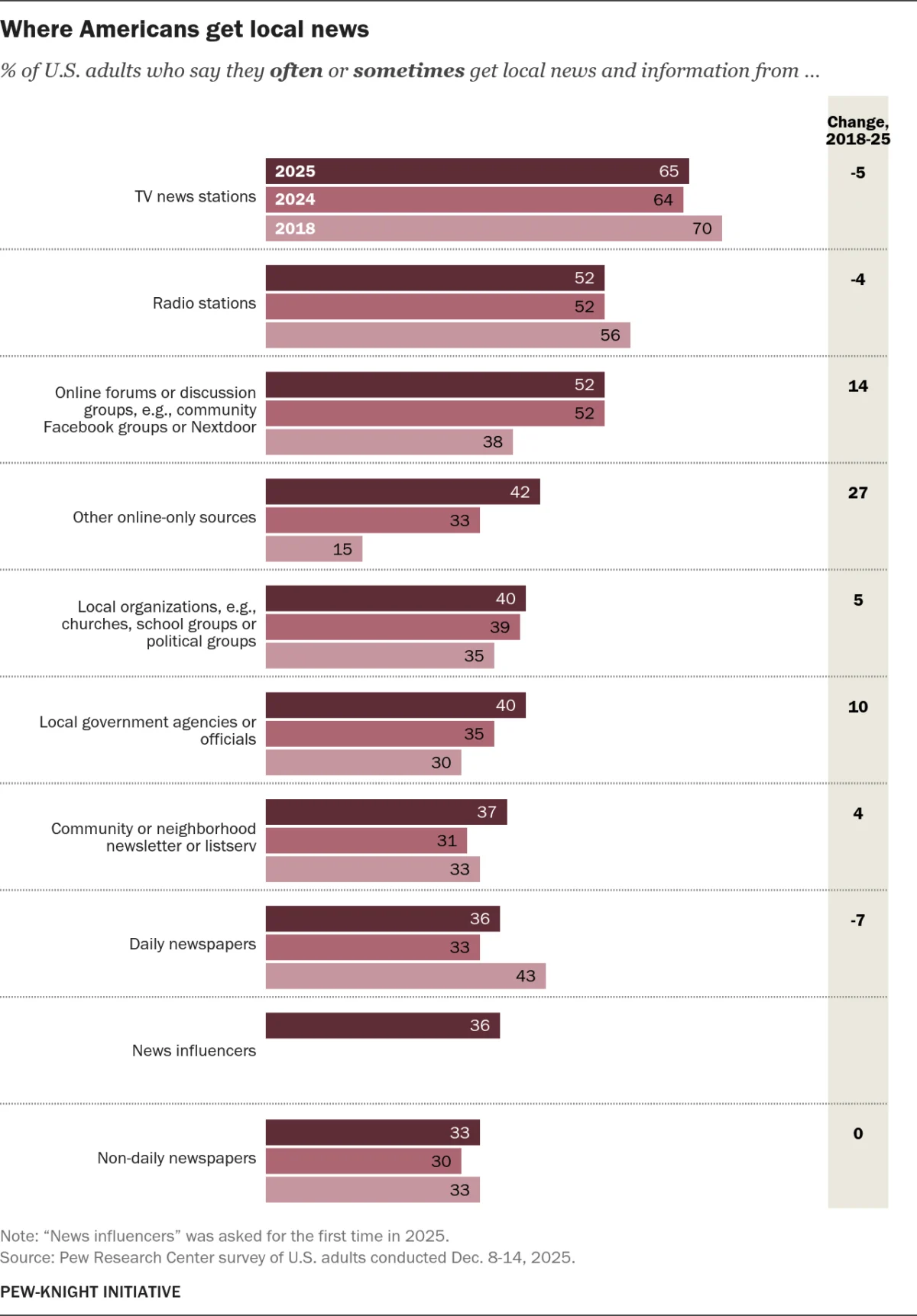
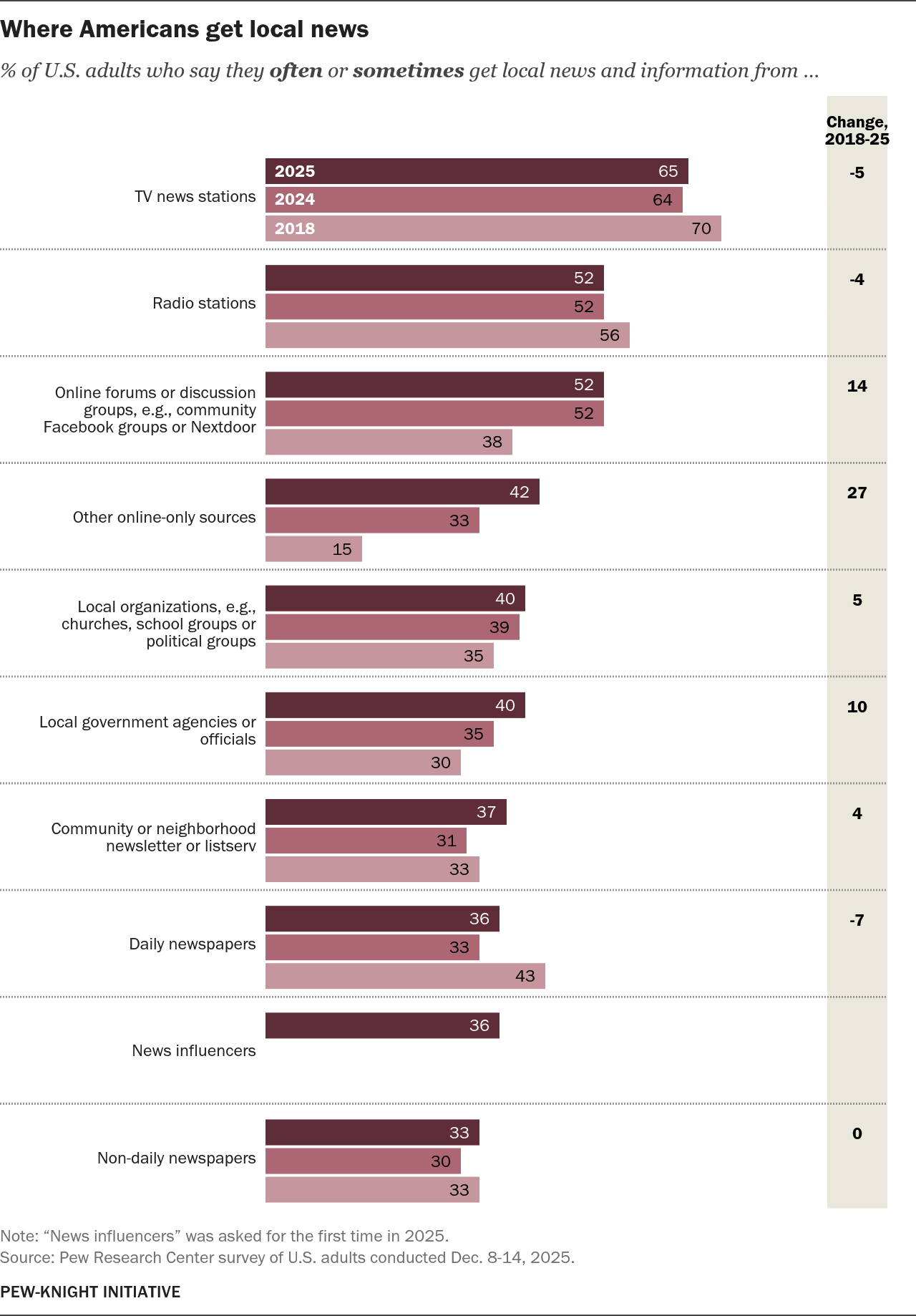
While attention wanes, the ways Americans access local news are becoming more varied. Traditional sources like local television news stations remain significant, with 65% of U.S. adults reporting they at least sometimes get news from this medium, a slight decrease from 70% in 2018. Local newspapers, however, have seen a more pronounced decline, with only 36% of adults accessing them at least sometimes in 2025, down from 43% in 2018.
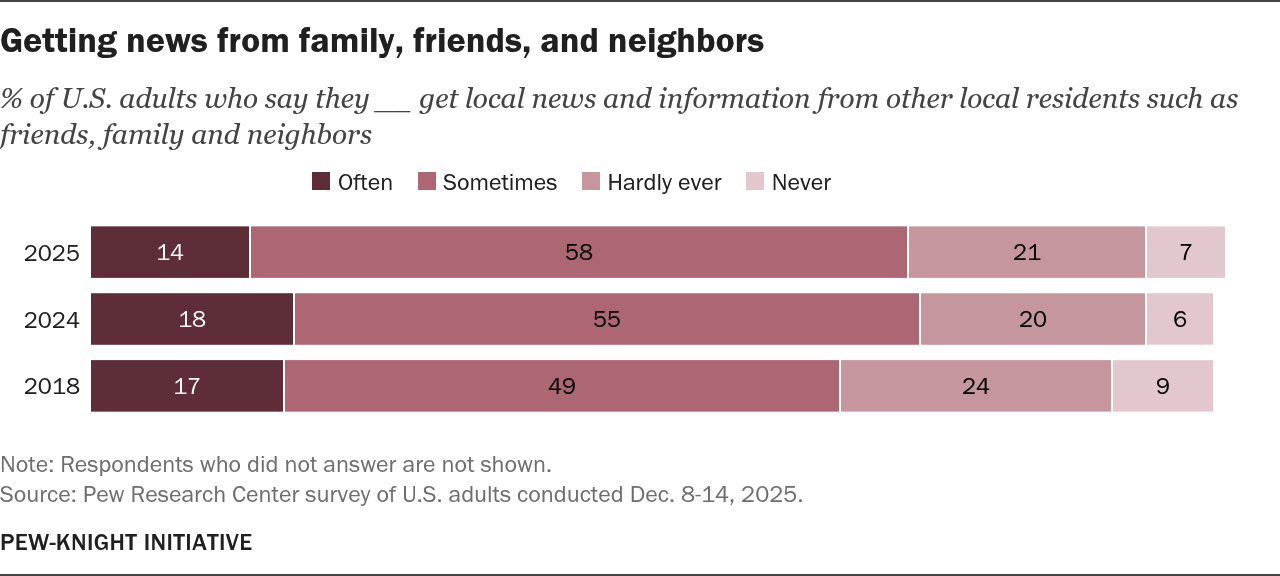
The real growth areas are in digital and community-driven sources. Online forums and discussion groups, such as community Facebook groups or Nextdoor, have seen a substantial increase, with 52% of Americans now getting local news from these platforms, up from 38% in 2018. Similarly, local government agencies and officials are becoming more direct sources of information, utilized by 40% of adults, a significant jump from 30% in 2018.
The most dramatic surge has been in "online-only" sources. In 2025, 42% of U.S. adults reported getting local news from sources that publish exclusively online and were not categorized elsewhere. This represents more than a doubling from just 15% in 2018, highlighting the rapid expansion of digital-native local news providers.
The distribution of local news sources in 2025 includes:
- Local TV news station: 65%
- Local radio station: 52%
- Online forums or discussion groups: 52%
- Online-only sources: 42%
- Local government agencies or officials: 40%
- Local organizations (churches, school groups, etc.): 40%
- Community newsletters or listservs: 37%
- "News influencers" (social media personalities): 36%
- Local daily newspaper: 36%
- Other community or specialized newspapers: 33%
This diversification suggests a public seeking information through channels that are often more immediate, interactive, and tailored to specific interests.
Evolving Preferences for News Platforms
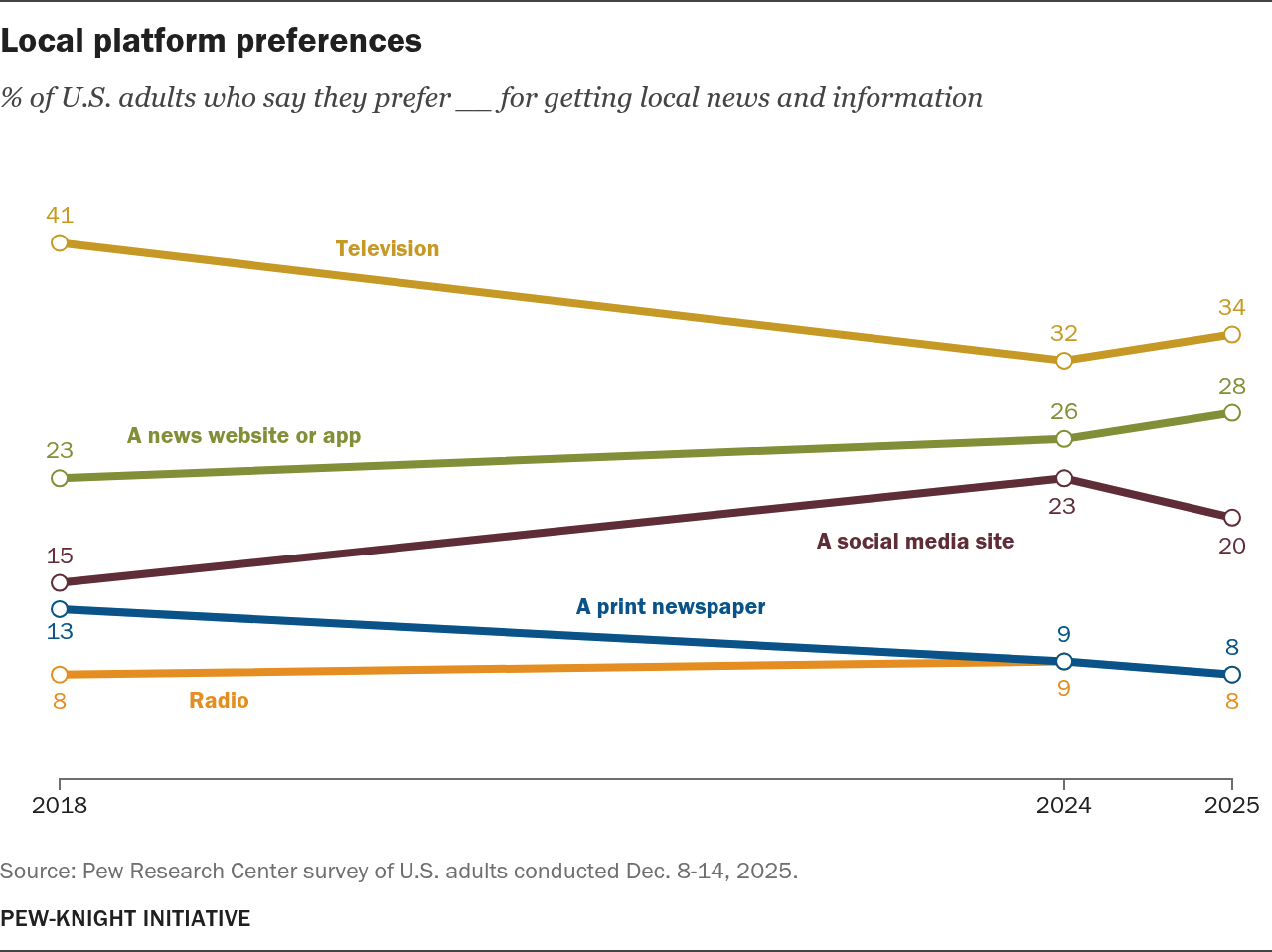
Despite the growing use of digital platforms, television remains the most preferred pathway for local news, albeit with declining preference. In 2025, 34% of U.S. adults expressed a preference for television for local news, down from 41% in 2018. However, this still outpaces other categories. Social media sites are preferred by 20%, and news websites or apps by 28% in 2025. Print newspapers are the least preferred at 8%.
The data on platform preference indicates a generational and digital divide:
- Younger adults (18-29) heavily favor social media (41%) and news websites/apps (30%).
- Older adults (65+) overwhelmingly prefer television (60%).
- Those with higher education levels show a greater preference for news websites and apps (39%) compared to television (24%).
This divergence in preference suggests that as older generations, who are more likely to prefer television, age out of the population, the overall preference for traditional media may continue to decline.
The Digital Integration of Traditional Outlets
The shift to digital is not just about new sources but also about how traditional outlets are accessed. A significant portion of those who consume local TV news now do so online. In 2025, 56% of local TV news consumers primarily accessed that content through traditional television, down from 76% in 2018. The remaining 43% primarily get their local TV station’s news online, via websites, apps, emails, or social media.
The trend is even more pronounced for local newspapers. A substantial 68% of individuals who get news from local daily newspapers now primarily access it online, a significant increase from 43% in 2018. This demonstrates the imperative for traditional news organizations to maintain a robust and user-friendly digital presence to reach their audiences effectively.
Perceptions of Financial Health and Willingness to Pay
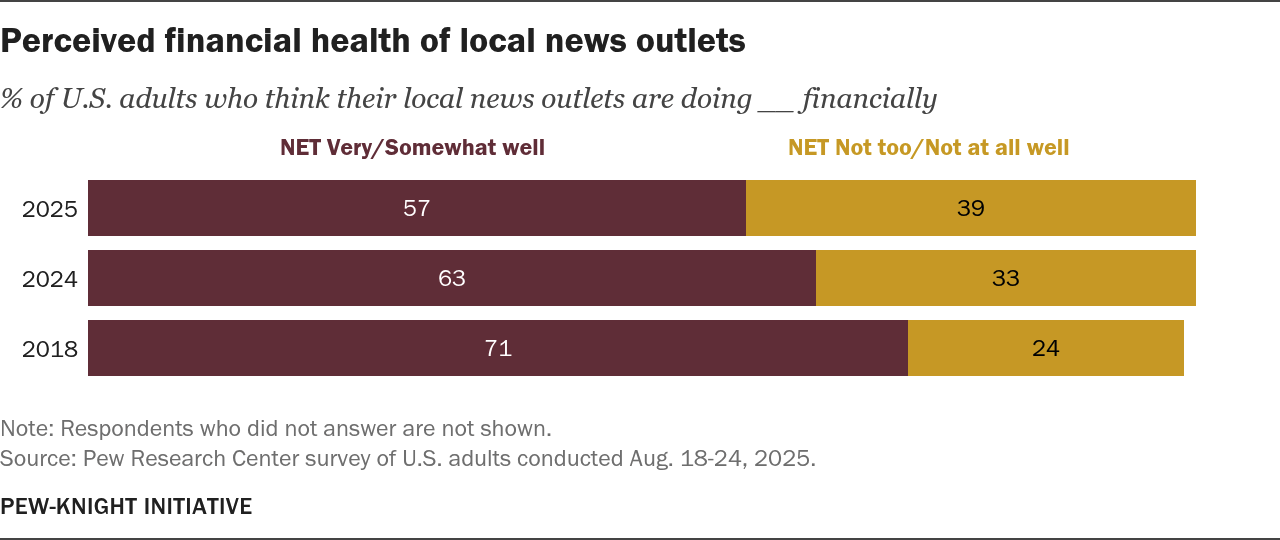
Concerns about the financial sustainability of local news outlets are a recurring theme. While a majority of U.S. adults (57% in 2025) believe their local news outlets are doing at least somewhat well financially, this represents a notable decline from 71% in 2018. Conversely, the proportion who believe these outlets are not doing well has increased from 24% in 2018 to 39% in 2025.
This perception of financial struggle is not translating into widespread direct financial support. A vast majority of Americans (88% in 2025) have not paid for local news in the past year through subscriptions, donations, or memberships. Only 12% report having done so. This figure has remained relatively stable, hovering around 14% in previous years.
The primary reasons cited for not paying for local news have remained consistent:
- 50% state they can find plenty of free local news.
- 29% are not interested enough to pay.
- 10% find it too expensive.
- 9% believe the news provided is not good enough to pay for.
These reasons suggest a challenge for news organizations seeking to implement paywalls or subscription models. The perception of free availability and a lack of perceived necessity or quality present significant hurdles.
The Enduring Importance of Local News
Despite the challenges in consumption and financial support, a strong majority of U.S. adults (80%) still recognize the importance of local news outlets to the well-being of their communities. However, there has been a recent dip in those who deem local news "extremely" or "very" important, falling from 44% in 2024 to 34% in 2025. While this indicates a slight erosion of perceived urgency, the overall sentiment remains that local news plays a vital role.
Demographic analysis reveals nuances in attitudes towards local news:
- Older adults (65+) and those with less formal education (HS or less) express slightly higher levels of concern about the importance of local news, though the overall majority across age and education groups affirm its significance.
- Republicans and those leaning Republican (75%) are less likely to consider local news outlets important compared to Democrats and those leaning Democratic (86%). This political divide in perceived importance could have implications for civic engagement and community action.
Direct Interaction with Local Journalists
Direct interaction with local journalists, while not widespread, provides a measure of engagement. Approximately 23% of Americans report having spoken with a local journalist at some point in their lives. This figure has remained relatively stable since 2016, indicating that direct personal connections with news professionals are not significantly increasing or decreasing across the general population. However, college graduates (30%) are more likely than those with a high school education or less (17%) to have had such interactions, suggesting a correlation between educational attainment and engagement with news creators.
Demographic Variations in News Habits
The Pew-Knight Initiative’s data also highlights significant demographic variations in local news consumption and attitudes.
Attention to Local News: While overall attention has declined, certain groups remain more engaged. Adults aged 65 and older (32%) are more likely to follow local news very closely than younger age groups. Black adults (34%) and Hispanic adults (21%) show varied levels of attention, with Black adults demonstrating higher engagement in this specific metric.
Local News Platform Use: Consumption patterns vary considerably by demographic. Younger adults (18-29) are more likely to use online forums (54%) and online-only sources (48%) for local news. Older adults (65+) still heavily rely on television news stations (78%) and daily newspapers (42%). Women are more likely than men to access local news through online forums/groups (57% vs. 46%), local government sources (43% vs. 36%), and local organizations (43% vs. 37%).
Local News Platform Preference: The preference for news platforms also shows stark demographic divides. Younger adults (18-29) overwhelmingly prefer social media sites (41%), while older adults (65+) strongly prefer television (60%). Individuals with college degrees or more education are significantly more likely to prefer news websites or apps (39%) than television (24%). Republicans show a stronger preference for television (35%) and print newspapers (9%) compared to Democrats, who lean more towards news websites/apps (31%) and social media (22%).
Paying for Local News: A notable trend emerges regarding financial support for local news. Adults aged 65 and older are the most likely to have paid for local news in the past year (19%), followed by those with college degrees or more education (17%). Democrats and those leaning Democratic (17%) are also more likely to pay than Republicans and those leaning Republican (8%). This suggests that while a large majority do not pay, those who do are disproportionately older, more educated, and politically liberal.

Implications for the Future of Local Journalism
The findings from the Pew-Knight Initiative underscore a critical juncture for local news in America. The continued decline in direct attention to local news, coupled with the shift towards fragmented digital sources, presents a challenge for fostering informed and engaged communities. The increasing reliance on social media and online forums for local information raises questions about the accuracy and depth of reporting, as well as the potential for misinformation to spread unchecked.
The financial struggles of local news organizations, evidenced by declining perceptions of their health and a persistent reluctance to pay for content, threaten the sustainability of in-depth, investigative local journalism. Without viable revenue streams, many local newsrooms may face further cutbacks or closures, leading to news deserts and a diminished capacity for local accountability and civic discourse.
The Pew-Knight Initiative’s ongoing research is vital for understanding these evolving dynamics. By providing data-driven insights, it equips policymakers, journalists, and the public with the knowledge needed to navigate these challenges and explore innovative solutions to ensure the future of robust local news ecosystems. The collaborative efforts of Pew Research Center and the Knight Foundation continue to shed light on these crucial issues, informing the public discourse and driving efforts to strengthen local journalism for the benefit of communities nationwide.