A comprehensive new report from the Pew-Knight Initiative, a collaboration dedicated to understanding American civic life, has unveiled distinct patterns of engagement across various domains, revealing significant generational divides in how Americans participate in their communities and the broader public sphere. The study, which analyzed data from extensive national surveys conducted between July and December 2025, categorizes Americans into four distinct "engagement groups" based on their involvement in politics, civic and community activities, news consumption, and religious participation. The findings highlight a clear divergence in behaviors and preferences between younger and older Americans, shaping their interactions with society.
The research underscores a fundamental shift in how different age cohorts connect with public life. While older Americans tend to gravitate towards traditional, more direct forms of participation, younger generations are increasingly leveraging digital platforms for engagement, often in more observational capacities. This generational stratification has profound implications for the future of civic discourse, community building, and political participation in the United States.

Understanding American Engagement: A New Framework
The Pew-Knight Initiative’s report, "How Americans Are Engaged With News, Politics, Religion and Civic Life," aims to provide a more integrated understanding of public engagement, moving beyond the siloed study of individual activities. Researchers collected data through two primary surveys: the Cross-Sectional Engagement Survey, comprising 5,393 U.S. adults, and Wave 179 of the American Trends Panel (ATP), with 5,195 respondents. The methodology involved a cluster analysis of 19 behavioral measures to identify distinct engagement groups. The study specifically sought to capture behaviors during a period that included the 2024 presidential election, acknowledging that political engagement patterns can fluctuate with the electoral cycle.
The core objective was to bridge the gap between disparate studies of public participation, offering a holistic view of how individuals combine different activities in their daily lives. Acknowledging the potential for surveys to underrepresent less engaged populations, the research team employed robust outreach strategies, including multiple contact attempts and diverse response modalities (online, paper, telephone) to ensure a more representative sample.
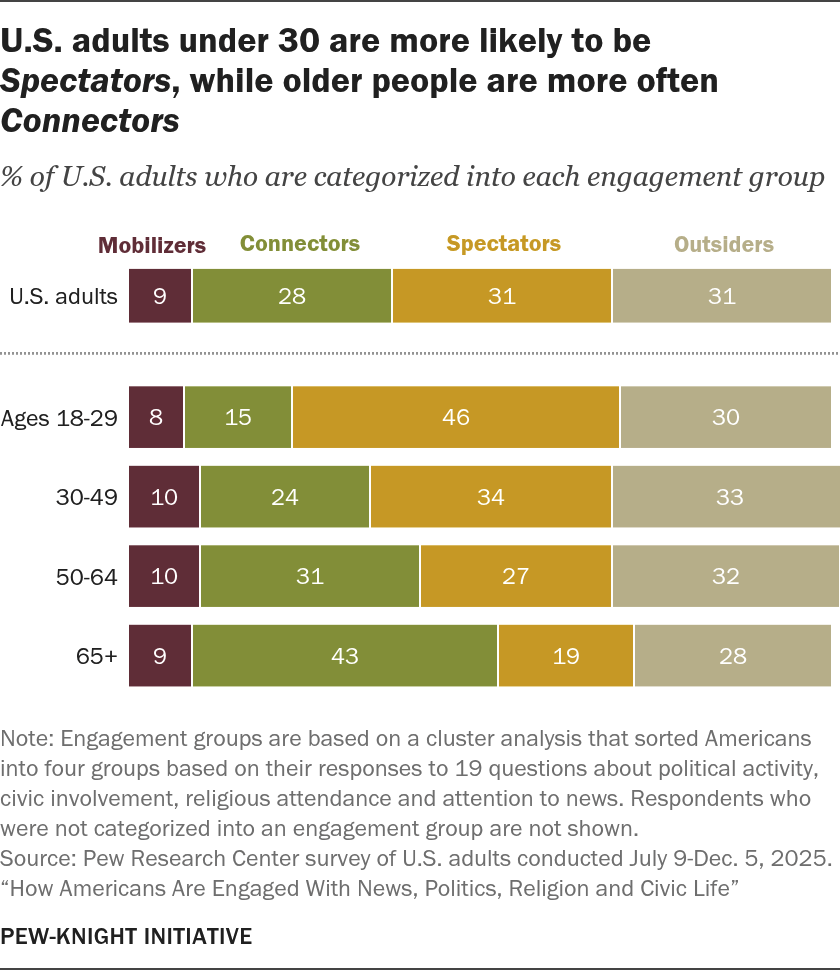
The four identified engagement groups are:
- Mobilizers: The most active segment, demonstrating high engagement across all domains—politics, civics, news, and religion. This group is the smallest.
- Connectors: Highly involved in civic and community life, religious activities, and news consumption, but less so in direct political action compared to Mobilizers.
- Spectators: Primarily engaged with news and information, particularly online, but with lower levels of participation in other civic or political activities.
- Outsiders: The least engaged group, showing minimal participation across most studied activities.
Generational Divides Emerge: Connectors vs. Spectators
A central finding of the Pew-Knight Initiative’s research is the stark contrast in engagement patterns between younger and older Americans. The study reveals that older adults are significantly more likely to be "Connectors," deeply involved in traditional civic and community activities, while younger adults disproportionately fall into the "Spectators" category, primarily engaging with information and news online.
The data indicates that 43% of Americans aged 65 and older identify as Connectors, a figure nearly three times higher than that of adults aged 18 to 29, where only 15% fall into this category. This suggests a sustained commitment to established forms of civic participation among older demographics. These activities often include voting, donating to charitable causes, volunteering, and attending religious services.
Conversely, nearly half of adults under 30 (46%) are classified as Spectators. This group is characterized by a high degree of news consumption and interaction, predominantly through digital channels. In contrast, only 19% of those aged 65 and older are Spectators, highlighting a generational preference for different modes of engagement.

Despite these differences in the dominant engagement styles, the report notes that the most and least engaged groups, Mobilizers and Outsiders, show more consistent distribution across age demographics. Approximately 10% of Americans in all age brackets are Mobilizers, representing the most active segment of the population. Similarly, around three-in-ten individuals across age groups are classified as Outsiders, indicating a consistent segment of the population that remains largely disengaged from public life.
Older Americans: Masters of Traditional Engagement
The research provides compelling evidence that older Americans are more deeply embedded in traditional forms of civic and political participation. When examined across key activities, distinct generational trends become apparent.
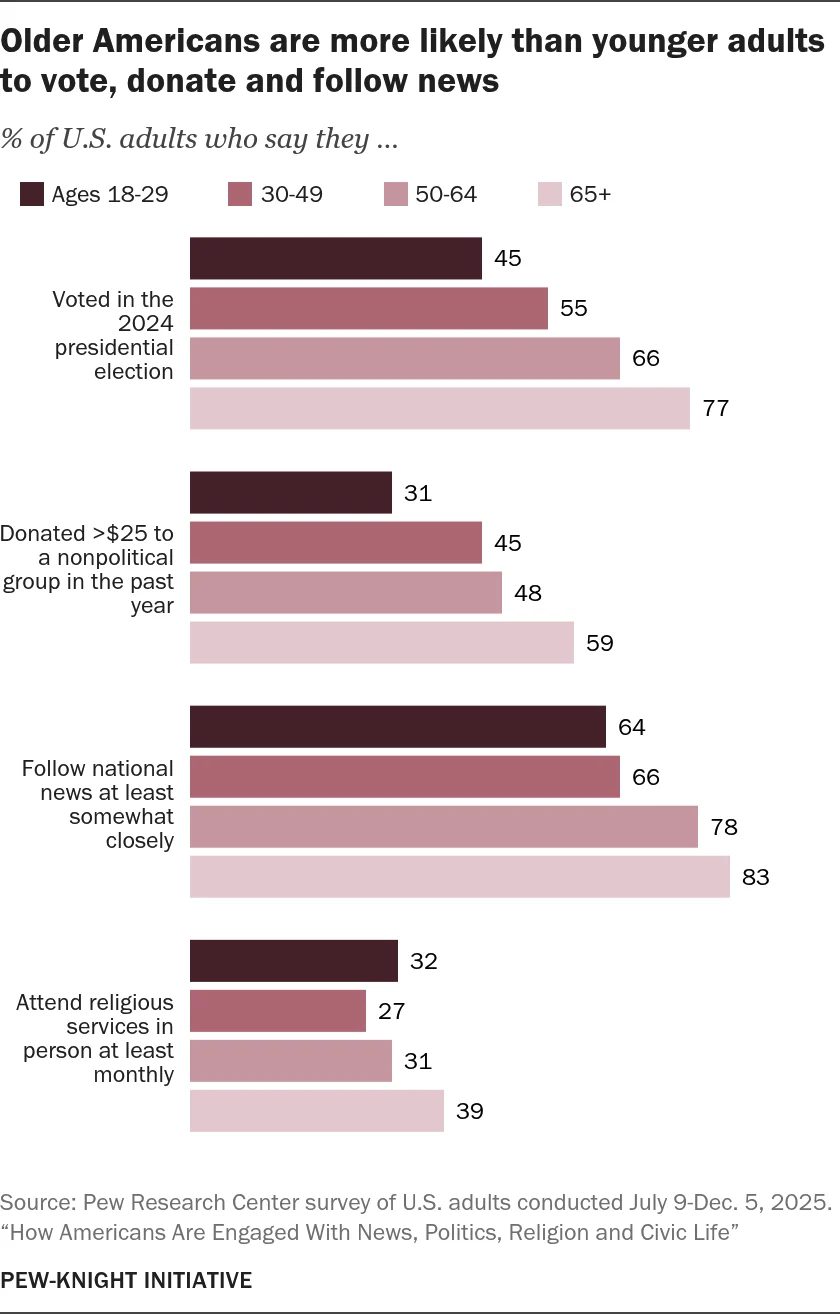
Political Participation: The data strongly supports the notion that older adults are more likely to vote. In the 2024 presidential election, 77% of individuals aged 65 and older reported voting, a figure that progressively decreases with younger age groups. Only 45% of adults under 30 indicated voting in the same election. This disparity underscores the enduring importance of the ballot box for older generations and highlights a potential challenge for mobilizing younger voters.

Financial and Charitable Contributions: Older Americans also demonstrate a greater propensity for financial contributions. Nearly six-in-ten individuals aged 65 and older (59%) reported donating more than $25 to a nonpolitical organization in the past year. This contrasts sharply with the 31% of adults under 30 who made similar donations. Furthermore, older adults were more likely to contribute to political campaigns, with 18% of those 65 and older donating to political organizations or campaigns, compared to just 6% of those under 30. This suggests that older cohorts may possess greater disposable income and a stronger inclination to support causes and campaigns financially.
News Consumption and Religious Attendance: The trend of higher engagement among older Americans extends to their consumption of national news and participation in religious life. A significant 83% of adults aged 65 and older reported following national news at least somewhat closely, compared to 64% of those under 30. Similarly, religious services see higher attendance among older demographics, with 39% of those 65 and older attending in person at least monthly, versus 32% of the youngest adults. These figures indicate a continued reliance on traditional media and religious institutions as sources of information and community for older generations.
Younger Americans: Navigating the Digital Public Square
While younger Americans may be less inclined towards traditional civic and political activities, the Pew-Knight Initiative study reveals a robust and distinct form of engagement: digital participation. This cohort is more likely to interact with news and public discourse through online channels, often in ways that are observational rather than directly participatory.

Online News Engagement: The research highlights a significant difference in how younger and older Americans engage with news online. A substantial 65% of adults aged 18 to 29 reported privately chatting about or sharing news online in the past week, a behavior significantly more common than among older age groups. This indicates a strong tendency among younger individuals to discuss and disseminate information within their social networks, albeit often in private digital spaces.
Furthermore, 59% of young adults reported liking or saving online posts about news, demonstrating an active engagement with content they encounter on social media and other platforms. This figure sharply declines with age, with only 32% of those 65 and older engaging in similar online news curation. This suggests that for younger generations, social media platforms serve as both a primary news source and a space for personal interaction with that content.
Public Online Discourse: Interestingly, the propensity for publicly posting, sharing, or commenting about news online shows less of a generational divide. Approximately a quarter of adults across all age groups engage in this behavior, suggesting that while the act of sharing news online is prevalent, the public nature of that sharing may not be as strongly age-differentiated as private sharing or content interaction.

Volunteering Trends: In contrast to their lower engagement in political activities, younger Americans show a slightly higher inclination towards volunteering. About a third of U.S. adults under 30 (32%) and a similar share of those aged 30 to 49 (31%) reported volunteering for an organization or association in the past 12 months. This figure is notably higher than among older age groups, with 26% of those aged 50 to 64 and 25% of those 65 and older reporting similar volunteer activities. This suggests that while older generations might be more engaged in traditional political and financial contributions, younger cohorts find avenues for community involvement through volunteer work.
Implications for the Future of Civic Life
The findings of the Pew-Knight Initiative study carry significant implications for understanding and shaping the future of American civic life. The diverging engagement patterns between generations point to a potential disconnect in how societal issues are perceived, discussed, and addressed.
The continued reliance of older Americans on traditional engagement methods, while vital for maintaining established civic structures, may not fully capture the evolving concerns and communication styles of younger generations. Conversely, the increasing digital-native engagement of younger Americans, while offering new avenues for information dissemination and social connection, can sometimes lack the depth of commitment and direct action characteristic of older cohorts.

The study’s emphasis on the "Spectator" role among younger adults suggests a need for strategies that can translate online awareness into tangible civic action. This could involve leveraging digital platforms to foster greater understanding of complex issues, encouraging more direct forms of political and community involvement, and ensuring that younger voices are not only heard but also empowered to participate more actively.
For policymakers, community leaders, and organizations, understanding these generational differences is crucial for developing effective outreach and engagement strategies. Tailoring communication methods, recognizing diverse forms of participation, and fostering intergenerational dialogue can help bridge these divides and build a more inclusive and robust public sphere. The Pew-Knight Initiative’s research provides a critical data-driven foundation for these ongoing efforts to understand and strengthen American engagement in public life.