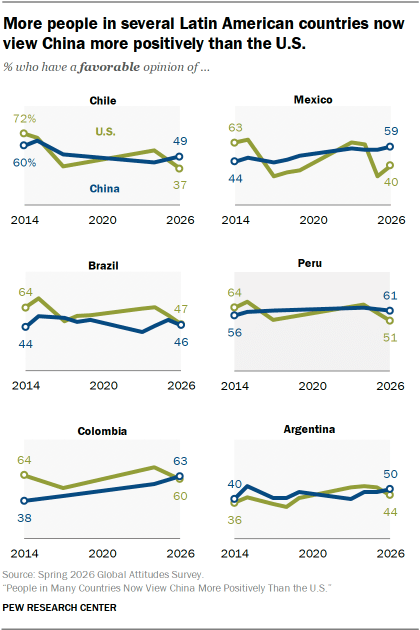
A comprehensive new survey by the Pew Research Center reveals a significant shift in public perception across Latin America regarding the United States and China. Over the past year, favorability ratings for the U.S. have declined in five out of six surveyed Latin American nations, while views of China have largely remained stable. This trend has resulted in increasingly comparable public favorability ratings for the two global powers in several key countries within the region. The findings underscore the intensifying competition for influence in Latin America, where both the U.S. and China have actively sought to deepen economic and strategic ties.
The report, which surveyed 42,151 individuals across 36 countries globally, dedicates specific analysis to six Latin American nations: Argentina, Brazil, Chile, Colombia, Mexico, and Peru. This regional focus highlights the nuanced dynamics at play as China solidifies its position as a major economic partner, while the U.S. navigates a complex geopolitical landscape. The survey, conducted between February 8 and May 13, 2026, provides a critical snapshot of evolving public sentiment, offering insights into how these nations perceive the leadership, foreign policy approaches, and respect for freedoms exhibited by both superpowers.
The Evolving Balance of Power: A Regional Snapshot
The survey data indicates a clear trend: in four of the six Latin American countries examined – Argentina, Chile, Mexico, and Peru – China now enjoys more favorable public opinion than the United States. In Brazil and Colombia, the perceptions of the two nations are nearly on par, suggesting a regional leveling of the playing field. This represents a notable departure from previous years. For instance, in 2014, a majority in most of these countries, with the exception of Argentina, held a more positive view of the U.S. compared to China.
The current sentiment in Brazil, Chile, and Peru mirrors favorability levels seen in 2017, which were historically low for the U.S. according to Pew Research Center’s past surveys. This sustained decline in U.S. favorability in these key South American nations signals a potential recalibration of diplomatic and economic priorities within the region.

Ideological and Generational Divides Shape Perceptions
Analysis of the survey results reveals significant ideological and generational divides influencing views on both the U.S. and China. In Brazil, for example, individuals identifying with the political right are considerably more likely to hold a positive view of the United States (58%) compared to those on the left (30%). Conversely, the ideological leanings are reversed when assessing China, with Brazilians on the left expressing greater favorability (57%) than those on the right (40%). Similar ideological patterns were observed in Colombia.
Age also plays a crucial role in shaping perceptions. Younger adults in Brazil, Chile, Mexico, and Peru are more inclined to view both the U.S. and China positively when contrasted with older demographics. In Mexico, 52% of individuals aged 18 to 34 expressed a favorable view of the U.S., while a significantly higher 70% held a positive view of China. Similarly, in Brazil, approximately six in ten adults under 35 expressed positive sentiments towards both superpowers, a stark contrast to the roughly four in ten aged 50 and above who shared similar views. These generational differences suggest that future U.S. and Chinese influence strategies may need to adapt to appeal to younger, increasingly globally connected populations.
Confidence in Leadership: A Shared Skepticism
A significant finding across all six Latin American countries is the general lack of confidence in both U.S. President Donald Trump and Chinese President Xi Jinping to effectively manage global affairs. In none of the surveyed nations did either leader receive a majority rating of confidence. This widespread skepticism towards the top leadership of both global powers suggests a regional desire for more stable and predictable international engagement.
However, nuances exist in these perceptions. Mexican adults are notably more likely to express confidence in President Xi Jinping (35%) than in President Trump (11%), a disparity of more than three to one. Conversely, in Colombia, President Trump garners more confidence (43%) than President Xi (33%). These divergent views highlight the localized impact of leadership styles and diplomatic overtures on public opinion within the region. A deeper dive into the broader 36-country survey reveals more comprehensive data on how these leaders are perceived globally.
Foreign Policy Approaches: Perceptions of Interference and Partnership
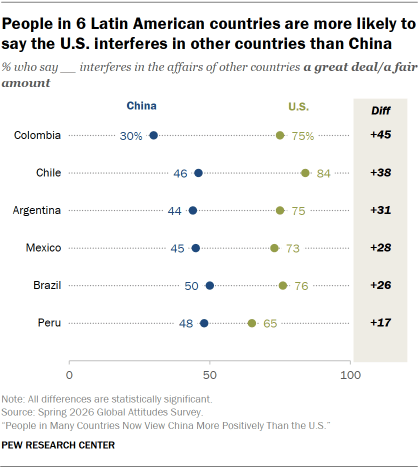
When it comes to foreign policy, a substantial majority in each of the six Latin American countries surveyed perceive the United States as interfering in the affairs of other nations. In contrast, a considerably smaller proportion of respondents believe China engages in similar interference. For instance, in Colombia, 75% of respondents indicated that the U.S. interferes "a great deal" or "a fair amount" in other countries’ affairs, compared to only 30% who expressed the same sentiment regarding China.
This perception of U.S. interference has remained relatively consistent in Argentina, Brazil, and Mexico since 2023, according to data from that year. However, the proportion of respondents who believe China interferes has actually decreased in Brazil and Mexico during the same period, further widening the perception gap.
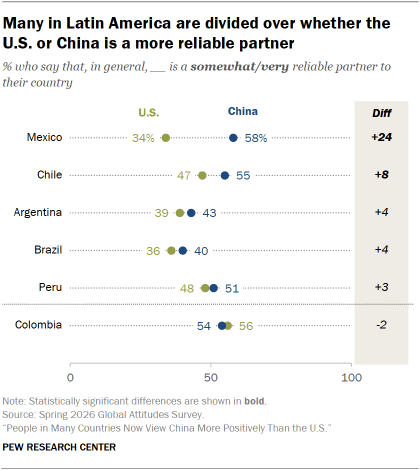
The question of which nation serves as a more reliable partner yields more divided opinions. In Mexico and Chile, a greater number of respondents identified China as a more reliable partner than the U.S. In the remaining four countries – Argentina, Brazil, Peru, and Colombia – there was no clear consensus. In Argentina and Brazil, approximately four in ten respondents considered both the U.S. and China to be reliable partners. In Peru and Colombia, roughly half or more of the respondents held a similar positive view of both nations’ reliability.
Similarly, in four of the six countries, there was no significant difference in the proportion of respondents who believed the U.S. and China consider the interests of countries like theirs when formulating international policy. However, in Mexico and Peru, a larger share of respondents felt that China is more attentive to the interests of other nations.
Views also diverge on the contributions of the U.S. and China to global peace and stability. In Mexico, respondents were more likely to attribute contributions to peace to China (47%) than to the U.S. (28%). Conversely, in Colombia, a slightly larger percentage of respondents believed the U.S. contributes more to peace (34%) than China (26%). These varied responses underscore the complex and often contradictory ways in which Latin American populations assess the global roles of these two major powers.
Respect for Personal Freedoms: A Narrowing Gap
On the critical issue of respect for personal freedoms, a majority in Argentina, Chile, Brazil, and Colombia still believe the U.S. government upholds its citizens’ freedoms more than the Chinese government does. However, a significant portion of respondents in these countries, half or more, expressed the view that neither government fully respects its people’s freedoms. Crucially, the perceived gap between the U.S. and China on this metric has generally narrowed over time.
Historically, in 2014, a substantial majority in all six surveyed Latin American countries were more likely to state that the U.S. government respects personal freedoms compared to the Chinese government. For example, in Chile, around half of respondents (53%) held this view regarding the U.S., while only 20% said the same about China.
The current data reveals a diminished disparity. This shift is largely attributed to a decline in the proportion of people who believe the U.S. government respects personal freedoms. Since the last comparable survey in 2018, this percentage has decreased in all surveyed Latin American countries except Argentina, where it remained steady.
In contrast, the perception of China’s respect for personal freedoms has largely remained unchanged in most of these nations since the last survey. An exception is Colombia, where the percentage of respondents who believe China respects personal freedoms saw an increase from 19% in 2017 to 30% in 2026. This indicates a slight but notable improvement in how China’s human rights record is perceived by some segments of the Colombian population, even as overall confidence in both nations’ respect for freedoms remains a point of concern.
Methodological Rigor and Broader Implications
The Pew Research Center’s report is built upon rigorous methodology, involving surveys of 42,151 individuals across 36 countries. The specific Latin American findings are derived from interviews with 6,132 respondents in Argentina, Brazil, Chile, Colombia, Mexico, and Peru, conducted between February 8 and May 13, 2026. The survey design aimed to accurately represent the adult population in each country.
The implications of these findings are far-reaching. As China continues to expand its economic and diplomatic footprint across Latin America, the U.S. faces the challenge of countering this influence without alienating regional partners. The declining favorability of the U.S., coupled with a perception of U.S. interference, suggests that traditional diplomatic and economic engagement strategies may require re-evaluation.
The data also highlights the importance of tailoring engagement strategies to specific national and demographic contexts. Ideological leanings and age demographics significantly influence how populations view global powers, suggesting that a one-size-fits-all approach to foreign policy will likely prove ineffective. The shared skepticism towards both President Trump and President Xi indicates a regional desire for leadership that prioritizes global cooperation and stability over assertive unilateralism.
As Latin American nations navigate their relationships with both the U.S. and China, their evolving perceptions will undoubtedly shape the geopolitical and economic landscape of the hemisphere for years to come. The Pew Research Center’s report provides an essential data-driven foundation for understanding these complex and dynamic shifts.